Still Time for Businesses and Nonprofits to Apply for Grants

Still Time for Businesses and Nonprofits to Apply for Grants

Contact: Kathleen Achtenberg achtenbergk@michigan.org

The Michigan Economic Development Corporation is reminding Michigan’s small businesses and nonprofits working to recover from the ongoing impact of the COVID-19 virus that there is still time to apply for grants of up to $20,000 through the Michigan Small Business Restart Program, announced earlier in July. The program will provide $100 million in economic assistance to Michigan’s small businesses and nonprofits and in turn, help support workers and their families facing economic uncertainty during the outbreak. The deadline for applications is Aug. 5, and information on how to apply, as well as eligibility criteria and program guidelines, are available at michiganbusiness.org/restart.


In addition, Gov. Gretchen Whitmer today signed into law an amendment to the program that now allows those small businesses that received grants through the Michigan Small Business Relief Program, authorized by the Michigan Strategic Fund in March, to be eligible for the Michigan Small Business Restart Program grants. The combined total of both grants cannot be in excess of $20,000. Previously, businesses that had received grants through the Small Business Relief Program were ineligible to apply for Restart grants.


“The Michigan Small Business Restart Program is providing a significant opportunity to address immediate needs of small businesses and nonprofits negatively impacted by COVID-19, and we encourage any small business or nonprofit in Michigan that hasn’t already applied for a grant to do so before the August 5 deadline,” said MEDC CEO Mark A. Burton. “Through this program and other MSF programs and services, as well as local and federal economic development support, we are working to ensure that small businesses throughout the state can recover from the short and long-term impacts of the COVID-19 outbreak.”


Approved by the Michigan Strategic Fund on July 7, the Michigan Small Business Restart Program allocates $100 million of federal CARES Act funding to provide support to Michigan’s small businesses and nonprofits that are reopening and have experienced a loss of income as a result of the COVID-19 crisis. The funding will be distributed across 15 local or nonprofit economic development organizations (EDOs) covering all 83 counties in the state for grants up to $20,000 to support certain small businesses and nonprofits that have realized a significant financial hardship as a result of the COVID-19 virus.


The Michigan Small Business Restart Program application period will be live through Wednesday, August 5 at michiganbusiness.org/restart and all applications received during that three week period will receive consideration; grants will be awarded after the close of the application period based on criteria that are defined by the EDOs. Funds can be used as working capital to support payroll expenses, rent, mortgage payments, utility expenses or other similar expenses.


The MEDC anticipates that more than 5,000 businesses across the state will benefit from this program.


To qualify for grant support, businesses must meet the following criteria, based on statutory requirements for the program:

  • Is a business or nonprofit with fewer than 50 employees that can demonstrate it is affected by the COVID-19 emergency
  • Needs working capital to support eligible expenses
  • Demonstrates an income loss as a result of the COVID-19 emergency


Additionally, at least 30 percent of the funds awarded under the program must be provided to women-owned, minority-owned or veteran-owned eligible businesses.


Per statutory requirements, a monthly report will be provided to the legislature that includes a listing of grants awarded in the previous month and the name of the recipient of each grant provided under the program. All reporting forms will also be available on michiganbusiness.org/restart.


The Michigan Small Business Restart Program is modeled after the Michigan Small Business Relief Program, approved on March 19 by the Michigan Strategic Fund to support small businesses impacted by the COVID-19 crisis.


The Michigan Small Business Relief Program consisted of a total of $20 million aimed at supporting businesses in need of immediate relief. The program included $10 million that was distributed to 15 local EDOs to provide grants up to $10,000 to certain small businesses impacted by COVID-19. Additionally, the program authorized $10 million for small business loans of not less than $50,000 and not more than $100,000 to eligible borrowers impacted by COVID-19 that were not able to seek alternative, suitable financing.


Under the Michigan Small Business Relief grant program, local EDOs selected more than 2,700 businesses across the state covering all 83 counties that received grant support expected to retain approximately 11,000 jobs. To date, more than 130 small business loans totaling more than $8 million have been approved through MSF delegated approval.


To date, the MEDC has launched 19 COVID-19 relief and recovery programs supporting more than 3,400 businesses in the state and helping to retain more than 14,700 jobs across all 83 counties. To learn more about MEDC’s COVID-19 response programs and the impact they are having on economic recovery efforts, visit michiganbusiness.org/covid19response. Other resources for economic reopening efforts as well as businesses across Michigan struggling with economic losses as a result of the COVID-19 virus can be found online at michiganbusiness.org/covid19.


About Michigan Economic Development Corporation (MEDC)

The Michigan Economic Development Corporation is the state’s marketing arm and lead advocate for business development, job awareness and community development with the focus on growing Michigan’s economy. For more information on the MEDC and our initiatives, visit www.MichiganBusiness.org. For Pure Michigan® tourism information, your trip begins at www.michigan.org. Join the conversation on: Facebook, Instagram, LinkedIn, and Twitter.


Information around this outbreak is changing rapidly. The latest information is available at michigan.gov/coronavirus and CDC.gov/Coronavirus.

Attorney General Joins Fight to Save the ACA

Attorney General Joins Fight to Save the ACA

Attorney General Dana Nessel

Media Contact:

Ryan Jarvi
(o) 517-335-7666 (c) 517-599-2746

FOR IMMEDIATE RELEASE:
Wednesday, July 29, 2020

Attorney General Nessel Joins Multistate Reply Brief in Supreme Court Fight to Save the ACA

LANSING – Michigan Attorney General Dana Nessel along with 19 other attorneys general  filed a reply brief today in the U.S. Supreme Court defending the Affordable Care Act (ACA) against a lawsuit filed by the State of Texas and the federal government that would dismantle the entire ACA, putting the health care of tens of millions of Americans at risk.

The Court agreed to review a Fifth Circuit decision that held the ACA’s individual mandate unconstitutional and called into question whether the remaining provisions of the law could still stand—jeopardizing Medicaid expansion, critical public health programs that help fight COVID-19, and subsidies that help working families access care, among countless others. If successful, this lawsuit would rescind critical health care coverage protections for 133 million Americans with pre-existing conditions, including by allowing health insurance companies to deny individuals care or charge more based on their health status. In today’s reply brief, the coalition argues that the ACA is not only legal, but is a crucial resource for Americans during the COVID-19 pandemic and recession.

“Millions of people across this nation have benefited from the Affordable Care Act, and the Trump administration and its supporters continue on their quest to repeal the ACA at a time when those people need it most—in the middle of a public health emergency,” said Nessel. “This lawsuit seeks to dismantle the entire ACA and doesn’t provide a realistic alternative to replace it. More than 4 million Michiganders with preexisting conditions could lose vital health care protections if the State of Texas and the Trump administration have their way. We must defend the ACA from these attacks so that access to quality health care for so many people is not jeopardized.”

In today’s filing, the coalition pushes back against the arguments made by the Trump administration and the Texas coalition. The reply brief makes clear that patients, doctors, hospitals, employers, workers and states will be negatively impacted by this litigation and adverse ruling. If the Trump administration and Texas get their way, they would put at risk important advancements in health care access made under the ACA, including:

  • More than 12 million Americans receiving coverage through Medicaid expansion;
  • Nearly 9 million individuals nationwide receiving tax credits to help afford health insurance coverage through individual marketplaces;
  • Millions of working families relying on high-quality, employer-sponsored insurance plans;
  • Important protections prohibiting insurers from denying health insurance to the 133 million Americans with pre-existing conditions (like diabetes, cancer, or pregnancy) or from charging individuals higher premiums because of their health status;
  • Improved payment reforms and increased access to Medicare for seniors and people with disabilities;
  • Nearly $1.3 trillion in federal funding being dedicated to keeping Americans healthy and covered, including Medicaid expansion and public health dollars; and
  • The expansion of health insurance and services that have been critical in the fight against the COVID-19 pandemic.

In defending the ACA, Nessel joins the attorneys general of California, Colorado, Connecticut, Delaware, the District of Columbia, Hawaii, Illinois, Iowa, Massachusetts, Minnesota (by and through its Department of Commerce), Nevada, New Jersey, New York, North Carolina, Oregon, Rhode Island, Vermont, Virginia, Washington, as well as the Governor of Kentucky.

Whitmer Amends MI Safe Start Order to Limit Indoor Gatherings

Whitmer Amends MI Safe Start Order to Limit Indoor Gatherings

Governor Gretchen Whitmer Banner - headshot with bridge graphic

FOR IMMEDIATE RELEASE 

July 29, 2020

Contact: press@mieog.gov


Governor Whitmer Amends MI Safe Start Order to Limit Indoor Gatherings, Save Lives

Statewide, bars are closed for indoor service and indoor gatherings are restricted to no more than 10 people


LANSING, Mich. – Today, Governor Gretchen Whitmer signed Executive Order 2020-160 and Executive Order 2020-161, amending Michigan’s Safe Start Order and issuing revised workplace safeguards. Under the Safe Start Order, starting July 31, 2020, statewide indoor gatherings will be limited to 10 people and bars will be closed for indoor service across the state, including in Regions 6 and 8.


“As we see COVID-19 cases continue to rise, Michiganders cannot afford to drop our guard. We must take every step possible to saave lives, protect the brave men and women on the front lines, and avoid overwhelming our healthcare system while we continue to combat COVID-19,” said Governor Whitmer. “After seeing a resurgence in cases connected to social gatherings across the state, we must further limit gatherings for the health of our community and economy. By taking these strong actions, we will be better positioned to get our children back into classrooms and avoid a potentially devastating second wave.”


COVID-19’s resurgence is closely associated with super-spreading events at large social gatherings, often attended by young people. An outbreak at a Lansing bar has resulted in 187 infections; more than 50 cases have been linked to a single house party in Saline; and a sandbar party at Torch Lake over the July 4 weekend led to at least 43 confirmed cases. Therefore, Executive Order 2020-160 limits statewide indoor gatherings to 10 people or less and, across most of the state, limits outdoor gatherings to 100. (The outdoor gathering limits will remain at 250 in Regions 6 and 8.)


Executive Order 2020-160 also orders that bars in every region, including those in regions 6 and 8, must close for indoor service if they earn more than 70% of their gross receipts from sales of alcoholic beverages.


Under the governor’s orders, Detroit casinos will also be allowed to open on August 5, but their occupancy will be limited to 15% capacity. Casinos must also, among other things, conduct a daily entry screening protocol for customers and employees, temperature screening. Casinos must require patrons to wear a face covering, except while eating or drinking or for identification purposes.


Executive Order 2020-160 will rescind Executive Orders 2020-110, 2020-115, 2020-120, 2020-133, and 2020-143.


Information around this outbreak is changing rapidly. The latest information is available at Michigan.gov/Coronavirus and CDC.gov/Coronavirus.

 

To view Executive Order 2020-160 and Executive Order 2020-161, click the links below:


Inside the OAA: MHSAA makes decision regarding start of Fall Season

Inside the OAA: MHSAA makes decision regarding start of Fall Season

Opioid overdoses surge during COVID-19 pandemic

Opioid overdoses surge during COVID-19 pandemic

MDHHS banner with logo no names

Press Release


FOR IMMEDIATE RELEASE: July 29, 2020

CONTACT: Lynn Sutfin, 517-241-2112, SutfinL1@michigan.gov

Opioid overdoses surge during COVID-19 pandemic;
MDHHS promotes treatment and resources

LANSING, Mich. – Emergency Medical Services (EMS) and emergency departments (EDs) in Michigan have both seen substantial increases in opioid overdoses since the beginning of the COVID-19 epidemic. These increases are a tragic reminder of the continued toll of the opioid epidemic, and the Michigan Department of Health and Human Services (MDHHS) urges anyone with opioid use disorder to carry naloxone and practice other safety measures to prevent overdose deaths.

According to statistics gathered by MDHHS, EMS responses for opioid overdose increased by 33 percent from April to May of this year. Additionally, EMS responses for opioid overdoses from April through June 2020 were 26 percent higher than the same period in 2019. EMS responses for opioid overdoses increased for all regions and nearly all demographic groups, with the exception of residents aged 65 years and older.

“Opioid overdoses kill far too many Michiganders, and it’s a double tragedy that the pandemic has exacerbated this crisis,” said Dr. Joneigh S. Khaldun, chief deputy for health and chief medical executive. “If you or someone you love has an opioid use disorder, please take steps to prevent overdose deaths – like carrying naloxone and never using alone.”

The data provides other insights on how the pandemic has impacted the opioid crisis. Patients were more likely to refuse transport to EDs in April to June compared to the same period in 2019. The percentage of opioid overdose EMS responses that resulted in the patient declining transport to EDs nearly doubled from 7.7 percent April to June 2019 to 14.3 percent April to June 2020.

While all racial groups demonstrated increases in opioid overdoses and transport refusals during the pandemic, preliminary data suggests white residents experienced the greatest increases during this period. Despite this finding, longstanding racial disparities continue to impact how black residents experience opioid overdoses, resulting in a far higher opioid overdose rate. The average monthly rate of EMS responses for opioid overdoses among black residents was 219.8 per 100,000 residents, as compared to 123.4 among white residents between April and June.

After an initial drop in April, ED visits for opioid overdoses increased in May and June to pre-pandemic levels despite EDs seeing fewer visits overall in Michigan during the pandemic. The total number of ED visits April to June 2020 declined 38 percent compared with April to June 2019, while the number of opioid overdose ED visits increased by 2 percent. It is too early to determine if opioid overdose deaths have increased following the onset of the pandemic due to the length of time required to finalize death certificates.

MDHHS continues to use every available tool to combat the opioid epidemic during this challenging time, including ensuring continued access to Syringe Service Programs (SSPs) and increasing access to naloxone, the medication used to treat overdoses, for individuals and organizations. Treatment for opioid use disorder, which may include medications used to combat the effect of opioids on a person’s brain, remains available. For individuals who are not ready to access treatment, MDHHS also recommends safer drug use to prevent further injury and death due to overdose during this time. MDHHS urges Michiganders to use the following treatment and safer drug use resources:

If you or someone you know has an opioid use disorder:

If you or someone you know would like to seek treatment for opioid use disorder:

If you or someone you know is in recovery:

  • Reach out with a phone call, text or email to let him or her know you are there. Model good coping behaviors yourself.
  • Share the COVID-19 hotline number (888-535-6136) and tell them to press “8” for free emotional support counseling.
  • Direct them to Michigan.gov/StayWell for a list of other help lines, including a peer “warm line” for individuals in distress who want to talk to someone who understands substance use disorders, the National Disaster Distress Helpline at 800-985-5990 and the National Suicide Prevention Lifeline at 800-273-8255.
  • Call 211. Anyone struggling or seeking resources for substance use treatment services can call this free service that connects Michigan residents with health resources in their communities.

For more information about overdoses and resources for prevention and treatment, visit Michigan.gov/Opioids.

Voters can vote safely from home or in person

Voters can vote safely from home or in person

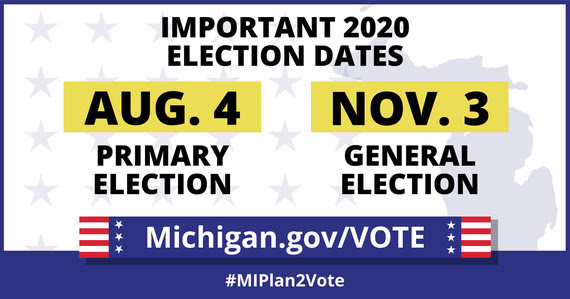
election dates

Aug. 4 statewide primary election:
Voters can vote safely from home or in person

Voters can safely cast their ballots in Michigan’s statewide primary election on Aug. 4 to determine candidates at the local, state and federal levels for the general election on Nov. 3.

The Aug. 4 primary election has a partisan section and voters should only vote in one party section. Voters must choose whether to vote for candidates in either the Democratic Primary or Republican Primary (or neither). If a voter crosses over and votes for candidates in both primary sections, none of those votes will count. Every voter can vote in the nonpartisan and proposal section of the primary ballot.

The Secretary of State encourages voters who already have a ballot at home to fill it out and sign the back of the envelope. Then, with the election a week away, voters should put it in the mail immediately or, to avoid possible U.S. Postal Service delays, deliver it to their local clerk’s secure ballot drop box if they have one, or to the clerk’s office if possible.

In-person voting will be available in every jurisdiction for voters who choose to do so and will be provided in accordance with social distancing and safety protocols to ensure the safety of voters and election workers. Wearing a mask is strongly encouraged.

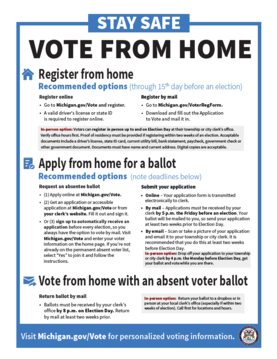
Download the Stay Safe voting guide and Safe Voting fact sheet for more details.

Stay safe flyerApplying for an absent voter ballot

Voting from home is a right all Michigan voters have and is a safe way to vote and protect your health, and the process is secure.

To obtain an absent voter ballot, voters must submit a request to their local clerk in one of the following ways:

  • Voters with a Michigan driver’s license or ID may apply online for an absent voter ballot at Michigan.gov/Vote.
  • Voters may download and complete an absent voter ballot application at Michigan.gov/Vote, print it and sign it, OR write out a request for an absent voter ballot and sign it.
    • Signed applications/requests may be mailed to the clerk OR scanned or photographed and emailed to your clerk. Make sure the entire application, including your signature, is readable in the picture.
    • You can find your clerk’s contact information at Michigan.gov/Vote or by calling your city or township office.
  • Accessible absent voter ballot applications are available at Michigan.gov/Vote. Voters with qualifying disabilities may apply for an accessible electronic ballot that can be marked remotely, printed and returned to the clerk.
  • Requests to have an absent voter ballot mailed to you must be received by your clerk no later than 5 p.m. the Friday before the election (July 31). However, to avoid possible U.S. Postal Service delays as Election Day nears, voters are encouraged to request their absent voter ballot in person at their clerk’s office.

Voting and returning an absent voter ballot

Once your request is received by the local clerk, your signature on the request will be checked against your voter registration record before a ballot is issued. After receiving your absent voter ballot, you have until 8 p.m. on Election Day to complete the ballot and return it to the clerk’s office. Your ballot will not be counted unless your signature is on the outside of the return envelope and matches your signature on file.

If you’re already registered at your current address, you can request an absent voter ballot in person at your clerk’s office anytime up to 4 p.m. on the day prior to the election.

In-person voting available

Beginning 40 days prior to Election Day, voters have the option of voting early in their clerk’s office until 4 p.m. on the day before the election.

Polling places will be open in every jurisdiction on Election Day for voters who want to vote in person and will follow distancing, hygiene and safety protocols. Voters are encouraged to wear masks and maintain social distance while at the polls.

Each polling location will have at least one voting station adapted to allow a person to vote while seated. In addition, all voters, including voters with disabilities, have access to a Voter Assist Terminal in all polling places. The Voter Assist Terminal helps the voter mark a ballot. It will mark the ballot with the voter’s choices but does not tally the votes. Once the ballot is marked, it is counted in exactly the same fashion as all other ballots.


You can register to vote through Election Day

Citizens who are not yet registered to vote but who wish to do so in the Aug. 4 election may do so at the office of their local clerk up until 8 p.m. on Election Day. You can find your clerk’s information at Michigan.gov/Vote.

Proof of residency must be provided if registering within two weeks of an election. Acceptable documents include a driver’s license, state ID card, current utility bill, bank statement, paycheck, government check or other government document. Documents must have name and current address. Digital copies are acceptable.


Be democracy’s MVP:
Sign up to be an election worker today!

Election workers are the Most Valuable Players of our democracy, ensuring free and fair elections for all. And our democracy needs election workers more than ever for the upcoming elections in August and November. Serving as an election worker is a paid position, and all election workers are trained on proper protocols.

During the coronavirus crisis, election workers are needed to assist clerks and count ballots. They will adhere to strict public health guidelines, including exercising social distancing, using sanitary equipment, and maintaining strong hygiene to protect themselves and others from coronavirus transmission.

Interested voters can sign up at Michigan.gov/DemocracyMVP.

Elections are the foundation of our democracy, and the way that all Michiganders can hold their leaders accountable in times of uncertainty.

Democracy MVP