by Becky Andrus | Aug 15, 2022 | Health and Wellness
Press Release
FOR IMMEDIATE RELEASE: August 15, 2022
CONTACT: Chelsea Wuth, 517-241-2112, WuthC@michigan.gov
MDHHS announces Community Information task force aimed at improving data sharing to address social needs
LANSING, Mich. –The Office of Policy and Planning at the Michigan Department of Health and Human Services (MDHHS) is announcing the formation of the Community Information Exchange task (CIE) force. CIE builds the technology and relationships required to address the social needs like food, housing and education for people and their communities. This task force will develop a statewide plan for CIE guided by the notion that data sharing between health care and social service providers is critical to improving comprehensive care and achieving health equity.
CIE stores information safely and provides referrals to social services to improve the health care of those in need. CIE also helps to coordinate health care services and connect individuals with resources across a variety of clinical and non-clinical partners and uses data collected about community resources and needs to drive policy change to promote more efficient and targeted distribution of resources and programming.
“MDHHS is convening the CIE task force as a critical step toward a more holistic approach to improving health and social needs in our state,” says Ninah Sasy, director of the Office of Policy and Planning. “We recruited a task force with representation from consumers and social service providers to ensure that frontline perspective is integral in our plans for statewide CIE.”
The CIE task force brings together community-based organizations (CBOs) that provide services and resources to address housing instability, food insecurity and other needs with representatives of health care, health IT and government to make recommendations to MDHHS on the development of a model for statewide CIE.
“As our state’s health IT infrastructure continues to grow, it’s important that social service providers are able to adopt interoperable technology that helps us work with partners both in clinical settings and at other agencies,” says Janée Tyus, Senior Director, Genesee Community Health Access Program and task force member representing social service organizations serving communities facing health inequities. “We know our clients are better off with a coordinated approach to care, but we often lack the resources and awareness of what it takes for the community buy in to adopt technologies comparable to our clinical counter parts. Through my involvement in the CIE task force I hope to center the challenges that community-based organizations face and help develop a plan that supports organizations and partners like mine in building capacity to participate in CIE across the state.”
Below is a list of CIE task force members, their organizational affiliations, and the sector they have been selected to represent.
| Domain Represented |
Name |
Title |
Organization |
| 211 |
Bob Kreha |
MI211 Technology Consultant, Principal & Co-Founder, BrightStreet Group |
Michigan 2-1-1 |
| Behavioral Health |
Joyce Fetrow |
Project Director |
Northern Michigan Opioid Response Consortium (NMORC) |
| Consumer |
Patrick McNeal |
Director |
North Flint Neighborhood Action Council |
| Consumer |
Ammar Alzuad |
Community Health Worker |
Molina Healthcare |
| Health Care |
Steven Grulke |
Chief Information Officer |
Mid-State Health Network |
| Health Equity |
Janee Tyus |
Senior Director, Genessee Community Health Access Program |
Greater Flint Health Coalition |
| HIT Commission |
Renee Smiddy |
Sr. Director, Policy |
Michigan Health & Hospital Association |
| HIT Commission |
Marissa Ebersole-Wood |
VP, Regulatory Implementation and Data Governance |
Blue Cross Blue Shield of Michigan |
| Implementing CIE (CHIR) |
Kelly Stupple |
Program Manager and Child Health Advocate |
Washtenaw Health Plan |
| Implementing CIE (CHIR) |
Ed Worthington |
President/Owner |
Advanced Technolgy Health Solutions/NMCHIR |
| MiHIN |
Tim Pletcher |
Executive Director |
MIHIN |
| Payers (Medicaid) |
Julia Aronica |
Director of Plan Initiatives |
Blue Cross Complete |
| Social Services/CBOs |
Gretchen Wagner |
Director of Early Childhood Education |
Bay Arenac Intermediate School District |
| Social Services/CBOs |
Nadeem Siddiqi |
Executive Director, Technology, Development and Data Strategy |
Wayne Metro CAA |
| Tribal Representative |
Tyler LaPlaunt |
Tribal Council Member |
Sault Ste. Marie Tribe of Chippewa Indians |
The Task Force will meet monthly through at least June of 2023, providing recommendations to MDHHS on the implementation of Community Information Exchange.
Find out more by visiting Michigan.gov/SDOH.
by Becky Andrus | Aug 15, 2022 | Recreation
|
|
 |
DNR News
|
|
 Aug. 15, 2022 Aug. 15, 2022
Media contact: DNR-Public-Info@Michigan.gov
DNR dedicates Ronald A. Olson Island Bridge, a tribute to longtime parks and recreation chief
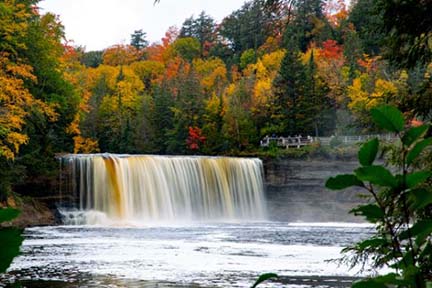
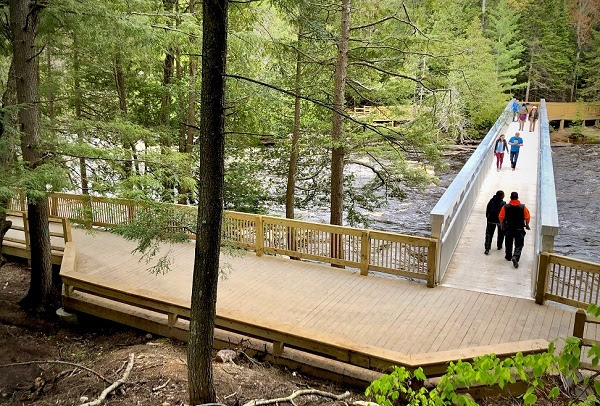
A 142-foot-long bridge installed last fall over the Tahquamenon River just got an important addition: a name. Friends, family, Michigan Department of Natural Resources officials and other colleagues gathered this morning at the Lower Tahquamenon Falls to dedicate the Ronald A. Olson Island Bridge, honoring the man at the helm of the DNR Parks and Recreation Division as chief for 17 years.
The fabricated, all-aluminum pedestrian bridge at Tahquamenon Falls State Park, located in Paradise in the eastern Upper Peninsula, officially opened for use over the Memorial Day holiday weekend. The bridge itself is an apt symbol for Olson, who has built a career around bringing people together and encouraging them to aim for destinations they can’t yet see.
“When it comes to possibilities in parks and recreation, nobody is better at building bridges and getting people to the table than Ron Olson,” said DNR Director Dan Eichinger.
“Ron lives and breathes Michigan state parks, trails and waterways, and he will talk – and listen – to anyone, anywhere about ways to protect and improve these treasured resources so that every resident and visitor can enjoy them and be inspired to love them as much as he does,” Eichinger said. “I am proud to be here today and share in this much-deserved celebration of Ron’s remarkable contributions.”
The bridge’s installed naming plaque reads: “Ronald A. Olson Island Bridge. In honor of his dedication, hard work and accomplishments with the Michigan Department of Natural Resources Parks and Recreation Division.”
 His accomplishments are many. Olson, who oversees a parks and recreation system that includes 103 state parks, nearly 1,300 boating access sites, 13,400 miles of state-designated trails and 82 state-sponsored harbors, has: His accomplishments are many. Olson, who oversees a parks and recreation system that includes 103 state parks, nearly 1,300 boating access sites, 13,400 miles of state-designated trails and 82 state-sponsored harbors, has:
- Championed (through the MI Big Green Gym partnership, with mParks and Blue Cross Blue Shield) the belief that state, county and local parks are the least expensive “gyms” around, and they drive tourism to even the most remote places in the state.
- Helped guide the implementation of the Recreation Passport to replace the old window sticker for vehicle entry to Michigan state parks – a move creating cost savings for individual parkgoers while establishing a more consistent source of operating revenue.
- Advocated for prioritizing a more diverse workforce through programs such as the Summer Youth Employment Initiative and efforts to infuse the department with new voices and perspectives.
- Introduced the Chief’s Challenges to inspire solution-focused ideas built around three goals: Green Initiatives to find energy savings, Marketing and Innovations to find new revenue-generating ventures, and the Million Dollar Challenge that tasked everyone with finding ways to save money, with the goal of saving $1 million in total.
- Pioneered a matching grant program for accessible recreation amenities, promising to match any community or Friends Group that could raise 50% of project funding for a playground, beach chair, Mobi-mat or fishing pier – a challenge that led to greater staff/community collaboration that continues today.
- Overseen some of Michigan’s biggest state park and campground visitation numbers – 35 million visitors a year – fueled in part by residents’ reliance on the outdoors during the COVID pandemic.
|
Signature vision, many honors
 The department’s natural resources deputy, Shannon Lott, said that since Olson joined the DNR in 2005, he has approached challenges and opportunities within the recreation world in his own way. The department’s natural resources deputy, Shannon Lott, said that since Olson joined the DNR in 2005, he has approached challenges and opportunities within the recreation world in his own way.
“Many of Ron’s staff talk about how Ron sees things differently: not as they are or how they’ve been, but what could be – in fact, what should be – to solidify state parks, trails and waterways as relevant, even revered, to every Michigan resident and visitor,” Lott said. “All of Ron’s decisions are guided by the goal of creating the best visitor experiences, but in ways that protect natural and historical resources and give employees the room to grow and succeed.”
One such example stemmed from Olson’s observation of aging park infrastructure, evolving camp lodging trends and staff seeking more work hours. That simple intersection of needs resulted in opportunities for seasonal rangers to extend their employment season in order to help build tiny houses and reimagine the mini-cabins that now are among campers’ most popular lodging choices.
Olson brought a wealth of experience to the DNR, having served as parks and recreation director in Ann Arbor, Michigan – he left his mark there, too; Olson Park is named in his honor – and other jurisdictions in Maryland, Indiana and Minnesota. He is active in the National Recreation and Park Association, the National Association of State Park Directors and the American Academy of Park and Recreation Professionals. He also is past president and current board member of the Michigan Recreation and Park Association Foundation. |
His passion and contributions have not gone unnoticed. Other honors include:
- Recognition (twice) as Public Official of the Year by the Huron Valley Sierra Club.
- Recipient of the W.W. Patty Alumni Award from Indiana University.
- Recognized as one of the College of Education’s top 100 alumni of the University of Minnesota.
- The Michigan state parks system earning the National Recreation and Park Association (NRPA) National Gold Medal Award for Excellence in State Park and Recreation Management (2011).
- The National Association of State Park Directors (NASPD) Distinguished Service Award (2014).
- The Richard Lawson Award for Professional Excellence (2022), in recognition of significant contributions over many years to the parks profession.
Not content to rest on his laurels, Olson also makes many efforts to bridge his knowledge and experience to the next generation of parks and recreation managers.
He has served on the Board of Regents and as an instructor for the National Parks and Recreation Supervisor Management School, served as a regent and instructor at the NASPD State Park Leadership School, and has presented numerous educational sessions at the NRPA national and Michigan conferences and at other states’ park and recreation conferences and training institutes.
About the bridge
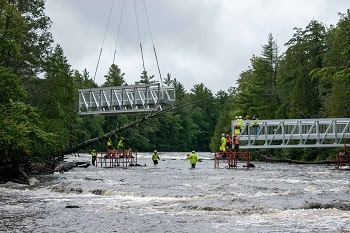 Installed in September 2021 in Tahquamenon Falls State Park, the 142-foot-long span was constructed in Florida, and its four sections were set in place with the aid of a helicopter. Installed in September 2021 in Tahquamenon Falls State Park, the 142-foot-long span was constructed in Florida, and its four sections were set in place with the aid of a helicopter.
The bridge now provides improved access for anyone who wants to view the river or visit an island situated in the middle of the Lower Falls rapids.
Other components of the bridge project include 350 feet of boardwalk connecting the mainland to the bridge abutment location and a half-mile, barrier-free pathway around the perimeter of the island, dotted with additional boardwalk sections and benches. DNR Parks and Recreation Division capital outlay funding paid for the entire $1.28 million project, including the bridge and accessibility improvements. |
Note to editors: Accompanying photos are available below for download. Caption information follows. All photos courtesy Michigan Department of Natural Resources.
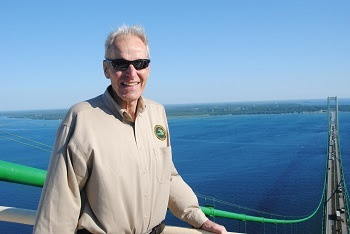
- Ron Olson: DNR Parks and Recreation Chief Ron Olson, shown here atop the Mackinac Bridge.
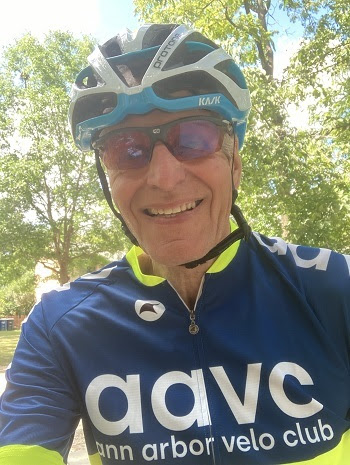
- Ron Olson biking: DNR Parks and Recreation Chief Ron Olson is an avid outdoorsman outside of work, too; he enjoys competing in triathlons, fishing and spending time with his granddaughters
- Plaque: The plaque honoring DNR Parks and Recreation Chief Ron Olson; the plaque now is affixed to the bridge bearing his name at Tahquamenon Falls State Park.
- Bridge1 and Bridge2: The new pedestrian bridge over the Tahquamenon River connects the mainland to an island in the rapids; it officially opened to visitors over the 2022 Memorial Day holiday weekend.
- Bridge installation: A helicopter lifts a segment of the new pedestrian bridge at the Lower Tahquamenon Falls into place during the September 2021 installation.
|
|
|
| We recently launched a new website, and we’d love to hear what you think via this brief survey. Thanks for helping us improve our site for all users! |
by Becky Andrus | Aug 15, 2022 | Transportation
Michigan Lt. Gov. Garlin Gilchrist on reimagining Michigan Avenue in Corktown
Late last week, the U.S. Department of Transportation and Michigan Gov. Gretchen Whitmer announced that the Michigan Department of Transportation (MDOT) and the City of Detroit would receive $25 million in a Rebuilding American Infrastructure with Sustainability and Equity RAISE grant toward a major project to modernize Michigan Avenue (U.S. 12) in Detroit’s Corktown neighborhood.
Listen now: https://www.buzzsprout.com/1374205/11140127-michigan-lt-gov-garlin-gilchrist-on-reimagining-michigan-avenue-in-corktown
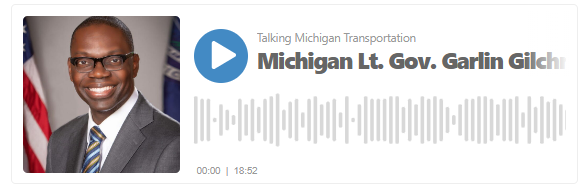
On a new edition of the Talking Michigan Transportation podcast, Michigan Lt. Gov. Garlin Gilchrist talks about what this means to him as a neighbor of the corridor.
Per the grant application:
MDOT and the city are collaborating on a project to rebuild a portion of Michigan Avenue to support a safe, innovative, and multi- modal travel corridor. The project will re- apportion space in the right of way to accommodate several new and improved multi-modal facilities, including:
- Expanded sidewalks and pedestrian amenities like seating, lighting, and street trees.
- Raised bike lanes at sidewalk level for areas with existing lanes, new dedicated and buffered bike lanes in downtown, and bike racks.
- Dedicated two center-running lanes for transit vehicles and for connected and autonomous vehicles. Transit vehicles will have signal priority to limit waiting time.
- Improved amenities, like concrete transit islands and new shelters.
- Improved markings and islands for additional/enhanced midblock pedestrian crossings.
- Added two new traffic signals for intersections.
Gilchrist talks about how these added benefits will transform the neighborhood and how the project spells good things to come for Corktown, a diverse neighborhood with a rich history.
Podcast photo: Michigan Lt. Governor Garlin Gilchrist II. Photo courtesy of Lt. Gov. Gilchrist’s Office.
|
|

by Becky Andrus | Aug 15, 2022 | Regional News
Gov. Whitmer Reminds Parents There is Still Time to Enroll Four-Year-Old Kids in Free Preschool Program
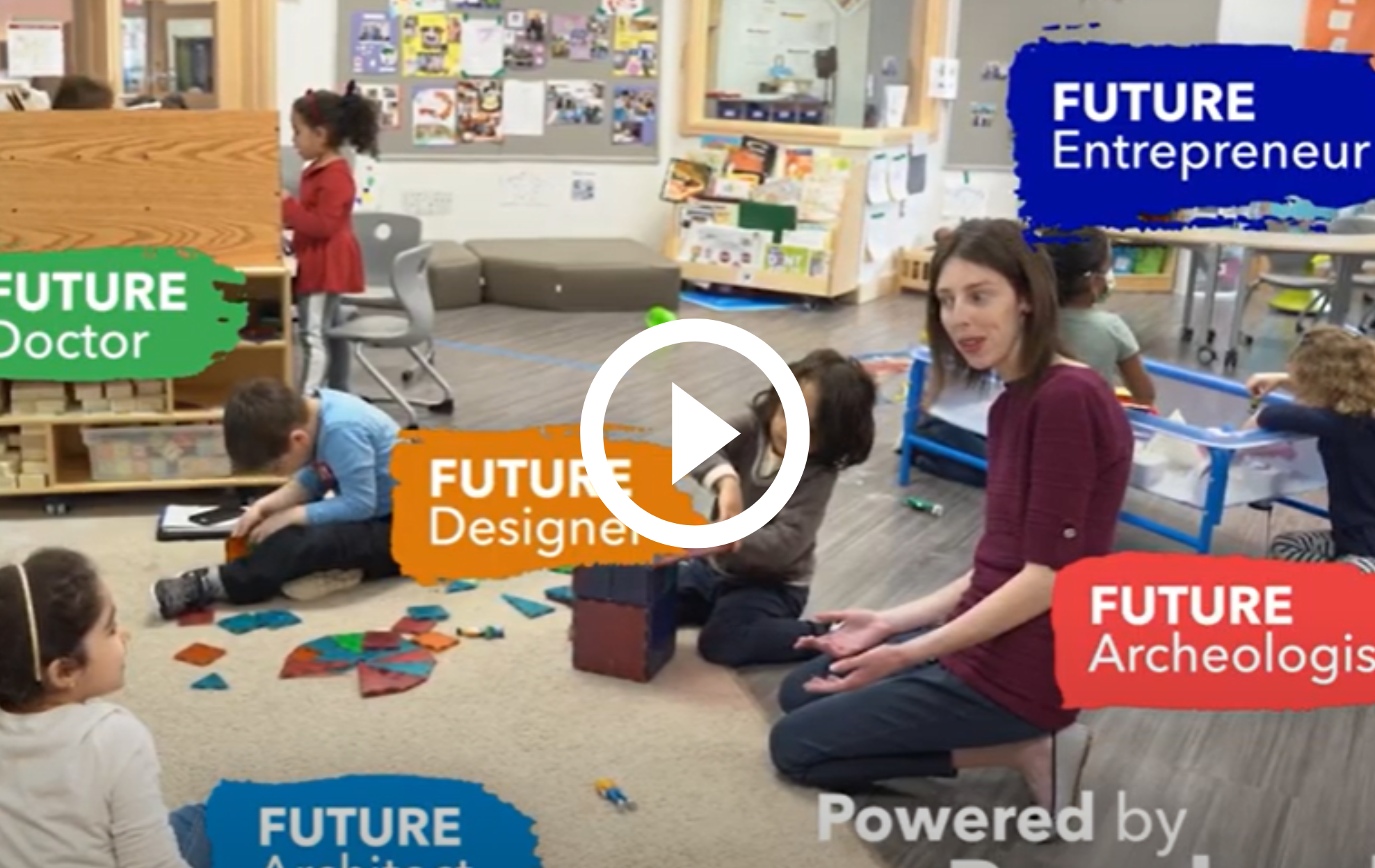
LANSING, Mich. — Governor Gretchen Whitmer and the Michigan Department of Education are encouraging parents of four-year-old children across Michigan to contact their local school districts or visit GreatStarttoQuality.org to explore about getting their children enrolled in a Great Start Readiness Program (GSRP)—Michigan’s nationally recognized, state-funded preschool for four-year-olds.
“Every kid deserves a great start to get on track for long-term success, and that starts with preschool,” said Governor Whitmer. “Access to high-quality preschool makes a huge difference for kids, increasing their kindergarten readiness, putting them on track for 3rd grade reading proficiency, and boosting eventual high school graduation rates. Since I took office, I am proud to have made bold, bipartisan investments in the Great Start Readiness Program, Michigan’s free preschool program for four-year-olds, expanding it to serve 22,000 more kids by eliminating waiting lists. Getting this done will help kids in every region of our state, and I encourage parents to sign up for free preschool by visiting greatstarttoquality.org.”
In 2021, Governor Whitmer announced a bold plan to expand GSRP to ensure more Michigan children could get a great start to a quality education. Last summer, she signed into law the largest expansion of GSRP in the state’s history—allowing Michigan to eliminate waiting lists and serve 22,000 more four-year-olds. This year, the governor continued to work with the legislature to take the next step in expansion and help recruit enough teachers and classrooms to serve all eligible children.
The expansion of GSRP increases the opportunity for more families to enroll their children in programs that will better prepare the youngsters for kindergarten. Children that attend GSRP are more likely to enter school ready to learn, read by third grade, and graduate from high school on time.
“Preschool helps develop children academically, physically, and socially,” said State Superintendent Dr. Michael Rice. “A high-quality early education program like GSRP helps children prepare for kindergarten and success later in school and in adulthood. I strongly encourage local and intermediate school leaders to work with their communities to expand GRSP pre-school to the maximum extent possible. An additional year of education at four years old is a research-based way to improve literacy, numeracy, and a wide range of outcomes for students.”
“We are excited that there was a bipartisan budget to support GSRP expansion across the state,” said Rebecca Josephson-Gorinac, Director of Early Childhood Services, St. Clair County RESA. “The increase in funding provides access to more resources to help reach families, support staffing of classrooms, and teacher compensation. We are seeing an increase in parent interest in preschool. Parents value preschool. We’re looking to expand and add three new programs in our community this year based on the number of applications we received.”
GSRP eligibility is primarily determined based on family household income (a family of four earning up to $69,375 a year is eligible). However, other factors such as a diagnosed disability, parent education, and primary home language other than English may also be considered. The program is offered as part-day and full-day with child care before and after school available in many areas. Some programs also offer transportation to families.
“We want all families to have experiences in the highest quality programs available,” said Cari O’Connor, Director of Early Childhood and Parent Programming, Montcalm Area Intermediate School District. “Through GSRP, we offer a high-quality experience and work to support healthy children in a whole child way. It’s more than a program; it creates a community that wraps around the child and the family.”
MDE worked with the advertising agency The Yaffe Group and DPTV to produce 30-second and 15-second public service announcement (PSA) videos to heighten awareness for the program. The videos are airing on Detroit PBS KIDS channel and The Michigan Learning Channel statewide.
|
by Becky Andrus | Aug 15, 2022 | Regional News
Lt. Governor Gilchrist II Highlights $55 Million Expansion of Michigan Reconnect Program to Help More Michiganders Get Postsecondary Degrees
Partners spotlight $6 million in new grants for Michigan Reconnect and Futures for Frontliners students
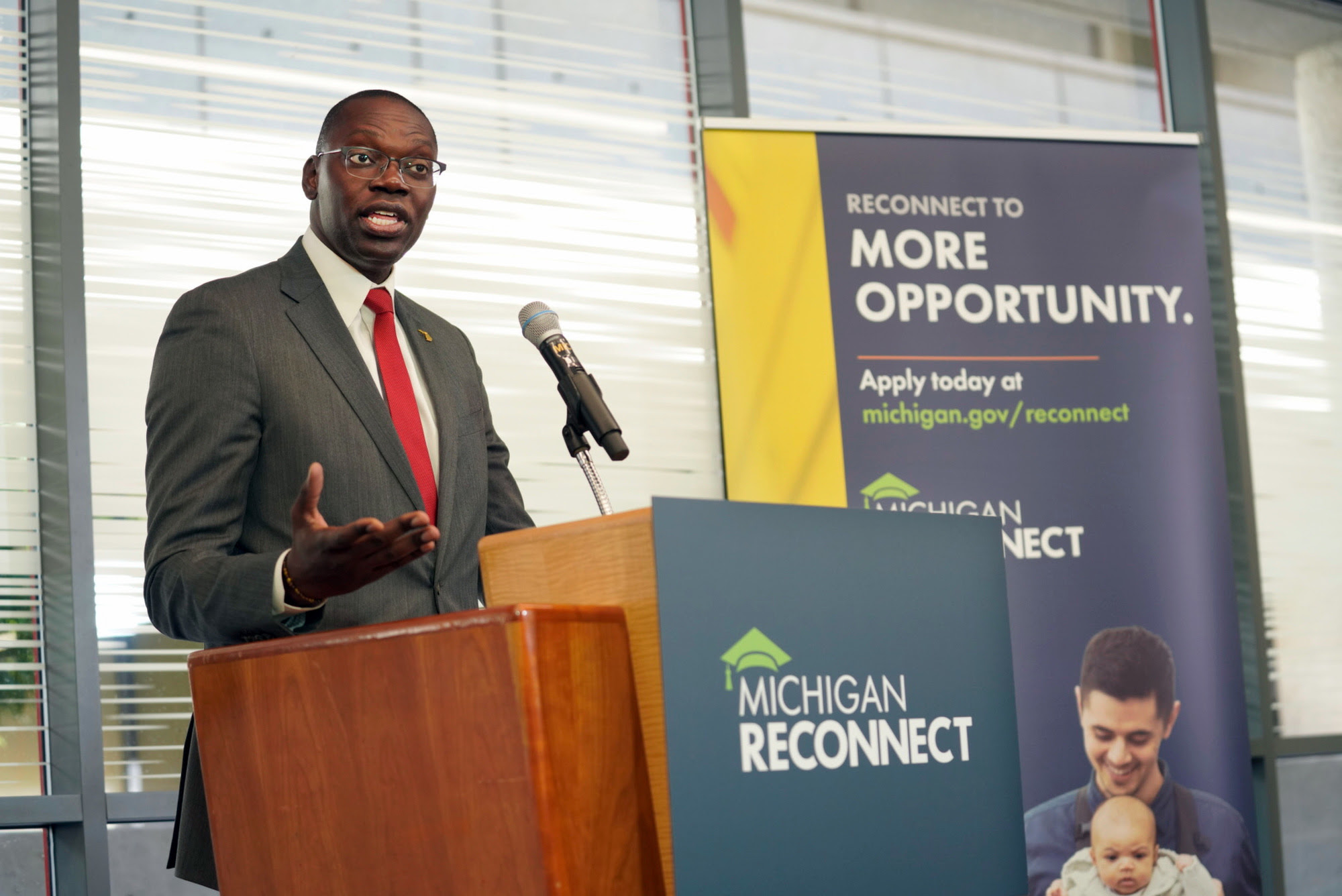
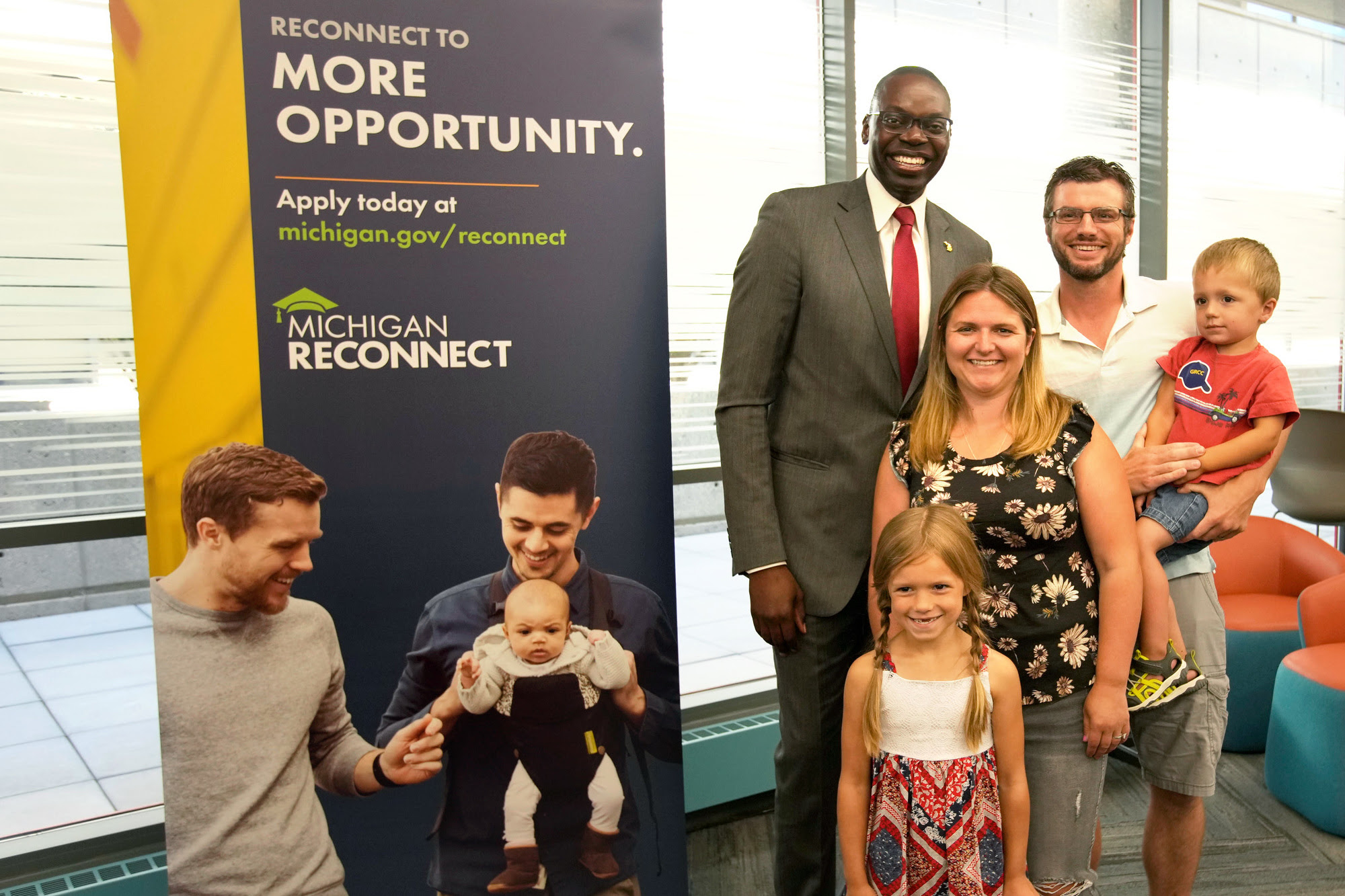
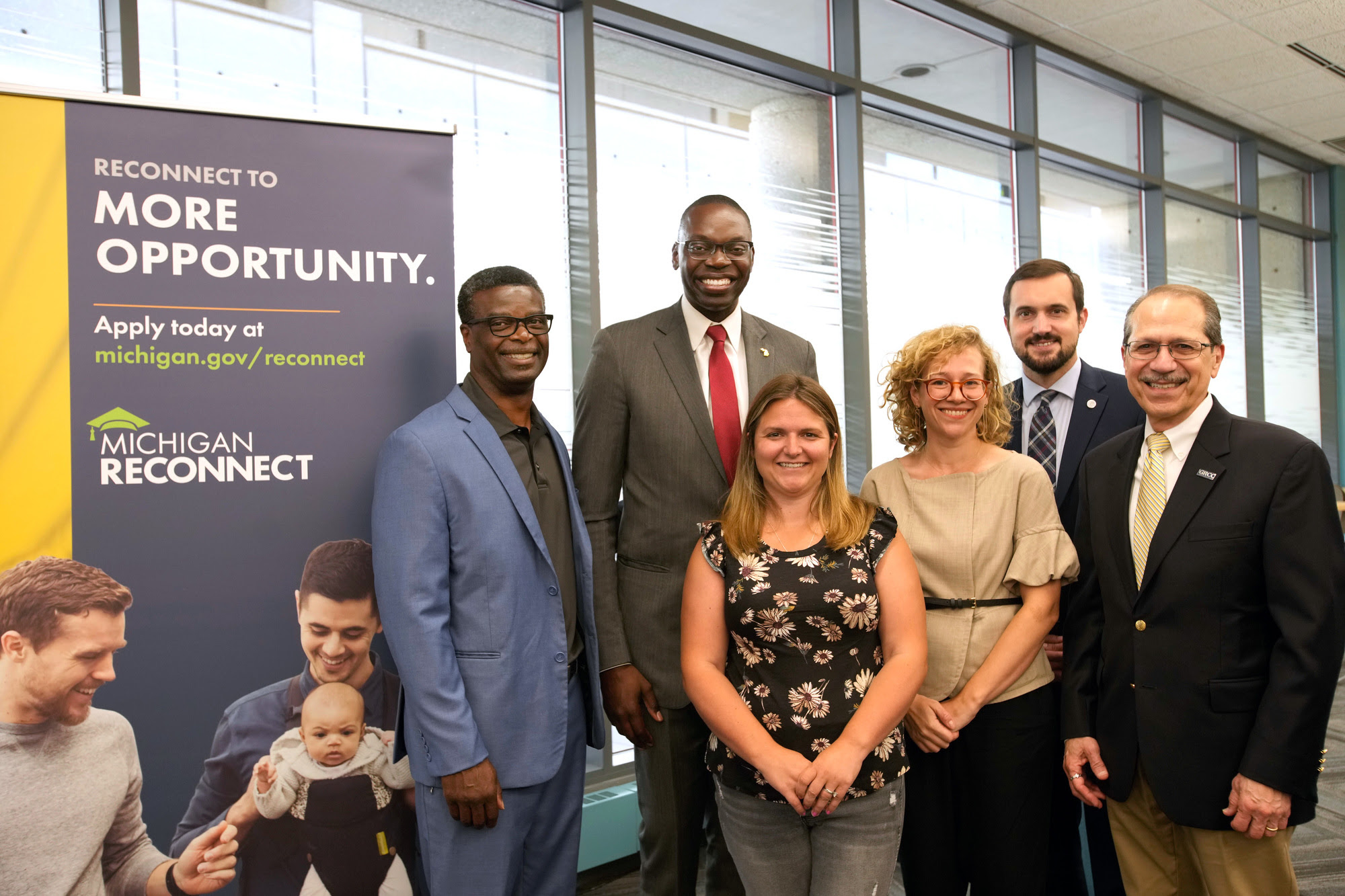
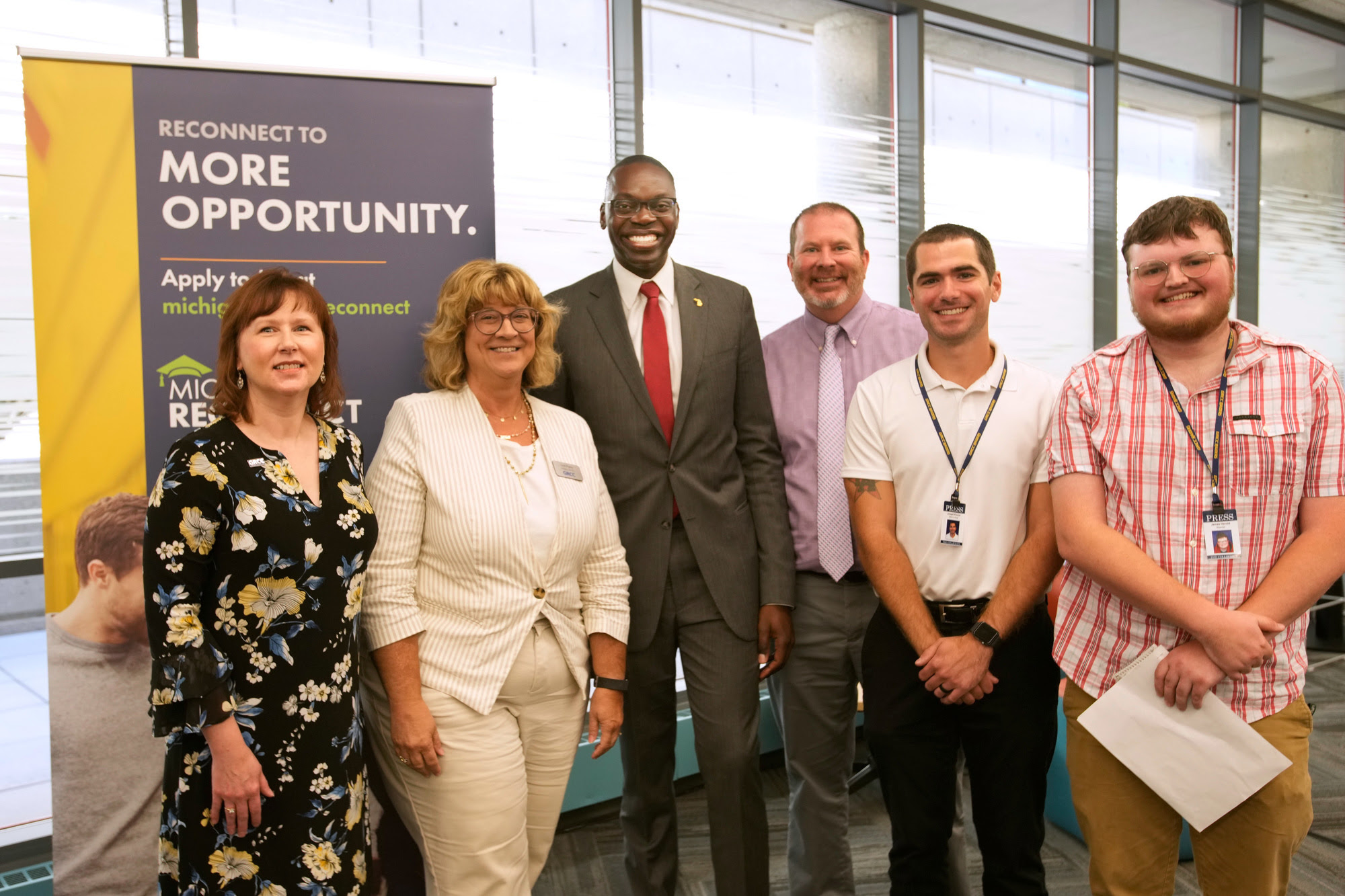
LANSING, Mich. — Today, during an event at Grand Rapids Community College, Lt. Governor Garlin Gilchrist II touted the bipartisan Fiscal Year 2023 budget’s inclusion of $55 million for the Michigan Reconnect program, calling it an affirmation of the program’s ongoing success in easing the path for working-age adults to earn a college degree or certificate.
“I was proud today to celebrate our historic budget investment in Michigan Reconnect,” said Lt. Governor Garlin Gilchrist II. “Reconnect is growing our economy, helping employers fill high-skilled job openings, and putting Michiganders on a tuition-free path to higher education and skills training. And there is even more to applaud. We recently added another $6 million in new grants to provide wraparound supports that reduce educational barriers and celebrated accepting more than 100,000 Michiganders into the program. Governor Whitmer and I will continue working with anyone to put Michigan’s adult learners on a path to a brighter future.”
The Michigan Reconnect program, which provides free or reduced community college tuition for students 25 and older who have not yet earned a degree, was launched in February 2021.
Lt. Governor Gilchrist was joined by Michigan Department of Labor and Economic Opportunity’s Office of Sixty by 30 Director Sarah Szurpicki, Grand Rapids Community College President Dr. Juan R. Olivarez, Grand Rapids Area Chamber of Commerce Vice President of Government Affairs Josh Lunger, and Michigan Reconnect student Morgan Brink.
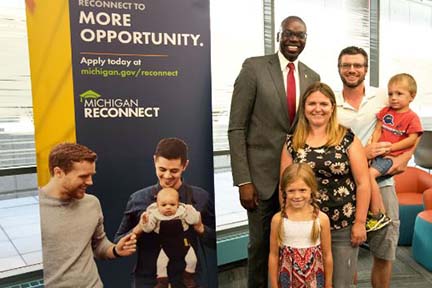
A married mother of two, Morgan Brink and her young family understand the value of the Reconnect program. At 32, Brink never thought college was possible for her until the COVID pandemic presented a unique chance to rethink her next steps. Realizing that college was the path to a more secure future and an opportunity to demonstrate to her children the power of education, she decided to enroll in classes through Reconnect.
“Honestly, I barely graduated from high school,” Brink said. “Now, my daughter sees me studying and going to school and now she’s already talking about going to college. That’s the power of the Michigan Reconnect program – it’s for college degrees now and for our children later.”
Today’s event highlighted how Michigan Reconnect and Futures for Frontliners are creating a rewarding path to in-demand careers for Michiganders and encouraged more participants to join the Michigan Reconnect program.
“We are continuing to build support from all corners – the business and economic development community, elected leaders, educational leaders – to make the pathway easier for adult learners,” said Sarah Szurpicki, Michigan Department of Labor and Economic Opportunity’s Office of Sixty by 30 Director. “The numbers are truly amazing. The people of Michigan are showing up and enrolling in college like never before. We need to encourage even more Michiganders to start on the road to higher earnings and a more secure future.”
“We are proud of our success as a Michigan Reconnect and Futures for Frontliners partner as we strive to attract, train and graduate students for the high-paying and high-demand jobs that will drive Michigan’s, and our region’s, economic future,” said Dr. Juan R. Olivarez, Grand Rapids Community College President.
Dr. Olivarez praised the Reconnect and Futures for Frontliners programs as vital in overcoming the barriers that often stand in the way of a college education for so many adult students. He pointed to the growing number of enrollees at Grand Rapids Community College, which has enrolled 1,100 Reconnectors and 1,004 Futures for Frontliners students for the upcoming fall semester.
“The reliability and adaptability of talent is a key factor in keeping existing jobs in a community, and in attracting new companies to a region,” said Josh Lunger, Grand Rapids Area Chamber of Commerce Vice President of Government Affairs. “The talent pipeline is strong in the Grand Rapids area. Michigan Reconnect and this new investment will make it even stronger.”
Today, Lt. Governor Gilchrist II also highlighted $6 million in grant funding to help defray other costs that often keep adult learners returning to college or enrolling for the first time through the Michigan Reconnect or Futures for Frontliners programs.
The new grants, which will be distributed by the state’s community and tribal colleges, can be used for books, childcare, internet access and transportation to help students pursue associate degrees or skills certificates. Grand Rapids Community College and other eligible institutions can distribute the allocated funds directly to eligible students who have completed at least one semester – with as much as $550 available per student per academic year.
To be eligible for the grants, students must:
- Be Michigan Reconnect or Futures for Frontliners scholarship participants.
- Have completed at least one semester within the respective scholarship program they are participating in.
- Be enrolled already or be in the process of enrolling for a following qualifying semester.
The wraparound grants build on Michigan’s network of people and resources in place to provide students with the critical support they need to successfully enroll in classes and complete a skill certificate or associate degree program.
To help Reconnect students succeed with the steps leading up to enrolling with a community college, the state’s Reconnect Navigators are available to help applicants complete admissions and financial aid requirements, set career goals, identify relevant educational opportunities and create a plan to graduate. Navigators, who reach out to students after they have been accepted into Reconnect, will also connect students to additional programs and assistance offered by their community college and local partners to remove barriers to education.
Michigan Reconnect is the largest effort in state history to ensure that Michiganders who are 25 or older and do not have a college degree have an opportunity to earn an associate degree or skills certificate with free or deeply discounted tuition.
Since Michigan Reconnect launched, over 100,000 Michiganders have been accepted into the scholarship program and nearly 18,000 have enrolled in a community college, helping to drive success toward Gov. Whitmer’s Sixty by 30 goal of having 60% of Michiganders with a postsecondary degree or skills certificate by 2030. In Kent County alone, there have been approximately 6,500 Reconnect applicants.
Michigan Reconnect pays the cost of in-district tuition for eligible adults who want to pursue an associate degree or skills certificate at any of Michigan’s public community colleges, including its three tribal colleges. Eligible residents can attend community college tuition-free at a community college where they are considered in-district. For those who are not considered in-district by a community college, Michigan Reconnect will still cover up to the in-district portion of tuition.
A recording of the event can be found here.
|