It’s spongy moth season: What to expect in 2022

It’s spongy moth season: What to expect in 2022

May 2, 2022

Contact: Cheryl Nelson 231-287-1714, or Joanne Foreman 517-284-5814

It’s spongy moth (formerly gypsy moth) season: What to expect in 2022

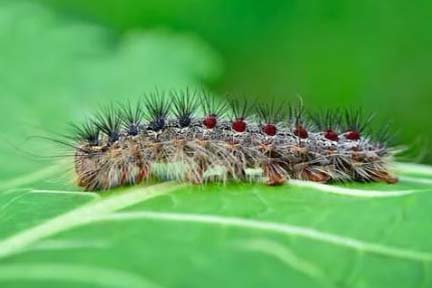
While the new name still may be unfamiliar, the invasive spongy moth, formerly referred to as gypsy moth, is well known across Michigan. In its caterpillar life stage, the insect is a voracious leaf eater.
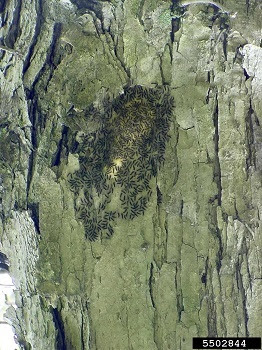
Hundreds of tiny, black caterpillars crawl on and around a fuzzy, tan egg mass on a tree trunk.Spongy moth populations were high last year across Lower Michigan, and many people are wondering whether the nuisance caterpillars will be plaguing their backyard events again in 2022. To find out, NotMISpecies webinar hosts brought together experts to share their insights on the invasive moth’s history in Michigan and the U.S. and what to expect this year.

Panelists Dr. Deborah McCullough from Michigan State University, Dr. Steven Katovich of the U.S. Department of Agriculture’s Forest Service, Susie Iott of the Michigan Department of Agriculture and Rural Development and James Wieferich of the Michigan Department of Natural Resources together represent nearly 100 years of knowledge about the pest. Following their April 14 session, they responded to participants’ questions in a written document.

Key points from the presentation and their answers to the most-asked questions about spongy moth are summarized here.

What is the forecast for 2022?

Based on recent aerial survey data, much of northern Lower Michigan has experienced two or three years of defoliation, which typically marks the end of an outbreak cycle. Egg mass surveys in the fall of 2021 confirmed that many areas in Michigan should expect a collapse of spongy moth activity in much of lower Michigan – meaning far fewer caterpillars this year. However, a few areas like Jackson County and parts of southwest Lower Michigan had large, healthy egg masses and may have high density populations again this summer.

What causes population crashes?

The last large-scale spongy moth outbreak occurred in Michigan from about 1992 to 1996. Since then, localized areas have experienced occasional outbreaks. Suppression efforts in the 1990s have continued to keep spongy moth populations largely in check while naturalizing infestations into Michigan’s forests and urban forest ecosystems.

In 1991, Entomophaga maimaiga, a fungal pathogen found to be killing spongy moth caterpillars in the northeastern states, was deployed in Michigan. This fungus proved an effective biological control, remaining in the soil from year to year and infecting spongy moth caterpillars that come in contact with the fungal spores. Moist soils help to activate the fungus, enabling spores to disperse and affect spongy moth populations. Caterpillars affected by the E. maimaiga fungus remain attached to tree trunks and hang straight down.
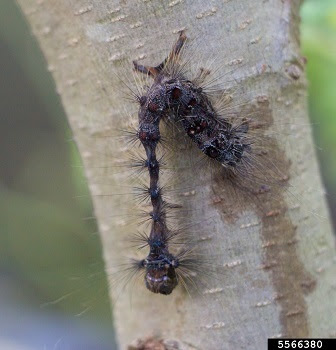
A desiccated caterpillar body hanging on a tree trunk in an inverted "V" position.Nucleopolyhedrosis virus occurs naturally in all spongy moth populations. NPV spreads through contact between caterpillars during outbreaks, causing a population crash. To determine whether NPV is at work in a certain location, look for dead caterpillars attached to tree trunks in an upside-down “V” position.

Both the NPV virus and E. maimaiga fungus can affect the same population, and dead NPV and fungus-killed caterpillars can be on the same tree.

These natural enemies of the spongy moth are now well-established across Michigan and are actively reducing populations. To date, these pathogens typically have limited the size and length of outbreaks to a couple years, eliminating the need for spray programs.

Today, spongy moth outbreaks are cyclical, peaking approximately every seven to 10 years. In these years, the virus and the fungal disease are spread more easily through dense populations, eventually causing a crash.

Do these controls affect other species?

NPV and the fungal disease have important benefits – they are specific to spongy moth populations and do not affect people, pets or beneficial insects like pollinators or insect predators. In addition, they remain in the environment, continuing to help control spongy moth populations every year.

The spongy moth NPV pathogen (virus) is species-specific. It arrived with spongy moth and has driven population dynamics for over 150 years. In lab tests, the E. maimaiga fungus was able to infect a few other species, but this has not been observed outside the lab – the timing and behavior of spongy moth caterpillars result in fungal infection in spring. Native species either can’t be infected, are not present until later in the year or have other behavioral patterns that prevent them from becoming infected.

What about spray programs?

The State of Michigan does not have a statewide spray program. Spongy moth is a naturalized pest in Michigan now. However, a few areas have long-standing millages in place to help survey and spray residential areas when needed.

Outbreaks will continue to occur occasionally in local areas and, yes, every now and then we will have extensive outbreaks like the current one. While an outbreak is not pleasant for people in an affected area, it is rarely a problem for healthy trees and forests.

What can I do if spongy moth returns this year?
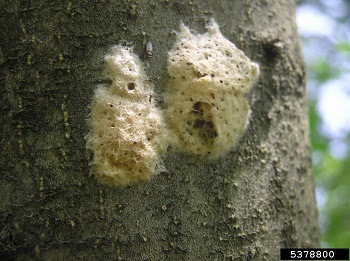
Two tan, fuzzy egg masses with small holes in them on a tree trunkFirst, check the spongy moth forecast for your neighborhood by looking for healthy egg masses now, before leaves expand. Healthy egg masses are larger than a quarter in size, tan or brownish in color and firm to the touch. Few egg masses and/or small (nickel-size) egg masses indicate the population is collapsing because the NPV pathogen is increasing. Old, no longer productive egg masses, like those in the above photo, are often abundant after an outbreak year and should not be counted. These masses are usually whiteish in color, may be falling apart and may have pin-size holes in the mass. An abundance of healthy egg masses suggests a heavy infestation of spongy moth caterpillars this season.

Before choosing a control method, remember that you will not be able to eliminate all the caterpillars – the goal is to reduce the density of caterpillars around your house.

  • Scraping: If healthy egg masses are found on trees, buildings or outdoor furniture around the home, act now, as egg masses can start hatching anytime! Use a scraper or hard, plastic card to scrape egg masses into a container of soapy water. Let them soak overnight, then bag and dispose of them. Alternately, egg masses can be placed in a fire and burned.
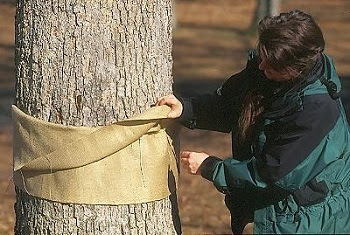
A person in a green and black jacket holds a flap of a piece of burlap wrapped and tied around a tree trunk

  • Banding: Cut a band of burlap 18 inches wide and long enough to go around the tree trunk and overlap a bit. Tie a string around the center of the band to make a two-layered skirt around the trunk. When caterpillars climb trees daily to feed, they will get caught in the band. Scrape them into a bucket of soapy water to kill them.
  • Spraying: To address an infestation in a handful of individual trees, homeowners can purchase a spray containing Bacillus thuringiensis var. kurstaki, a bacterium that naturally occurs in the soil but can be lethal to certain caterpillars and moths. The best time to spray is when caterpillars are small, usually mid-May through early June. Be sure to choose an Environmental Protection Agency-registered pesticide and apply it according to label directions. Remember, there is no good reason to spray woodlots or forested areas. Healthy trees and forests can withstand periodic infestations.

To learn more about spongy moth caterpillars and options for residents living in an outbreak area, visit the MSU IPM Gypsy Moth website. The bulletin Btk: One management option for Lymantria dispar offers detailed information about Btk management for spongy moth.

Check for upcoming NotMiSpecies webinars and watch past, recorded webinars – on everything from spongy moth to invasive carp – at Michigan.gov/Invasives.

Children’s Trust Fund observes Child Abuse Prevention Month

Children’s Trust Fund observes Child Abuse Prevention Month

MDHHS banner with logo no names

Press Release


FOR IMMEDIATE RELEASE: April 18, 2022

CONTACT: Bob Wheaton, 517-241-2112, WheatonB@michigan.gov 

Children’s Trust Fund observes Child Abuse Prevention Month 

Activities, events around the state culminate in April 26 gathering at State Capitol

LANSING, Mich. – Michigan’s Children’s Trust Fund is recognizing the importance of preventing child abuse and neglect with a month of activities that will culminate with an April 26 ceremony on the lawn of the State Capitol.

Activities and initiatives through Michigan this month will center on the symbolic blue and silver pinwheel of Prevent Child Abuse America, which serves as a visual representation that everyone plays a role in providing children with a bright future.

The mission of the Children’s Trust Fund to keep children safe and strengthen families across the state takes special significance each April for Child Abuse Prevention Month.

As the only statewide organization dedicated to the prevention of child abuse and neglect, the work of the Children’s Trust Fund – which is within the Michigan Department of Health and Human Services (MDHHS) – supports local programs and services that touch all 83 Michigan counties.

“Prevent Child Abuse America introduced the Pinwheels for Prevention campaign in 2008,” said Suzanne Greenberg, executive director of the Children’s Trust Fund. “The pinwheels are a representation of child-like whimsy and lightheartedness as well as a vision for a world where all children grow up happy, healthy, and prepared to succeed in supportive families and communities.”

The Power of the Pinwheel is the theme of this year’s pinwheel campaign. Through the 100-plus prevention partners of the Children’s Trust Fund and this year’s statewide partnership with Blue Cross Blue Shield of Michigan, supporters of preventing child abuse are planting 50,000 pinwheels in hundreds of gardens throughout the state.

The 14th annual Child Abuse Prevention Awareness Day rally is 11 a.m. April 26 on the steps of the Michigan Capitol. Featured speakers this year include MDHHS Director Elizabeth Hertel. The inaugural Inspire Award winner for volunteer service and commitment to preventing child abuse and neglect in Michigan will be presented to Sharon Barry of Barry County.

“We are thrilled that our new partnership with Blue Cross Blue Shield of Michigan is giving us farther reach to expand and amplify our message for Child Abuse Prevention Month,” Greenberg said. “When we recognize that child abuse and neglect affect each of us and can unite under a common cause, we are giving hope to every child in our state and ensuring Michigan secures a stronger future.”

For information on the Children’s Trust Fund and Child Abuse Prevention Month, visit michigan.gov/ctf.

Year’s first Adopt-A-Highway pickup starts Saturday

Year’s first Adopt-A-Highway pickup starts Saturday

MDOT E-mail

MDOT on facebook MDOT on Twitter MDOT on YouTube Mi Drive - Know before you go. MDOT on Instagram Sign up for E-mails form MDOT
 

FOR IMMEDIATE RELEASE                                                                MEDIA CONTACT
April 18, 2022                                                                                      Dan Weingarten
906-250-4809
WeingartenD@Michigan.gov

Year’s first Adopt-A-Highway pickup starts Saturday

Fast facts:
– The first Michigan Department of Transportation (MDOT) Adopt-A-Highway pickup of the year is April 23-May 1 for the Lower Peninsula.
– Pickups for the Upper Peninsula will be from May 7 to 15.
– Sections of highway are still available to adopt. Go to www.Michigan.gov/AdoptAHighway for more information.

LANSING, Mich. ­- Volunteers will fan out across lower Michigan to give state highway roadsides their annual spring cleaning beginning Saturday as groups in the Michigan Department of Transportation (MDOT) Adopt-A-Highway (AAH) program pick up litter from April 23 to May 1.

The first AAH pickup for the Upper Peninsula will be later, from May 7 to 15, when spring has had more time to set in.

“We want to acknowledge the valuable service these thousands of Adopt-A-Highway volunteers provide each year keeping our roadsides clean,” said State Transportation Director Paul C. Ajegba. “Their commitment to their communities makes a huge difference across Michigan. We also remind motorists to keep an eye out for the volunteers and drive cautiously during the pickup periods.”

The AAH program began in Michigan in 1990. Today, around 2,900 groups have adopted more than 6,000 miles of state highway. In a typical year, these volunteers collect 60,000 to 70,000 bags of trash annually, an estimated $5 million value for the state.

Volunteers pick up litter three times each year. Statewide, there will be a summer pickup from July 16 to 24 and a fall pickup from Sept. 24 to Oct. 2.

AAH groups wear high-visibility, yellow-green safety vests required by federal regulations when working within a highway right of way. MDOT provides free vests and trash bags, and arranges to haul away the trash. Volunteers include members of various civic groups, businesses and families. Crew members have to be at least 12 years old, and each group must number at least three people.

Sections of highway are still available for adoption. Groups are asked to adopt a section for at least two years. AAH signs bearing a group’s name are posted along the stretch of adopted highway. There is no fee to participate.

Several landfills in southwestern Michigan are also chipping in to help the AAH program. Westside Landfill in St. Joseph County, C&C Landfill in Calhoun County, Orchard Hill Landfill in Berrien County, Southeast Berrien County Landfill near Niles, and Republic Services Gembrit Circle Transfer Station in Kalamazoo have all agreed to accept trash generated by the three annual AAH pickups at no charge. In exchange, these businesses receive a sign recognizing their support.

###

Michigan’s Food and Agriculture Exports Sets Record-Breaking Year

Michigan’s Food and Agriculture Exports Sets Record-Breaking Year

Gov. Whitmer Press Release Header

FOR IMMEDIATE RELEASE

April 13, 2022

Contact: Press@michigan.gov


Gov. Whitmer Announce Michigan’s Food and Agriculture Exports Sets Record-Breaking Year Totaling $2.5 Billion in 2021


LANSING, Mich. — Governor Whitmer today announced that Michigan food, agriculture, and forest products exports experienced a 19 percent year-over-year growth in 2021. Though business owners and farmers across the nation continued to adapt to global challenges in 2021, Michigan’s food and agriculture sector experienced success despite these challenges. According to the U.S. Census Bureau, Michigan’s food and agriculture exports totaled $2.5 billion in 2021.


“Michigan’s food and agriculture industry is thriving with 19% annual growth and $2.5 billion in exports. It continues to uplift Michigan’s economy and make a local, national and global impact,” said Governor Whitmer. “Michigan’s agriculture industry is critical to expanding economic opportunities and creating more good-paying jobs for Michiganders. We will stay focused on investing in rural economic development, empowering farmers and agriculture businesses, and ensuring that the words ‘Made in Michigan’ are seen around the world.”


“I’m proud that Michigan’s food and agriculture production continues to thrive, and our reputation grows worldwide,” said Michigan Department of Agriculture and Rural Development (MDARD) Director Gary McDowell. “Michigan food and agriculture diverse, high-quality products are well-known known globally. I’m excited as this industry continues to show the world what makes Michigan food and agriculture so special.”


Overall, processed food products ($437 million) represented the highest total value of Michigan’s exported food and agriculture products in 2021. This product category alone accounted for a $72 million increase over 2020 export totals. Other top product categories included soybean, sugar beet, and wheat byproducts ($304 million); dairy products ($234 million), wood products ($230 million); and edible meat products ($215 million).


Michigan consistently ranks as one of the most agriculturally diverse states in the nation resulting in a wide array of exported products ranging from bulk soybeans to dried fruit, pickles, and baked goods. Demand for these high-quality, dependable products continues to grow in local markets, online retailers, and supercenters across the globe.


“These annual export figures are a direct reflection of the hard work and dedication Michigan food and agriculture business put into their export efforts on a daily basis,” said Jamie Zmitko-Somers, MDARD’s Agriculture Development Division Director. “These businesses have been faced with supply chain disruptions, weather challenges, labor shortages, and more over the last year, yet they came through it all in tremendous fashion. We are excited to continue collaborating with the food and agriculture industry to grow our global footprint for years to come.”


Despite supply chain issues which impacted nearly every industry, Michigan companies saw an increase in the value of export across multiple international markets. This indicates demand for delicious, reliable Michigan food and agriculture remains strong despite delays in ingredient availability or shipping times.


In 2021, the top international markets for food and agriculture exports from Michigan were Canada ($1.19 billion), Mexico ($292 million), China ($168 million), South Korea ($163 million) and Japan ($146 million). These countries are often at or near the top as export destinations from Michigan.

White retires at Groves

White retires at Groves

Wednesday, April 13, 2022

White retires at Groves.

Written Wednesday April 13th at 11:30 AM

Written by Sammy Taomina

The Falcons will have a new Boys Basketball coach next winter.

Groves coach Benny White announced his retirement from coaching boys basketball. The move was confirmed by the Falcons Twitter page.

“Thank you to Coach Benny White for four great years as our Boys Basketball Coach. We wish you well on your retirement” said the Groves Twitter page.

White is well known around the basketball world. He coached at Detroit Martin Luther King for 15 years and had a 201-89 record with the Crusaders. White was induced into the Detroit Public Schools League Hall of Fame in 2007 and was the regional coach of the year in 2010.

White coached for four years at Groves. He led the Falcons to a 42-34 record overall with the program. Groves went 13-8 this season falling to Birmingham Brother Rice in the district semifinals.

The Falcons lose a ton of experience in Nick Lurz, Ben Roman, Quinton Steele, Armat Sran, Paige Williams, Kalik Blount, and Aaron DuBose. They have Jack Abbot, Elijah Yelder, Max Kramer, Josh Gibson, Myles McClary, Brody Tushman, and Max Young coming back.

Program strength looks to be solid heading into next season for the new coach.

Thoughts

White did a very good job with the program. Groves improved each season under White. They won 13 games this season.

It will be very interesting to see what the Falcons do next season.

Stay tuned to OAA Now for the latest on this developing story.

Here is the Tweet confirming the move.

https://twitter.com/GrovesAthletics/status/1514233655169896448

MDHHS committee to seek advice on Health Disparities

MDHHS committee to seek advice on Health Disparities

MDHHS banner with logo no names

Press Release


FOR IMMEDIATE RELEASE: March 30, 2022

CONTACT: Lynn Sutfin, 517-241-2112, SutfinL1@michigan.gov

MDHHS forms advisory committees to seek advice on Health
Disparities in Medicaid’s Home and Community-Based Services

LANSING, Mich, – The Michigan Department of Health and Human Services (MDHHS) is seeking advice on ways to improve health equity in home and community-based services.

The department is forming advisory committees with dollars from the Michigan Health Endowment Fund.

“MDHHS wants to hear from stakeholders as the department works to continue to improve healthy equity,” said Kate Massey. “Health equity means that everyone has a fair and just chance to be healthy. That happens when every person can attain their full health potential. This means that who you are or where you live will not stop you from being healthy. Health inequities can make it harder to find health care, shorten a life, lower quality of life, and contribute to higher rates of disease, disability and death.”

These committees will examine what causes health inequities for people who need services and will suggest changes so it is easier for everyone to get those needed services.

Advisory committees will provide a way for people to share ideas on health equity in the following MDHHS Medicaid programs – Home HelpMI Choice, Home Health, MI Health Link and Program of All-Inclusive Care for the Elderly programsPeople receiving services from these programs are invited to apply, along with family members, guardians, advocates and community partners who are familiar with the programs.

There will be a statewide advisory committee as well as separate county-specific committees for people who work or live in the counties of Chippewa, Grand Traverse, Kalamazoo and Wayne. The goal is to increase the use of home and community-based services by removing barriers to equitable access.

The Statewide Health Equity Advisory Committee will:

  • Review county data to learn how the findings affect statewide access.
  • Look for gaps in data.
  • Decide if the project should include more counties.
  • Propose a statewide plan to address health inequities.
  • Make suggestions to the county advisory teams.
  • Review MDHHS messages about home and community-based services.

County Health Equity Advisory Committees will:

  • Review county data to learn how the findings affect access.
  • Look for gaps in data.
  • Review messages and surveys to send to people to get more data.
  • Identify how MDHHS can get information about the public’s knowledge of services.
  • Identify how to get information about the public’s experiences with services.
  • Identify people who can help gather data on health equity.
  • Make suggestions on county-level ideas to improve heath equity.

MDHHS would like the advisory committees to include a diverse group with people who receive services and others who are familiar with the home and community-based services. Those who want to be considered for the Statewide or County Health Equity Advisory Committees can submit an application via email to MDHHS-HASA-HCBSHealthEquity@michigan.gov or by completing an online application.

Applications must be received by April 30. Questions about applications or the Health Equity Advisory Committees can be emailed to MDHHS-HASA-HCBSHealthEquity@michigan.gov.