Governor Whitmer Signs Bills Into Law

Governor Whitmer Signs Bills Into Law

Governor Gretchen Whitmer Banner - headshot with bridge graphic

FOR IMMEDIATE RELEASE

October 8, 2020

Contact: Press@michigan.gov


Governor Whitmer Signs Bills Into Law


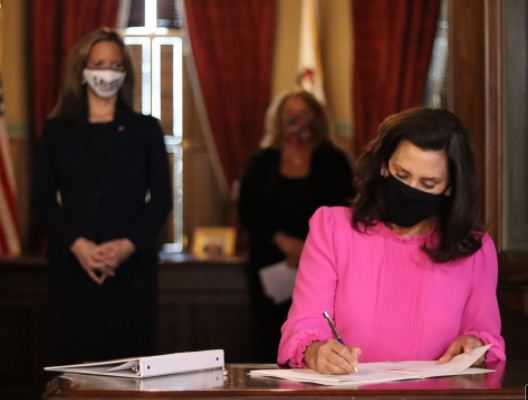
LANSING, Mich. — Today, Governor Whitmer signed the following bills into law, as well as vetoed House Bill 5443.


House Bill 5492 requires the Michigan Department of Technology Management and Budget (DTMB) to assume all responsibility for the procurement, development, and maintenance of information technology (IT) services for the Department of Health and Human Services (DHHS) by October 1, 2022. The bill was sponsored by Representative Abdullah Hammoud, D-Dearborn.


House Bill 5493 requires the Enterprise Portfolio Management Office within DTMB to provide a quarterly report on projects involving information technology (IT) services. The bill was sponsored by Representative Mary Whiteford, R-Casco Township.


House Bill 5494 requires DTMB to develop a process for accounting for and monitoring project costs for each information technology (IT) projects over $250,000. The bill was sponsored by Representative Annette Glenn, R-Midland.


House Bill 5495 specifies that if the Auditor General selects any IT system development vendor contract or maintenance project for an audit, they must also review compliance with DTMB’s new accounting and monitoring process. The bill was sponsored by Representative Terry Sabo, D-Muskegon.


House Bill 5148 allows adoption attorneys to advertise their services in order to help consumers find reputable legal help related to adoption, via an amendment to the Probate Code. Attorney advertising must still comply with the Michigan Rules of Professional Conduct. The bill was sponsored by Representative Brenda Carter, D-Pontiac.


House Bill 5149 clarifies that adoption attorneys may be compensated for their services related to a court supervised adoption proceeding and certain temporary placements. The bill was sponsored by Representative Doug Wozniak, R-Shelby Township.


House Bill 5248 requires the Children’s Ombudsman to conduct a preliminary investigation, prior to a determination of the need for a full investigation, for all child fatality cases caused by or alleged to have been caused by child abuse or neglect. The bill was sponsored by Representative Matt Hall, R-Marshall.


House Bill 5249 requires the Children’s Ombudsman to publicly release his or her findings, recommendations, and agency responses not more than 30 days after the case closure date of a case investigated by the Office of Children’s Ombudsman (OCO). Any confidential information must be redacted. The bill was sponsored by Representative Andrea Schroeder, R-Independence Township.


House Bill 5443 was vetoed by the governor due to technical deficiencies. Nevertheless, Governor Whitmer remains supportive of the goals of the bills and hopes to work with the representatives to create a Kinship Caregiver Advisory Council. HB 5443 was sponsored by Representative Kathy Crawford, R-Novi.


House Bill 5444 was signed by the governor and would create the kinship caregiver navigator program. HB 5444 was sponsored by Representative Frank Liberati, D-Allen Park, and is tie-barred to HB 5443.


To view the veto letter, click the link below:

336 Farms and Food Processors Awarded $15 Million

336 Farms and Food Processors Awarded $15 Million

Governor Gretchen Whitmer Banner - headshot with bridge graphic

FOR IMMEDIATE RELEASE

October 7, 2020

Contact: Press@michigan.gov


336 Farms and Food Processors Awarded $15 Million in Michigan Agricultural Safety Grants to Protect Employees, Food Industry


  • More than 26,000 jobs retained statewide
  • 124 small farms receive $567,000 in MEDC Small Farm Safety Grants
  • Farms and food processors in 55 of 83 counties received grants
  • Funds used to cover testing costs, personal protection equipment, facility needs and more to help mitigate risks of COVID-19


LANSING, Mich. – A total of 177 farms and 159 food processors have been awarded $15 million in Michigan Agricultural Safety Grants to mitigate risks of the COVID-19 virus across the state’s food production industry, the Michigan Economic Development Corporation (MEDC) and the Michigan Department of Agriculture and Rural Development (MDARD) announced today. Additionally, 124 small farms of less than 10 employees received $567,000 in grants for COVID-19 risk mitigation through the MEDC Small Farm Safety Grants.


“Michigan’s food and agriculture sector has been hit particularly hard by COVID-19, and through the Michigan Agricultural Safety Grant program we were able to provide some relief to our farmers and food processors across the state while ensuring the safety of our agricultural workforce and food production,” said Governor Gretchen Whitmer. “This program puts federal funding to work for Michigan’s farms and builds on additional COVID-19 relief efforts led by MEDC and MDARD to create a strong foundation for Michigan’s long-term economic recovery.”


Approved in July, the Michigan Agricultural Safety Grant program allocated $15 million of federal CARES Act funding to provide much-needed funding to Michigan’s agricultural processors and farms’ COVID-19 mitigation efforts in support of this critical industry in the state. Awarded on a first come, first serve basis the Michigan Agricultural Safety Grants helped to retain 26,003 jobs with 26 percent of grants being awarded in geographically disadvantaged areas. Total Agricultural Safety Grants were divided between agricultural processors and farms with 10 or more employees as follows:

  • $10 million in grants to 159 processors statewide.
  • $5 million in grants to 177 farms statewide.


“When Michigan was hit with one crisis after another, and when there were some troubling trends in food and agriculture nationally, we worked to ensure that Michigan’s food supply chain was safe and secure,” said MDARD Director Gary McDowell. “And we all understood this could not be done if our essential workers became ill or felt unsafe in the workplace. We’re incredibly thankful for the work of Governor Whitmer and our partners at MEDC and GreenStone not only for executing this program, but also for doing it quickly when Michigan businesses and residents needed it the most.”


As a result of high demand for the Michigan Agricultural Safety Grant program, and a clear need to help small farms mitigate risks of the COVID-19 virus in their operation, MEDC launched the MEDC Small Farm Safety Grant program on July 21, 2020. MEDC Small Farm Safety Grants were available to farms with less than 10 employees to fund COVID-19 mitigation costs.


A full list of awardees for both programs is available at michiganbusiness.org/agsafety.


Applications for both programs were processed by East Lansing-based GreenStone Farm Credit Services, one of America’s largest rural lenders, including 31 branches in Michigan. GreenStone has a 100-year track record providing financial services to the agricultural industry – including short, intermediate and long-term loans, equipment and building leases, life insurance, crop insurance, accounting and tax services. GreenStone completed initial screenings of all applications and supporting documentation and recommended applications to MEDC for final approval and disbursements of the grants awarded.


King Orchards in Central Lake was awarded a Michigan Agricultural Safety Grant utilized for PPE, sanitation supplies, quarantine housing and the implementation of COVID-19 testing for all workers.


“We are very grateful for the timely actions by the MEDC to make the Michigan Agricultural Safety Grant available to farmers,” said Juliette King McAvoy, Food Safety Manager at King Orchards. “The application process was simple and funds were disbursed within 72 hours. The grant provided us with the support we needed to protect our workers and customers while simultaneously reducing the risk of detrimental disruptions to our operations and distribution of produce.”


According to MDARD, food and agriculture contributes $104.7 billion annually to Michigan’s economy, and represents 805,000 jobs statewide. Additionally, Michigan exports approximately $1.8 billion of food and agriculture products each year.


“This grant has been a big blessing to help offset the other expenses and losses we have experienced this year because of COVID-19,” said Catherine Genovese, owner of Candy Cane Christmas Tree Farm who received an MEDC Small Farm Safety Grant. “It will ensure that we have necessary PPE going into our busiest season, including masks, wipes and plexiglass screens to ensure the safety of both our employees and our clients.”


The authorizing legislation for the Michigan Agricultural Safety Grant program also requires reporting on the program’s results by October 15, 2020 to the Legislature and State Budget Office. That report will be available on michiganbusiness.org/agsafety.


“Working in partnership with MDARD and GreenStone, we were able get this critical support into the hands of our farms and agricultural processors quickly and effectively to keep our workers and our food supply safe,” said Mark A. Burton, CEO of the Michigan Economic Development Corporation. “The Michigan Agricultural Safety Grant program built on our efforts to ensure COVID-19 relief was felt by businesses and workers statewide and that we were setting a strong foundation for economic recovery looking forward.”


To learn more about MEDC’s COVID-19 response programs and the impact they are having on economic recovery efforts, visit michiganbusiness.org/covid19response. Other resources for economic reopening efforts as well as businesses across Michigan struggling with economic losses as a result of the COVID-19 virus can be found online at michiganbusiness.org/covid19.


About Michigan Economic Development Corporation (MEDC)

The Michigan Economic Development Corporation is the state’s marketing arm and lead advocate for business development, job awareness and community development with the focus on growing Michigan’s economy. For more information on the MEDC and our initiatives, visit www.MichiganBusiness.org. For Pure Michigan® tourism information, your trip begins at www.michigan.org. Join the conversation on: FacebookInstagramLinkedIn, and Twitter.

Protecting Young Viewers from Tobacco Imagery

Protecting Young Viewers from Tobacco Imagery

Attorney General Dana Nessel

Media Contacts:

Ryan Jarvi
(c) 517-599-2746

FOR IMMEDIATE RELEASE:
Wednesday, Oct. 7, 2020

Attorney General Nessel Joins Bipartisan Coalition in Urging Creative Community to Protect Young Viewers from Tobacco Imagery

LANSING – Michigan Attorney General Dana Nessel recently joined a coalition of 43 attorneys general in urging the creative community to take action to protect young viewers from tobacco imagery in streamed movies and programs. The coalition sent letters to five Hollywood creative guilds as part of an ongoing effort to reduce youth exposure to tobacco.

Last year, a coalition of  attorneys general sent letters urging the streaming industry to limit tobacco imagery in their video content. The creative guilds’ assistance and support is critical to stopping the normalization and glamorization of tobacco use, especially youth vaping.

“The statistics across our nation and right here in Michigan very clearly demonstrate that youth vaping is not something we can turn a blind eye to. Across counties in Michigan last year, our state witnessed between a 30 percent and 118 percent increase in e-cigarette use among high school students. This increase is substantial and alarming and will require all hands on deck to change it,” said Nessel. “My colleagues and I encourage the creative guilds to join this very important dialogue to ensure our youth across this nation are protected from the influences of tobacco use.”

According to an August 2020 report from The Truth Initiative, e-cigarette use doubled among high school students and tripled among middle school students from 2017 through 2019. Young people who use e-cigarettes are four times more likely to start smoking cigarettes, are more likely to become addicted to nicotine, have more difficulty quitting and may be at higher risk for addiction to other substances.

Tobacco is the No. 1 preventable killer in the United States, with over 480,000 Americans dying from tobacco-related diseases every year. A growing body of evidence indicates that vaping can permanently damage lungs and lead to a lifetime of tobacco and nicotine use.

In the race to launch new platforms, provide more content and capture audiences, many streaming companies failed to consider the impact that easy access to movies and programs with tobacco imagery would have on children. In 2012, following a decade of studies, the Surgeon General concluded that “[t]here is a causal relationship between depictions of smoking in the movies and the initiation of smoking among young people.” More recently, a study by the Truth Initiative found that children who watch episodic programs with tobacco content are significantly more likely to begin vaping than those who are not exposed to such content. Even those with low levels of exposure were more than twice as likely to start using e-cigarettes, and those with high exposure were over three times more likely.

In the letter sent Monday, the bipartisan coalition urges Hollywood’s creative guilds to use their collective influence to persuade members of the creative community to depict tobacco imagery more responsibly and to encourage streaming companies to:

  • Adopt best practices that steer young viewers away from content with tobacco imagery, such as excluding tobacco imagery in future content targeting children;
  • Only recommend and promote tobacco-free titles for children and families;
  • Mitigate the historic and cumulative impact of watching tobacco imagery by running strong anti-tobacco spots and displaying prominent and forceful tobacco warnings, especially before content with smoking or vaping; and
  • Offer effective parental controls, so families may be empowered to choose smoke-free content.

Letters were sent to the Directors Guild of America, Producers Guild of America, Screenwriters Guild of America, Screen Actors Guild-American Federation of Television and Radio Artists, and International Alliance of Theatrical Stage Employees.

Attorney General Nessel joins the attorneys general of Alaska, Arkansas, California, Colorado, Connecticut, Delaware, the District of Columbia, Florida, Guam, Hawaii, Idaho, Illinois, Iowa, Kansas, Kentucky, Louisiana, Maine, Maryland, Massachusetts, Minnesota, Montana, Nebraska, Nevada, New Hampshire, New Jersey, New Mexico, New York, North Carolina, the Northern Mariana Islands, Ohio, Oklahoma, Oregon, Pennsylvania, Puerto Rico, Rhode Island, Tennessee, Utah, Vermont, the U.S. Virgin Islands, Virginia, Washington and Wisconsin in sending the letters.

Whitmer Signs Bill To Ensure Every Vote is Counted

Whitmer Signs Bill To Ensure Every Vote is Counted

Governor Gretchen Whitmer Banner - headshot with bridge graphic

FOR IMMEDIATE RELEASE

October 6, 2020

Media Contact: Press@Michigan.gov


Governor Whitmer Signs Bill To Help Ensure Every Vote is Counted in the November Election

Republican Legislature holds back bill expanding voter protections for military service members and their families


LANSING, Mich. — Today, Governor Gretchen Whitmer signed Senate Bill 757, which will help the State of Michigan ensure every vote is counted in the upcoming November election. SB 757 would allow clerks in certain cities or townships to begin processing absentee ballots prior to election day. It would also provide that clerks will notify voters of any reason their vote won’t be counted within 48 hours. The governor signed the bill alongside Michigan Secretary of State Jocelyn Benson.


“We are anticipating historic turnouts in the November election, and we are committed to ensuring every Michigander can cast their vote safely, and that their votes are counted. Whether you mail in an absentee ballot, drop it off at your local clerk, or vote in person on election day, your vote will count on November 3rd,” said Governor Whitmer. “Michigan voters: request your ballot, fill it out, and drop it in the mail by October 19th or take it to your local clerk’s office. Your voice will be heard in November.”


“Michigan citizens can be confident their votes will count and the results of our elections will be an accurate reflection of the will of the people,” said Secretary of State Jocelyn Benson. “While it falls short of providing the relief clerks have asked for, Senate Bill 757 is a small step in the right direction to allow some clerks additional hours to open envelopes and prepare ballots to be tabulated on Election Day.”


“Thank you to both Governor Whitmer and Secretary of State Benson for their leadership during this year’s unprecedented election,” said Mary Clark, Delta Township Clerk. “This critical legislation will give Michigan Clerks the support we need during undoubtedly the most important election of our careers. Myself and Clerks across the state are committed to ensuring the integrity and accuracy of this election.”


SB 757 would amend the Michigan Election Law to allow clerks in cities or townships with a population of at least 25,000 to perform certain absent voter (AV) ballot pre-processing activities prior to Election Day, as long as they give notice of that action to the Secretary of State (SOS) at least 20 days before Election Day. This provision would apply only for the November 3, 2020, general election. The Department of State would have to post any written notices on its website, and the clerk would have to post the notice on the city or township website. The bill would also allow election inspectors on AV counting boards in cities or townships to work in shifts. Additionally, it would provide requirements for AV ballot drop boxes and notification requirements for AV ballot applications and ballots that were rejected for missing a signature or having one that did not match the signature on file. SB 757 is sponsored by Sen. Ruth Johnson (R-Holly).


The governor was supposed to sign Senate Bill 117 at the press conference, which would allow service members and their spouses to return their ballots to their local clerks electronically if they are unable to do so in person. However, the Republican Legislature failed to send the bill to her desk.


“Elections are not the time to play partisan games. Our brave service members and their families put their lives on the line for us, and they deserve leaders who will help them vote,” said Governor Whitmer. “It’s time for the legislature to stop playing games, get back to work, and send this bill to my desk.”


Tripp Adams, a Michigan veteran who served overseas in the United States Army and Navy, said “I think it’s a disservice to our service members and their spouses that the state legislature would hold back already-passed, bipartisan legislation that would ensure these patriots serving overseas can securely exercise their right to vote.”


“It is time for the state legislature to stop playing games and do the right thing for our democracy and the men and women who serve it overseas,” said Liz Snell, a Michigander, former nominee for Military Spouse of the Year, and co-founder of Military Spouses of Strength. “They and their spouses have the right to have their vote counted, and anyone who stands in the way of that clearly misunderstands what it is to serve our state and country.”


SB 117 would amend the Michigan Election Law to require the Michigan Secretary of State (SOS) to create a process to allow eligible members to return ballots to their local clerks electronically. Eligible members include a member of a uniformed service on active duty or his or her spouse or member of the merchant marine or his or her spouse who, because of active duty or service, is absent from the U.S. and does not expect to return to the residence where the member or spouse is otherwise qualified to vote before an election. Currently, federal and state law require that ballots must be electronically transmitted or mailed to active duty members of the military at least 45 days before an election. The bill would require the SOS to promulgate rules that establish policies and procedures for the electronic return of voted ballots by eligible members of the military. SB 117 is sponsored by Sen. Adam Hollier (D-Detroit).


On September 30, Governor Whitmer joined 11 other governors in a joint statement regarding the recent threats to the democratic process and reports of efforts to circumvent the election results. Governors Gretchen Whitmer (MI), Jay Inslee (WA), Kate Brown (OR), Gavin Newsom (CA), Phil Murphy (NJ), J.B. Pritzker (IL), Tony Evers (WI), Tim Walz (MN), Ralph Northam (VA), John Carney (DE), Steve Sisolak (NV) and Michelle Lujan Grisham (NM) stated, “we affirm that all votes cast in the upcoming election will be counted and that democracy will be delivered in this election.”


Governor Proclaims October as College Month 

Governor Proclaims October as College Month 

Governor Gretchen Whitmer Banner - headshot with bridge graphic

FOR IMMEDIATE RELEASE 

October 7, 2020

Contact: Press@michigan.gov


Governor Whitmer Proclaims October as College Month


LANSING, Mich. — Governor Whitmer proclaimed October as College Month to connect Michiganders with educational and financial resources and to help close the skills gap and move the state closer to reaching the governor’s goal of 60% postsecondary educational attainment by 2030.


“Since day one, I have been committed to ensuring all Michiganders have a path to opportunity, and have worked across the aisle to help provide pathways to a post-secondary education,” said Governor Whitmer. “I just signed the fiscal year 2021 budget, which includes funding for the Michigan Reconnect program, which provides a tuition-free pathway for adults looking to earn a postsecondary certificate or associate degree. And I announced the Futures for Frontliners program, which offers a tuition free pathway to a postsecondary degree or certificate for those frontline workers who worked on our behalf during the COVID-19 pandemic. Since the program opened, more than 60,000 people have applied. During college month, I hope Michiganders everywhere explore these opportunities to see if they’re right for them.”


A month ago, Governor Whitmer announced the Futures for Frontliners program, the nation’s first-of-its’s-kind program offering tuition-free college to an estimated 625,000 Michiganders who served on the front lines during the COVID-19 pandemic.


Last year, the governor announced her Sixty by 30 goal, which aims to increase the number of working-age adults with a skills certificate or college degree to 60% by 2030. To advance her goal, Governor Whitmer signed into law the 2021 budget which included $30 million for the Michigan Reconnect program to provide a tuition-free pathway for adults looking to upskill and earn a postsecondary certificate or associate degree.


Additionally, the budget included a total of $28.7 million is provided for the Going PRO program to support job training grants to businesses to support training for current and new employees in high-demand, skilled trades industries. New funding of $3 million is provided for a statewide pre-apprenticeship program with the goal of developing qualified candidates for building trades apprenticeships in the construction industry.


According to the Georgetown Center on Education and the Workforce, 70 percent of all jobs in Michigan will require some postsecondary education or training beyond high school by 2020. To encourage Michiganders to apply for college, during the month of October, all Michigan colleges will accept the National Associated for College Admission Counseling application fee waiver for any student who has demonstrated financial need.


To view proclamation, click the link below: