by Becky Andrus | Dec 8, 2021 | Transportation
FOR IMMEDIATE RELEASE MEDIA CONTACT
December 8, 2021 James Lake
906-250-0993
LakeJ1@Michigan.gov
‘Tis the season: Practice safe snow removal
Fast facts:
– Piling or depositing snow that obstructs vision is a violation of Michigan’s Vehicle Code.
– Piling snow at the ends of driveways along highway shoulders and pushing snow across roads can create hazardous conditions.
– Keeping sidewalks clear is important to help people walk safely and access public transit.
LANSING, Mich. - Snow is beginning to pile up in parts of the state, and the Michigan Department of Transportation (MDOT) is reminding residents living along state highways to be careful and follow the law as they plow or shovel snow.
Two primary concerns are when residents and businesses pile snow at the ends of driveways along the highway shoulder, and when snow is pushed across the road, leaving snow or slush on the road surface.
Michigan Vehicle Code 257.677a prohibits “the obstruction of safety vision by removal or deposit of snow, ice, or slush.” This includes the end of driveways, where banked snow can reduce visibility for vehicles trying to enter the roadway.
“Piling snow at the end of a driveway may be convenient, but makes it difficult for drivers to make sure it’s safe to pull out onto the highway, and tough for drivers to see other vehicles waiting to pull out,” said State Transportation Director Paul C. Ajegba. “Our crews work to keep the shoulders clear and knock down snowbanks at intersections for motorist safety, and residents and business owners need to do the same at their driveways.”
Trails of snow left on the pavement while plowing across the road also can cause problems. As temperatures change, slushy snow can become packed and icy, or refreeze in ridges of ice across the road.
“Careless plowing creates an added hazard to unsuspecting motorists and plow drivers,” Ajegba said.
It also is important to remember that many local ordinances require residents and businesses to keep sidewalks clear of snow. This is important for pedestrians and those waiting for public transit.
“Winter can be a difficult time to get around for those on foot, so please make the extra effort to clear your sidewalks and help everyone stay mobile and safe,” Ajegba said.
by Becky Andrus | Nov 30, 2021 | Transportation
|
$10 million federal grant will enhance connectivity in Detroit, with Lt. Gov. Garlin Gilchrist and MDOT project manager Jon Loree
On this week’s edition of the Talking Michigan Transportation podcast, conversations with senior Michigan Department of Transportation (MDOT) project manager Jonathan Loree and Michigan Lt. Gov. Garlin Gilchrist about some key MDOT projects aimed at enhancing connections for travelers in the city of Detroit.
Listen now: https://www.buzzsprout.com/1374205/9632163-10-million-federal-grant-will-enhance-connectivity-in-detroit-with-lt-gov-garlin-gilchrist-and-mdot-project-manager-jon-loree
The U.S. Department of Transportation announced on Nov. 22 $1 billion in Rebuilding American Infrastructure with Sustainability and Equity (RAISE) grants, including a grant for the long-planned intermodal facility in the New Center area of Detroit. This would allow for development of new passenger rail and intercity bus facilities in Detroit to accommodate growing ridership projections.

The news comes as MDOT continues work on some other key connectivity initiatives in Detroit:
- A conversion of the I-375 freeway to an urban boulevard with safe access for pedestrians and cyclists; and
- A study to transform Michigan Avenue from I-96 through the historic Corktown neighborhood to Campus Martius Park downtown and allow safer access for other users as well as economic development.
Loree explains the projects and his work with City of Detroit officials, business owners and residents.
|
 |
|
In a second segment, Lt. Gov. Gilchrist talks about growing up in Detroit and how rethinking transportation is aiding Detroit’s comeback. As discussed on a previous podcast, he talks about the social and environmental justice components of the I-375 project and how the same principles apply to developing the intermodal facility and rethinking Michigan Avenue.
|
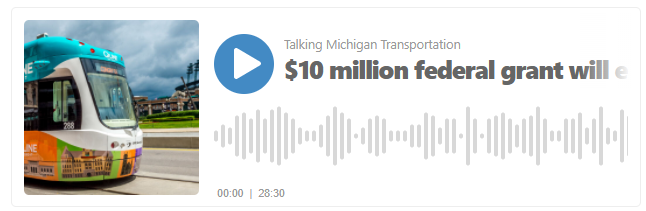
Podcast photo: Q-Line (M-1 Rail) on Woodward Ave. in Detroit.
First portrait: Jonathan Loree, senior MDOT project manager.
Second portrait: Michigan Lt. Gov. Garlin Gilchrist.
|
|
|
|
by Becky Andrus | Nov 16, 2021 | Transportation
|
A $1.2 trillion investment in infrastructure, some historic, global context
This week, as President Biden signs the $1.2 trillion Infrastructure Investment and Jobs Act (IIJA), a conversation about the historic context of the legislation and what it can mean to Michigan.
Listen now: https://www.buzzsprout.com/1374205/9553844-a-1-2-trillion-investment-in-infrastructure-some-historic-global-context


Andy Doctoroff, a Huntington Woods lawyer who teaches a class that he created at the University of Michigan Law School focusing on infrastructure, joins the conversation to offer his insights.
Doctoroff explains why he believes the $550 billion in new money authorized in the legislation is historically significant. He talks about the challenge of reaching a compromise with such heightened partisanship and the need for strong leadership to ensure the success of the program.
Comparing the approach to investing in building infrastructure in other countries, he offers insight on China’s Belt and Road Initiative, a multi-trillion-dollar global infrastructure development strategy.
He also talks about how the IIJA compares to other historic infrastructure investments, including the Transcontinental Railroad, the Rural Electrification Act, and the Interstate Highway System, as outlined in this VOA video.
Emphasizing the enhanced human connectivity offered by the broadband investments, as well as the rebuilding of roads and bridges.
Later, Doctoroff, who also has a contract with the State of Michigan to help oversee construction of the Gordie Howe International Bridge, offers a progress update.
Podcast image: Green dollar sign with a road running across it.
Portrait: Andy Doctoroff, Huntington Woods attorney and University of Michigan Law lecturer.
|
|
|
|
|
by Becky Andrus | Nov 11, 2021 | Transportation
The pandemic brought faster vehicle speeds and more crashes; is automated enforcement one answer?
On this week’s Talking Michigan Transportation podcast, conversations with two people about the ongoing surge in highway speeds that began with the pandemic in early 2020 and the resulting rise in crash deaths.
Listen now: https://www.buzzsprout.com/1374205/9527509-the-pandemic-brought-faster-vehicle-speeds-and-more-crashes-is-automated-enforcement-one-answer

First, author and columnist Helaine Olen talks about observations in her Washington Post column this week about the spike in reckless driving and traffic fatalities. Also discussed is the decline in seat belt use during the pandemic.
Olen writes that in the United States, “we’ve long failed to take road safety as seriously as we should. The results are predictably tragic: The United States leads the developed world in traffic-related deaths, with more than double the rate of any other country.”
She also talks about why her column underscores the need to use the word “crash” instead of “accident,” as discussed previously on the podcast.
|

Later, Pamela Fischer, senior director of external engagement at the Washington D.C.-based Governors Highway Safety Association (GHSA), offers her organization’s perspective on the problem and how automated traffic enforcement could stem the tide. She and a colleague penned an Op-Ed earlier this year that touched on the topic.
A bill introduced in the Michigan Legislature in August would allow speeding enforcement by camera in communities where leaders have expressed concerns about excessive speeds.
Some other relevant links:
Research on automated enforcement by the National Conference of State Legislatures: https://www.ncsl.org/research/transportation/automated-enforcement-overview.aspx
GHSA data on speed and red light cameras nationally:
https://www.ghsa.org/state-laws/issues/speed%20and%20red%20light%20cameras
GHSA Releases Independent Recommendations to Advance Equity in Traffic Safety Programs:
https://www.ghsa.org/resources/Equity-in-Highway-Safety-Enforcement-and-Engagement21
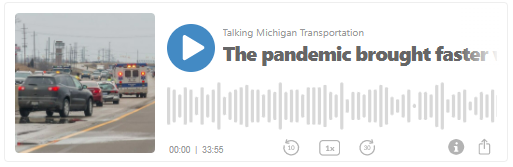
Podcast photo: Crash scene on I-96 in Metro Detroit.
First portrait: Helaine Olen, author and columnist.
Second portrait: Pamela Fischer, senior director of external engagement at the Washington D.C.-based Governors Highway Safety Association (GHSA).
|
|
|
by Becky Andrus | Nov 4, 2021 | Transportation
|
FOR IMMEDIATE RELEASE THURSDAY, NOVEMBER 4, 2021
CONTACT: Diane Cross, MDOT Office of Communications, CrossD2@Michigan.gov
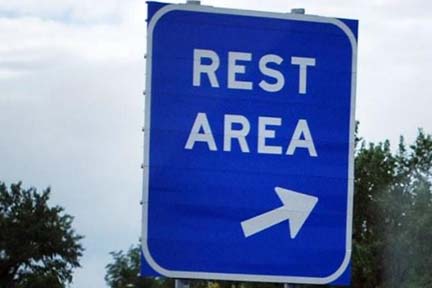
Clarkston Rest Area closing for three weeks
in Oakland County for accessibility upgrades
COUNTY:
Oakland COMMUNITY: Clarkston
START DATE:
Thursday, Nov. 4, 2021
9 a.m.
REOPEN DATE:
Late November 2021
CLOSURE DETAILS:
The southbound I-75 Clarkston Rest Area, south of Davisburg Road in Springfield Township, will have interior and exterior upgrades to ensure the rest area is compliant with the Americans with Disabilities Act (ADA). Beginning 9 a.m. Thursday, Nov. 4, through late November, the facility will be completely closed. The northbound I-75 Davisburg Rest Area in Springfield Township, northern Oakland County, has reopened.
SAFETY BENEFIT:
These accessibility upgrades will bring this facility up to the most current ADA standards.
|
by Becky Andrus | Nov 2, 2021 | Transportation
|
FOR IMMEDIATE RELEASE TUESDAY, NOVEMBER 2, 2021
CONTACT: Nick Schirripa, MDOT Office of Communications, 269-208-7829
SchirripaN@Michigan.gov
The real question: Is winter ready for MDOT?
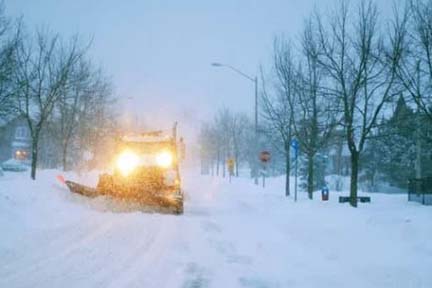
November 2, 2021 — Michigan’s fall colors aren’t even in their full brilliance, and that telltale chill already is in the air. Winter’s first snow is on its way. With almost 10,000 miles of state highways to clear, the Michigan Department of Transportation (MDOT) is ready to greet the snowy season with a full fleet of plow trucks and contract counties.
“We’re going to be just fine,” said Mark Geib, administrator for MDOT’s Transportation Systems Management and Operations Division. “We have highly trained people, we have the material we need, our equipment has been inspected and is ready to go. We’re in good shape.”
Whether it’s the wing plows, tow plows, or salt trucks, MDOT’s winter fleet is at the ready. In addition to the 330 plow trucks MDOT operates, it contracts with 63 counties to maintain state highways, bringing the total number plows to closer to 1,300 statewide. While MDOT relies on direct forces to plow about 25 percent of its state roads, the other 75 percent are plowed by county forces paid by the state for their services.
For this winter, the state has budgeted around $25 million for salt. There is 450,000 tons of salt filling storage barns around the state.
MDOT also is expanding a program started last winter and will be applying liquid salt to three trunklines: M-43 in Grand Ledge, M-20 in Mt. Pleasant, and M-66 in Montcalm County. The liquid is a 23 percent salt solution sprayed instead of spreading rock salt. It’s been used for a few years in other states, and MDOT is examining the efficiency of the practice for expanded use statewide in the future.
The salt solution will work faster than rock salt but also has a shorter working period. The liquid stays where it’s sprayed, eliminating the “bounce and scatter” of spreading rock salt, which results in some waste. The liquid program also reduces the amount of salt being introduced into the environment. MDOT will continue to expand the liquid use as best practices are learned and the needed equipment is acquired.
The final and most important pieces of MDOT’s winter maintenance operations, the brave people who pilot the plow trucks, also are falling into place. Full-time MDOT maintenance workers are at the ready, with seasonal operators currently being interviewed and hired. Many seasonal plow operators work in construction during the warmer months and return to MDOT each year when that work halts for the winter. Many of those seasonal operators still are working on active projects; their return is anticipated in the coming weeks, plenty of time to fortify MDOT’s plow operator team before the heaviest of Michigan’s winter weather is expected. |