As the snow flies, why is driving to the conditions so difficult?
|
|
|

|
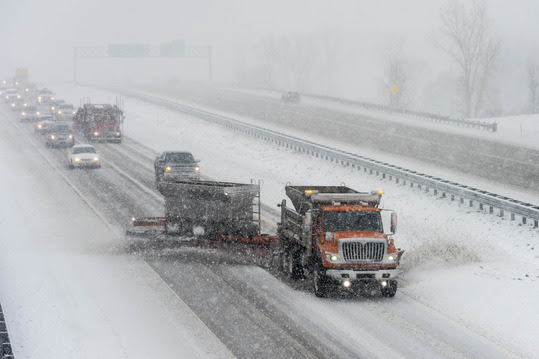 With strong winds churning up lake-effect snow on Michigan’s western lakeshore, police agencies have reported dozens of crashes. Despite ongoing messages from law enforcement and safety advocates, drivers often fail to drive to the conditions.
|

|
|
|
|
|

 |
FOR IMMEDIATE RELEASE
November 21, 2024 Diane Cross
US-24 (Telegraph Road)/M-102 (8 Mile Road) diverging diamond interchange expected to open soon in Metro Detroit
DETROIT/SOUTHFIELD, Mich. – The Michigan Department of Transportation (MDOT) project to modernize the US-24 (Telegraph Road)/M-102 (8 Mile Road) interchange to a diverging diamond interchange (DDI) is wrapping up, with the new DDI expected to be in operation sometime this weekend or early next week. This is the first DDI in this part of Metro Detroit.
While the majority of work for this project is expected to be completed by the end of the year, crews will return next spring for landscaping and punch list work.
DDIs allow for safer driving as they eliminate loop ramps, reduce conflict points and delays, and produce lower traffic speeds. MDOT has already installed DDIs at the I-96/Cascade Road interchange in Grand Rapids, the I-75/University Drive interchange in Auburn Hills, and the I-94/US-127/West Avenue interchange in Jackson, among others.
US-24 (Telegraph Road) will be closed in each direction at M-102 (8 Mile Road) from 7 p.m. Friday, Nov. 22, to 6 a.m. Monday, Nov. 25, while crews continue to install supports for overhead signs, complete traffic signal and under-bridge lighting, place pavement markings and begin work on traffic control islands to help direct drivers through the new interchange. Traffic will be detoured onto M-102 (8 Mile Road) to the first turnaround, then back to US-24 (Telegraph Road) via M-102 (8 Mile Road).
Beginning at 6 a.m., Monday, Nov. 25, if weather cooperates, northbound and southbound US-24 (Telegraph) will have a combined 18 new traffic signals at M-102 (8 Mile Road) in operation to control traffic through the newly modernized interchange, with left turns from US-24 (Telegraph Road) to M-102 (8 Mile Road).
As part of the DDI design, US-24 (Telegraph Road) now shifts first left and then right under the M-102 (8 Mile Road) bridge to permit left turns from US-24 (Telegraph Road) to M-102 (8 Mile Road) without encountering oncoming traffic.
Initially, there will be only two lanes open for northbound and southbound US-24 (Telegraph Road) at M-102 (8 Mile Road) until mid-December when traffic will reopen to four lanes in each direction.
In addition to modernizing this interchange to improve efficiency and enhance safety, MDOT invested $54 million over two years to rebuild 1.4 miles of US-24 (Telegraph Road) between M-5 (Grand River Avenue) to north of M-102 (8 Mile Road). Work also included improving five bridges, drainage and water main relocation work, sidewalk ramp improvements compliant with the Americans With Disabilities Act (ADA), replacing signs, and traffic signal and lighting work from the M-5 (Grand River Avenue) intersection to M-102 (8 Mile Road).
Based on economic modeling, this investment is expected to directly and indirectly support 653 jobs.
|
|
|
|
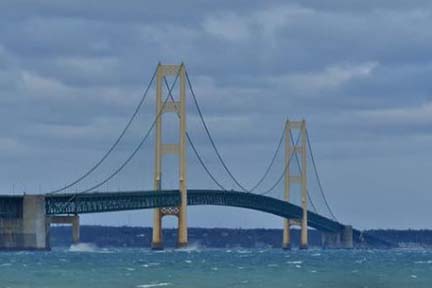
Mackinac Bridge Authority approves credit card convenience fees, lower deposit limits for MacPass Fast facts:
SAULT STE. MARIE, Mich. – Recognizing the increased costs for credit and debit card transaction fees, the Mackinac Bridge Authority (MBA) today approved collecting a 2.3 percent convenience fee for tolls paid by credit cards to recoup some of those expenses.
Authority members cited the rising costs of transaction fees from credit card companies, which totaled $341,761.51 in 2024, as the reason for the new convenience fees. The current average credit card fees for tolls paid is 3.07 percent; roughly 12-13 percent of all tolls are paid by credit card.
“Though this convenience fee will not cover all credit card processing costs, it will help defray those costs in a way that will allow us to continue directing most of our toll revenues to the neverending job of maintaining and operating the Mackinac Bridge,” said Authority Chairman Patrick “Shorty” Gleason.
The convenience fee will add roughly $0.09 for the typical $4 toll for passenger vehicles. The new fee would take effect Jan. 1, 2025.
Customers who pay in the toll lanes can avoid the credit card fees by paying cash. MacPass holders can make deposits with cash or electronic checks to avoid the fees.
To make it easier for customers to open and refill their MacPass commuter toll program accounts, the Authority also reduced the initial account minimum deposit from $80 to $40, and refill deposit minimums from $50 to $20. Those changes are expected to take effect Dec. 1, or as soon as possible.
Noting the relatively higher credit card processing fees for American Express, currently at 4.79 percent, the Authority also approved discontinuing acceptance of those credit cards for payment beginning Jan. 1, 2025.
The MBA took action today at its meeting in Sault Ste. Marie, Mich. A recording of the meeting is available to view on YouTube.
|

 |
| FOR IMMEDIATE RELEASE October 22, 2024
|
MEDIA CONTACT Jocelyn Garza 989-245-7117 GarzaJ10@Michigan.gov |
Blue Water Bridge traffic shift planned for Oct. 23, additional work to continue through November
Fast facts:
PORT HURON, Mich. - The Michigan Department of Transportation (MDOT) will be shifting eastbound traffic back to the eastbound span of the Blue Water Bridge (BWB) on Oct. 23, weather permitting, following the majority of the critical maintenance work started in May. After the traffic shift, the BWB will be able to accommodate wide loads up to 15 feet, along with superloads on an at-need basis.
Crews will continue additional painting on the approach span through the end of November, requiring intermittent lane closures and traffic shifts. The Pine Grove Avenue ramp to the toll plaza will remain closed during peak hours (Wednesday – Saturday) through the end of October.
This project, managed by MDOT, addressed required maintenance on the eastbound BWB span connecting Port Huron, Michigan, and Point Edward, Ontario. During work, the Federal Bridge Corporation Limited (FBCL) also addressed additional repairs on the eastbound span, working closely with MDOT to coordinate work and closures, reducing continual impact on commuters.
The BWB is an essential economic link between Canada and the United States. This important project continues the commitment between MDOT and FBCL to maintain and preserve the safety and reliability of the BWB.
For more information:
Dave Smith
MDOT BWB
810-434-3274
SmithD134@Michigan.gov
Jocelyn Garza
MDOT Office of Communications
989-245-7117
GarzaJ10@Michigan.gov