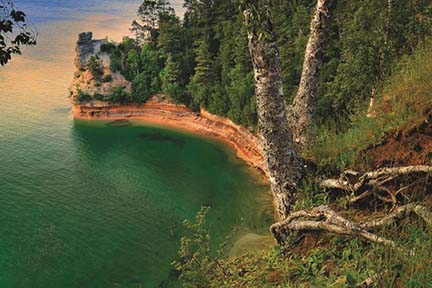
Grants to make Michigan’s National Parks More Accessible 

Grants to make Michigan’s National Parks More Accessible 

LG Header 2022

FOR IMMEDIATE RELEASE

July 29, 2024

Contact: press@michigan.gov


Lt. Governor Gilchrist Announces Grants Under Federal Partnership to make Michigan’s National Parks More Accessible

National Park Mobility Challenge grants will enhance access and visitor experience


LANSING, Mich.— Today, Lieutenant Governor Garlin Gilchrist II joined the National Park Service (NPS) to announce the first round of grant funding under the National Park Service Mobility Challenge Program, a partnership with the Biden-Harris Administration. The funding will support three innovative projects to improve access, visitor experience, and environmental conservation in Michigan’s state and national parks.


“Every Michigander should be able to enjoy the incredible natural resources we are blessed to steward,” said Lieutenant Governor Garlin Gilchrist II. “These grants represent a key milestone in our efforts alongside the National Park Service to pioneer future mobility in our state and national parks. We will keep working hard to build on our historic investments in Michigan parks, improve our park experiences, grow our economy, and preserve our natural landscapes for decades to come.”


Grant recipients are as follows:


  • ADASTEC received $250,000 to deploy an automated, electric full-size bus that will transport passengers around the Pierce Stocking Scenic Drive at Sleeping Bear Dunes National Lakeshore. ADASTEC, together with Vicinity Motor Corp and ARIBO, an AV advisor supporting the project, previously deployed its automated bus technology at Michigan State University. The State of Michigan and the National Park Service are bringing this team to Sleeping Bear Dunes to study how the next generation of automated bus technology performs in an outdoor recreational setting. ADASTEC will demonstrate how automated, electric buses can enhance traffic safety and reduce congestion in areas with lots of visitors.
  • Superior Watershed Partnership and Land Conservancy received $240,000 to install multi-modal chargers in NPS gateway communities to the Keweenaw National Historical Park (Hancock) and Pictured Rocks National Lakeshore (Munising and Grand Marais), as well as in Marquette. The charging hubs will be deployed in partnership with FLO Charging, the Michigan Department of Environment, Great Lakes, and Energy (EGLE), as well as local municipalities and utilities.
  • The Michigan Department of Natural Resources (DNR) received $10,000 to deploy off-road track wheelchairs at Muskallonge Lake State Park, near Pictured Rocks National Lakeshore. The track chairs will help to improve access to outdoor recreation for persons with disabilities. The project is part of a larger statewide campaign through the DNR to provide off-road wheelchairs at Michigan State Parks.


National Park Service Mobility Challenge

The National Park Service Mobility Challenge is a challenge issued to the global mobility industry to identify and deploy advanced mobility and electrification technologies in and around Michigan’s state and national parks, improving safety, sustainability, and equitable access through new mobility technology.


This challenge builds on a pre-existing partnership between NPS and Michigan to improve access at National Parks using mobility technologies. Governor Whitmer first announced the partnership in 2022 between the National Park Service and multiple departments within the state of Michigan including the Michigan Outdoor Recreation Industry Office, the Department of Transportation (MDOT), the Department of Labor and Economic Development (LEO), and the Office of Future Mobility and Electrification (OFME) with the goal of implementing safe, innovative technology to increase accessibility and equity in parks.


The NPMMC directly supports the goals and initiatives outlined in the MI Healthy Climate Plan, which aims to reduce greenhouse gas emissions and transition the State toward economy-wide carbon neutrality. The challenge also ladders back to broader sustainability goals outlined in the Michigan Office of Future Mobility and Electrification’s MI Future Mobility Plan, which entails providing safer, greener, and more accessible transportation infrastructure for Michiganders.


​​​“The National Park Service is looking forward to the exciting innovations the Michigan Mobility Challenge will bring to the transportation needs of our visitors and gateway communities.,” said Bert Frost, National Park Service Midwest Regional Director.


“At ADASTEC, we are honored to collaborate with the National Park Service, the U.S. DOT Volpe Center, Michigan Department of Transportation, and the Michigan Economic Development Corporation—Office of Future Mobility and Electrification to bring our advanced automated bus technology to Sleeping Bear Dunes National Lakeshore,” said Cemre Kavvasoğlu, Product Management Director, ADASTEC North America. “This project underscores our commitment to sustainability, accessibility, and innovation in public transportation. By working alongside Vicinity Motor Corp and ARIBO, leveraging our extensive deployment experience, we aim to enhance the visitor experience while preserving the natural beauty of the national parks.”


“Our mission at ADASTEC is to solve modern city mobility problems with automated public transportation,” said Dr. Ali Peker, Chief Executive Officer of ADASTEC. “This project highlights our focus on providing clean, 24/7 available, accessible, sustainable transportation for all. Together with our partners, we are bringing the first low-floor, automated bus that meets FMVSS and ADA requirements to the market. This collaboration demonstrates our commitment to advancing mobility in a way that benefits both the environment and the community.”


“I am incredibly excited about the progress we have made in advancing sustainable mobility within our national parks,” said Justine Johnson, Chief Mobility Officer for the State of Michigan. “These new initiatives not only reflect Michigan’s innovative capabilities but also significantly contribute to our broader mobility ecosystem, propelling us toward a more interconnected and sustainable future.”


About Michigan Economic Development Corporation (MEDC)

The Michigan Economic Development Corporation is the state’s marketing arm and lead advocate for business development, job awareness and community development with the focus on growing Michigan’s economy. For more information on the MEDC and our initiatives, visit www.MichiganBusiness.org. For Pure Michigan® tourism information, your trip begins at www.michigan.org. Join the conversation on: Facebook Instagram LinkedIn, and Twitter.


About the National Park Service Emerging Mobility Initiative

Since 2018, the U.S. DOT Volpe Center has worked with the National Park Service (NPS) to develop a strategy to help national parks adapt to and proactively address emerging mobility trends, including electric vehicles and charging, micromobility, traveler information technologies, ridehailing, and automated driving systems.


The U.S. DOT Volpe Center is supporting NPS in exploring emerging mobility projects with dozens of parks across the country. The U.S. DOT Volpe Center provides NPS with extensive technical assistance at all stages of the projects, including assessment, planning, deployment, and evaluation. Findings from these demonstration projects will support future efforts related to the safe integration of these new technologies. Emerging mobility project opportunities include:

  • Implementing electric vehicle charging stations in partnership with gateway communities.
  • Using technology to display enhanced roadway, transit, or parking information in parks, online, or through mobile apps.
  • Establishing designated pick-up/drop-off zones for ridehailing.
  • Partnering with gateway communities and transportation providers to establish bike share or scooter share opportunities.
  • Testing low-speed, electric automated shuttles in park settings


###


This email was sent to bandrus@orionontv.org using GovDelivery Communications Cloud on behalf of: Michigan Executive Office of the Governor · 111 S. Capitol Ave · Lansing, Michigan 48901 GovDelivery logo
DNR: News Digest – Week of July 29, 2024

DNR: News Digest – Week of July 29, 2024

DNR banner

News Digest – Week of July 29, 2024

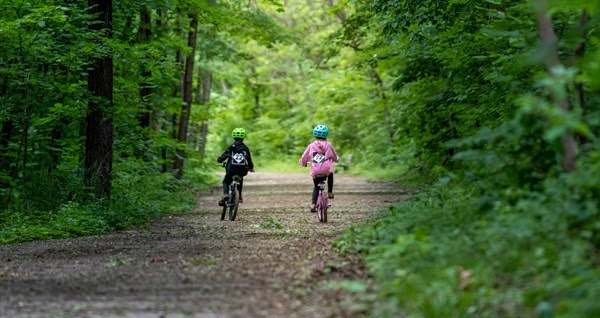
two little kids in blue and pink jackets and helmets ride their bikes down a leaf-covered trail in a lush, green forest

The 2024 Michigan Trails Experience Survey closes Aug. 1; add your voice!

Here are a few of this week’s stories from the Michigan Department of Natural Resources:

See other news releases, Showcasing the DNR stories, photos and other resources at Michigan.gov/DNRPressRoom.

PHOTO FOLDER: Larger, higher-res versions of some of the images used below, and others, are available in this folder.


Explorer guides give good nature at dozens of state parks

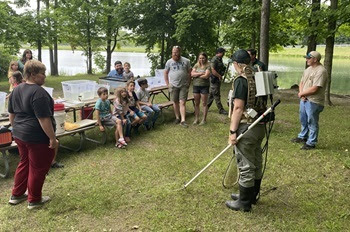
a woman in T-shirt and waders holds electrofishing gear while talking to kids and adults sitting at picnic tables outdoorsMore than 100 people gathered along the banks of Ionia State Recreation Area’s Session Lake earlier this summer to enjoy an “Underwater Zoo” program from first-year explorer guide Cathy Lawrence.
The Explorer Program is the DNR’s way of providing engaging seasonal environmental education in over two dozen state parks that don’t have full-time visitor centers, and Ionia’s “Underwater Zoo” is just one option offered to campers and day-use visitors.

The program involved an electroshocking demonstration by DNR fisheries biologist Addie Myers. Electroshocking is a humane technique widely practiced in fish sampling, where a small electrical current is used to temporarily stun fish. This doesn’t harm the fish but does cause them to float to the surface of the water, where they are scooped into a net and studied to monitor the overall health of the water system and the biodiversity within it.

Visitors at this event had the opportunity see a wide range of fish up close and to learn more about the bluegill, bass and trout that inhabit the local streams and lakes within the park, which is located about halfway between Grand Rapids and Lansing.

“I enjoy being an explorer guide and putting on programs like this because I have a passion for connecting people to the natural world around them,” Lawrence said. “All of my programs focus on the birds, insects, native plants and fish at my park, and it’s rewarding to be there, alongside our visitors, learning more about these natural marvels.”

Visitors to Ionia State Recreation Area can enjoy this program when it is offered again Friday, Aug. 9, at 4 p.m. and 6 p.m. Get programming information and weekly schedules for this park and the other 25 explorer guide parks, with topics ranging from orienteering, wildlife identification and survival skills to astronomy, basic fishing lessons and scavenger hunts, at Michigan.gov/NaturePrograms.

Questions about the DNR’s Explorer Program? Contact Shaun McKeon at 989-370-0789.


Volunteer at state parks, game areas, UP State Fair

Each month, there are a variety of opportunities to get involved with the DNR’s work – here are a few coming up next month!

Help natural areas in state parks

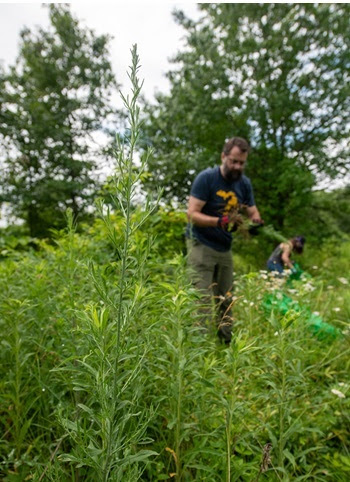
A man in a navy blue T-shirt and jeans pulls sections of plants out while standing among tall, thing, flowering green plants outdoorsSeveral state parks in southern Michigan will host stewardship workdays, where volunteers are needed to help high-quality ecosystems thrive.
Workdays will take place at:

  • Island Lake Recreation Area (Livingston County), 10 a.m. to 1 p.m. Saturday, Aug. 3, and 10 a.m. to 12:30 p.m. Sunday, Aug. 11.
  • Waterloo Recreation Area (Washtenaw County), 10 a.m. to 12:30 p.m. Sunday, Aug. 4.
  • Bald Mountain Recreation Area (Oakland County), 9 to 11:30 a.m. Saturday, Aug. 10.
  • Yankee Springs Recreation Area (Barry County), 10 a.m. to noon Saturday, Aug. 10.
  • Highland Recreation Area (Oakland County), 9 a.m. to 1 p.m. Saturday, Aug. 17.
  • Grand Mere State Park (Berrien County), 10 a.m. to noon Saturday, Aug. 17.
  • Muskegon State Park (Muskegon County), 10 a.m. to 12:30 p.m. Sunday, Aug. 18.
  • Fort Custer Recreation Area (Kalamazoo County), 9:30 a.m. to noon Saturday, Aug. 24.
  • Saugatuck Dunes State Park (Allegan County), 9:30 a.m. to noon Sunday, Aug. 25.
  • Pinckney Recreation Area (Washtenaw County), 10 a.m. to 12:30 p.m. Sunday, Aug. 25.
  • Warren Dunes State Park (Berrien County), 10 a.m. to noon Saturday, Aug. 31.

More details about each workday and how to register can be found on the DNR volunteer events calendar.

Improve habitat at state game areas

On the Ground, Michigan United Conservation Clubs’ volunteer program in partnership with the DNR, will host two habitat improvement events in August. Lunch, gear and volunteer gifts will be provided for both events.

Invasive species removal stewardship day at Gourdneck State Game Area (Kalamazoo County), 9 a.m. to noon Saturday, Aug. 3. Help remove woody invasives like glossy buckthorn to make room for native plants to grow.

Cleanup at Pointe Mouillee State Game Area (Monroe/Wayne counties), 9 a.m. to 2 p.m. Saturday, Aug. 10. Volunteers will remove trash from the state game area to help enhance the quality of fish and wildlife habitat on public land.

Share the outdoors at U.P. State Fair

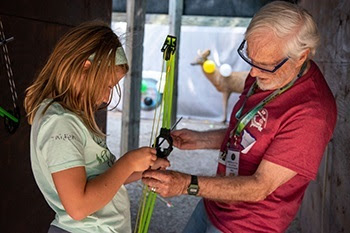
An older, white-haired man in glasses helps a young red-haired girl load an arrow into a bowMentors are needed to help staff the DNR’s Pocket Park during the Aug. 12-18 Upper Peninsula State Fair in Escanaba. Activities volunteers assist with include helping kids catch and release bluegills in the U.P.-shaped pond and shoot pellet guns or bow and arrow, staffing the fire tower and greeting visitors.
Volunteer training for all activities is provided. A variety of three- to four-hour shifts are available. Volunteers must be at least 16 years old (unless under preapproved circumstances) and pass a background check. A meal and T-shirt will be provided.

Anyone interested in volunteering should contact Jo Ann Alexander at 906-786-2351, ext. 0, or Kristi Dahlstrom at 906-226-1331.

Give us your input on state forests

Prescribed burns, timber harvests and other activities are carefully planned to keep Michigan’s nearly 4 million acres of state forest thriving. Plans for these activities are currently being made for 2026, but public input is welcome now. Find out what activities are planned and how to share your ideas at Michigan.gov/ForestInput. You can submit online comments during designated 30-day periods or attend an open house or compartment review meeting, where plans are finalized. See all scheduled comment periods, open houses and compartment review meetings for the 2024 season.

For more opportunities to volunteer, contribute and provide input, visit Michigan.gov/DNRVolunteers.


Get safety-certified during Hunter Safety Education Week

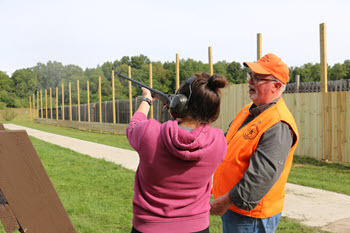
girl shooting firearm with instructorFall hunting is right around the corner, but you can get safety-certified now during the DNR’s Hunter Safety Education Week, Aug. 12-18. More than 60 in-person classes and/or field days are being offered in 40 counties throughout the state as additional opportunities to obtain your hunter safety education certificate.
To purchase a hunting license in Michigan, anyone born on or after Jan. 1, 1960, is required to successfully complete an approved hunter safety education course.

These classes are commonly offered in the spring, ahead of spring turkey season, or in the fall before the firearm deer season. Hunter Safety Education Week is being offered in addition to the already planned fall classes.

“Just like preparing for school and fall extracurriculars, hunting season needs to be considered in advance,” said Lt. Tom Wanless, DNR recreational safety, education and enforcement supervisor.

“We don’t want to see people wait until the week before they want to hunt to try locating a class, at which point classes are often full,” he said. “We hope that by offering an influx of in-person classes during a particular week each year, it will give people enough notice to prepare for hunting season.”

There are four options for completing hunter safety education in Michigan, all of which require at least four hours of in-person instruction:

  • Traditional classroom-based course.
  • Online course followed by an in-person field day.
  • Interactive online course (with animations and videos that put students in virtual real-life scenarios) followed by an in-person field day.
  • Take-home study course followed by an in-person field day.

Hunter safety education helps the next generation of hunters learn how to safely and responsibly enjoy hunting and understand the importance of wildlife management. The DNR-managed program teaches lifelong skills, such as firearm safety, basic first aid and how to use a map and compass, to an average of 15,000 students per year.

Learn more or register for a class at Michigan.gov/HunterEducation.

Questions? Contact Sgt. Cary Foster at 616-262-9532.


Summer fun: August is packed with things to do

Ready to discover Michigan’s great outdoors and stories? We’ve got you covered! Here’s just a sampling – see a full list at Michigan.gov/DNRCalendar.

Classes on bear, deer, mushrooms and more

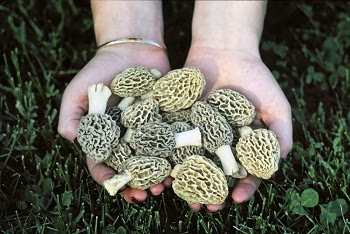
Handfulls of morel mushrooms are shown.The DNR Outdoor Skills Academy offers several opportunities in August to get started with, or get better at, hunting, fishing and foraging. Classes include:

Birds, bats, kayaking with the OAC

The Outdoor Adventure Center in Detroit offers fun programs for all ages, with an August calendar featuring archery, education programs for kids and seniors, yoga, fishing and much more. OAC educators will also lead adventures at other area destinations including Kayaking Belle Isle Aug. 11; a bat hike at Maybury State Park in Northville and Nature at Night on Belle Isle, both Aug. 22; and Birding Belle Isle Aug. 24.

Pheasants, turkeys and shooting sports

a smiling, dark-haired boy in a gray sweatshirt holds a paper with an illustrated turkey and target. He is standing in front of a colorful bannerOn Pheasant Fridays, join representatives from Pheasants Forever and learn about firearm safety and the organization’s effort to restore habitat for these beautiful birds. Participants will get an opportunity to shoot a BB gun with expert instruction in a safe environment. There will also be hands-on activities to learn about grasslands and pollinators. Pheasant Friday will take place Aug. 2 at Sleeper State Park in Caseville and Aug. 9 at Seven Lakes State Park in Holly.
The National Wild Turkey Federation State Park Turkey Tour is coming to several state parks, with a BB gun range and NWTF members on hand to share information about wild turkey conservation and hunting heritage. State Park Turkey Tour locations include Silver Lake State Park in Mears (Aug. 8), Mears State Park in Pentwater (Aug. 9) and Clear Lake State Park in Atlanta (Aug. 16).

History happenings: baseball, lumberjacks, Smokey Bear and more

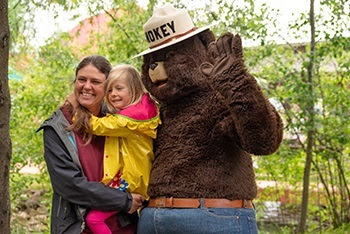
A smiling woman holds a little girl in her arms, standing next to someone in a Smokey Bear costumeStep back in time and learn more about our state’s past at Michigan History Center sites, with events including:
At Hartwick Pines Logging Museum in Grayling, a musical tribute to Michigan Lumberjacks Aug. 2; Forest Fest, a chance to meet Smokey Bear and learn about Michigan’s forests with fun activities and crafts, Aug. 10; and Black Iron Days, Aug. 24-25, with demonstrations by blacksmiths and other artisans and a steam-powered sawmill in operation.

A Tree Party at Higgins Lake Nursery and CCC Museum in Roscommon Aug. 3, where guests can celebrate Smokey Bear’s 80th birthday with cake, a bounce house, historical reenactors, “touch-a-truck” and more.

An Aug. 24 vintage baseball tournament and a farmers market Aug. 4, 11 and 25 at Cambridge Junction Historic State Park in Brooklyn.

A series of Tuesday afternoon presentations at the Michigan Iron Industry Museum in Negaunee – “Michigan Mining Scrip” Aug. 6, “Researching Misinformation and Disinformation in U.P. Lore” Aug. 13 and “Paternalism and Welfare Capitalism on the Marquette Iron Range” Aug. 20.

Free ORV Weekend, Aug. 17-18

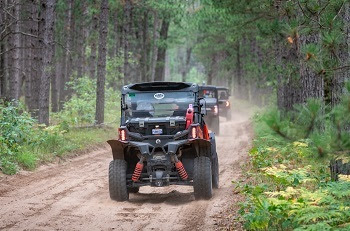
a black off-road vehicle drives down a dirt road in a green, forested areaTaking place twice a year, Free ORV Weekend – coming up Aug. 17-18 – is a great time to see, experience and test out Michigan’s off-road vehicle trails. Residents and out-of-state visitors legally can ride Michigan’s 4,000 miles of off-road vehicle trails and routes and the state’s six scramble areas on two back-to-back days without an ORV license or trail permit. The entrance fee at Holly Oaks ORV Park in Oakland County also will be waived this year. All other ORV rules and laws still apply, and you must supply your own ORV.

Photo ambassador snapshot: Port Crescent perfection

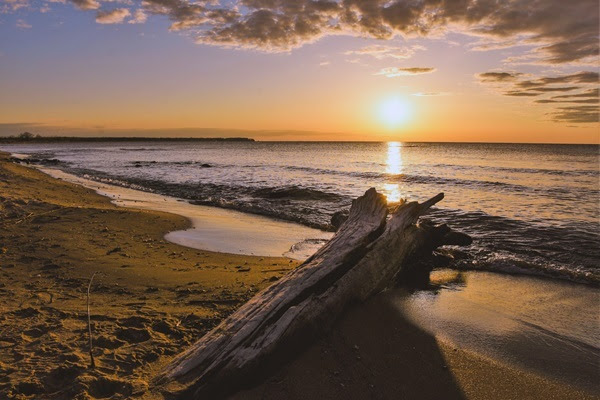
Driftwood on the sandy shore, as the bright golden sun rises over a calm, deep-blue lake. Thin, puffy clouds frame the right side.See more pictures by Michigan state parks photo ambassadors at Instagram.com/MiStateParks. For more on the program, call Stephanie Yancer at 989-274-6182. (This photo is by Karen Allmond, for the Michigan DNR, at Port Crescent State Park in Huron County.)


THINGS TO DO

Kayak piers, track chairs, color-blind scenic viewers and more; accessible recreation options help more people connect with Michigan’s outdoors.

BUY & APPLY

Time to renew your license plate? Consider purchasing a wildlife habitat plate and support Michigan’s endangered, threatened and nongame species.

GET INVOLVED

If you love trails, we’d love to hear from you. Take our 2024 Trails Experience Survey by Aug. 1 and tell us what quality time on the trails looks like to YOU!

Showcasing the DNR: Summer’s dog days

Showcasing the DNR: Summer’s dog days

DNR banner

Showcasing the DNR

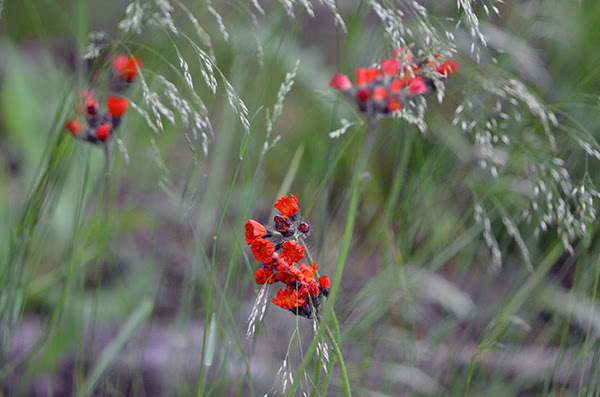
A field of summer grasses and blooming red hawkweed is shown from the Upper Peninsula.

Showcasing the DNR: Summer’s dog days

“Summertime and the living is easy, fish are jumpin’ and the cotton is high,” – George Gershwin

By JOHN PEPIN
Deputy public information officer
Michigan Department of Natural Resources

Out under the powdery blue morning skies, the sun was already beating down like someone had left the woodstove door wide open.

I was surprised at how intently I could feel the sun’s rays through the long sleeves of my shirt – seemingly penetrating deep into my skin, perhaps all the way to the bone.

The day would certainly become what people familiar with ironing clothes would call a scorcher. I tend to wilt like a daisy in these conditions.

Despite my affinity for California, after living there for many years, the hot summer sun can slow me down quickly without some shade, a place to rest and a cool drink.

I saw a picture a few days ago that showed the temperature at the Death Valley National Monument at 130 degrees.

The highest temperature I’ve experienced was 112 degrees while driving through Las Vegas on a summertime trip headed back to California from Michigan.

On another occasion, during a late May birding trip to southeastern Arizona, we had to get up quite early to do our hiking and birdwatching before wildlife activity would drop off and the temperatures would jump up into the mid-90s by 10 a.m.

Thank goodness the heat out there in those Arizona and New Mexico deserts is dry. Under those temperatures, coupled with midwestern humidity, it would be unbearable.

I walked along, just inside a line of trees where the shade of the forest cloaked me in coolness and respite from the bright and glaring sunshine.

There was no dry heat here on this Michigan morning.

The humidity was high, making it feel like being in a sauna with no cupped hands filled with cool water to breathe from. The seemingly thick air was tight up against my nose and mouth, like a furry mitten.

For me, it’s an interesting time of year, one when the forest creatures tend to be quieter and less visible while the human activity and associated noise levels are greatly increased.

I tend to be like the deer that retreat to the quiet forests to rest and relax during the daytime swelter, or some of the birds that have already done their breeding and are likely already anticipating their approaching migration south before wintertime.

The days between July 3 and Aug. 11 are typically the warmest of the year – famously referred to as the “dog days” of summer.

They are called that because the star Sirius, which is nicknamed “the Dog Star” and is the brightest star in the constellation Canis Major (that resembles a dog), appears during this time each year in the same place in the sky as the sun.

“In the summer, Sirius rises and sets with the sun. On July 23rd, specifically, it is in conjunction with the sun, and because the star is so bright, the ancient Romans believed it actually gave off heat and added to the sun’s warmth, accounting for the long stretch of sultry weather. They referred to this time as dies caniculares, or ‘dog days,’” according to The Old Farmer’s Almanac.

“Thus, the term Dog Days of Summer came to mean the 20 days before and 20 days after this alignment of Sirius with the sun.”

To me, the summertime activity in the forest passes by like a Fourth of July parade.

Here come the deer. They are showing off their new fawns, like the sandhill cranes presenting their colts along the shoulders of highways and across farm fields.

In fact, many species of birds of highly varied stripe and color are tending to their young at this time of the season. Some, like robins, may hatch two, three or even four broods in a single summer – with three to four eggs in each. Wow.

At home, there are families of downy woodpeckers and northern flickers, chipping sparrows, red-eyed vireos and ruffed grouse around our yard.

The lupines are done blooming, while the black-eyed Susans just started. Green apples are already on the trees. Blueberries and raspberries have ripened, and it won’t be long before the black and thimble berries will be ready to enjoy.

I make my way down to the creek, where those high temperatures of late have competed with passing thunderstorms in raising or lowering water depths and temperatures.

In some places, it looks like the contest has been a tie. In others, the water is low and warm, moving only sluggishly. Grass growth from the bottoms of these low-flow creeks is high – wavy and green, like a witch’s hair.

I walk upstream along the banks of a stream that always seems to have enough water to make its rapids and small waterfalls chatter. Today, the water flow is nearly bank full. I’m guessing an artesian well or spring is the source of its strength.

I get a physical itch in the palms of my hands as I see the deeper holes where trout are no doubt hugging the stream bottom waiting for food. I am not fishing today, just out walking, trying to stay cool while enjoying the scene.

I kneel at the river’s edge and plunge my hand into the fast water. It is very chilly and refreshing. I follow with my other hand. I lift a small amount of water up to my face and rub it across my nose, mouth and eyes.

It feels as though I am removing two saddle bags worth of sand from my skin. The water makes my face feel so clean, especially with the light breeze moving across it.

The heat and intermittent rains of these days of late have really allowed the plants to grow thick and deep with greenery. Everything along the stream is so lush and heavy with vegetation growth.

It fills in all the blank spots where winter and early spring would have allowed a passerby like me to gaze far into the forest through bare trees, downed limbs and almost no plants growing up from the forest floor.

I keep moving upstream along a small informal trail. Before long, I come to a pool at the bottom of a rapids where the creek turns on a sharp bend.

There are big boulders here to sit on, where I can feel misting spray from the water being sloshed between the rocks.

Animal tracks are covering an expanse of mud at the trail’s edge. Drag marks from a beaver’s tail are here too.

These remnants of activity represent actions taken likely under the cover of darkness or in the early and cool confines of the morning hours. A beautiful mourning cloak butterfly stops here too for a drink.

Kneeling against one of the rocks, I enjoy my shady spot along the water, listening to hear what my surroundings, along with my head, heart and soul, might have to say to me.

I am continuously surprised by how being deliberate about focusing and listening without and within can produce valuable insights that I might often carry with me for months or years later.

Today, I can hear piano music from a quiet and otherwise empty room in a large and vacant house. The furniture and the windowsills are dusty and old. It’s not a haunted house, just a lonesome house.

A staircase twirls up toward more empty rooms and an attic that is no doubt hot and uncomfortable; maybe one of those attic vents spins slowly in circles.

I sense an acquaintanceship and alignment with this house somehow, not that I ever lived here, but more that I can feel what it feels. There’s a usefulness outlived, a carrying on that’s been carried away and an understated but palpable obsolescence.

A blue jay swoops into the branches of a leafy maple on the far side of the creek and disappears. His loud crying calls announce my presence to anyone in the woods who will listen, popping the spell bubble cast around my reverie.

I return to the sound of the water moving over the rocks and the pleasant sights along this woodland waterway.

In not too long a walk, I reemerge at the edge of the trees and follow the line to a clearing where I move into the open under the still-hot sun.

Guideposts mark the distances to several locations on an old wooden sign. All these destinations are too far for me to reach today under these jungle-like conditions.

Another day, with cooler temperatures, will entice me to wander down these trails to new and unexplored places within this aged and knowledgeable forest.

I am the interloper here, the stranger, the searcher appearing silent and shadowy at the gate, looking for reason, truth and reconciliation.

With bowed head and heart, I will again return to enter nature’s grand sanctuary.

Check out previous Showcasing the DNR stories at Michigan.gov/DNRStories. To subscribe to upcoming Showcasing articles, sign up for free email delivery at Michigan.gov/DNREmail.


Note to editors: This feature previously issued as part of the DNR’s weekly Outdoors North column series. Contact: John Pepin, Showcasing the DNR series editor, 906-226-1352. An accompanying photo and a text-only version of this story are available below for download. Caption information follows. Credit Michigan Department of Natural Resources, unless otherwise noted.

Text-only version of this story.

Hawkweed: A field of summer grasses and blooming red hawkweed is shown from the Upper Peninsula.

The Michigan Department of Natural Resources is committed to the conservation, protection, management, use and enjoyment of the state’s natural and cultural resources for current and future generations. For more information, go to Michigan.gov/DNR.
Michigan’s forest industry contributes $26 billion to economy

Michigan’s forest industry contributes $26 billion to economy

DNR banner with link to website

DNR News

July 12, 2024
Contact: Jagdish Poudel, 517-256-3928

Michigan’s expanding forest products industry contributes more than $26 billion to state’s economy

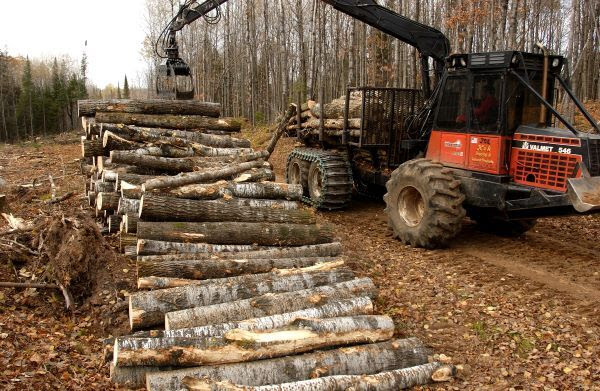
Timber harvests are an important part of Michigan's $26 billion forest products economy. Michigan’s forest products industry has hit a new peak, adding $26.5 billion to Michigan’s economy, according to new data released by the Michigan Department of Natural Resources.
That figure represents the impact of the industry in 2022, the most recent figures available, and is up $4 billion from 2019.

“Although the number of people directly employed in the industry decreased by 3.6%, all other economic indicators show significant growth,” said Jagdish Poudel, DNR forest economist. Those indicators include the average wage, labor income, output and industry productivity.

The increase in total output can be attributed to a strong forest products industry and its links to other industries. Additionally, Arauco, the largest particleboard manufacturer in the world, opened its $450 million Grayling production facility in 2019. Arauco directly generates around 220 jobs, which in turn create additional indirect and induced effects in the economy.

A growing impact

The forest products industry includes forestry and logging, wood furniture, pulp, paper, paperboard products and woody biomass power generation.

“Michigan’s forests provide a sustainable source for building materials, furniture and paper and cardboard products,” said Jeff Stampfly, chief of the DNR’s Forest Resources Division and the state forester. “We are always looking for ways to best support the industry and respond to the public’s increasing desire for sustainability.”

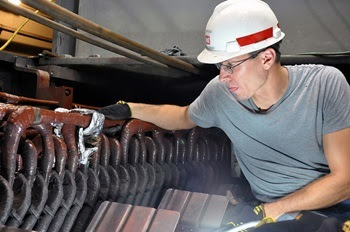
A man in a gray T-shirt, gloves and a white hardhat examines a metal component in a biomass plantMichigan’s 20.2 million acres of forest cover about half the state and are concentrated in the Upper Peninsula and the northern Lower Peninsula. Nearly 4 million of those acres are DNR-managed state forest lands.

The DNR works hand in hand with industry to support and expand it. For example, the woody biomass power generation industry sector directly generates around 120 jobs in Michigan. Biomass power is sustainable and uses materials with little value such as mill and manufacturer residues, logging residues and low-value forest products.

The DNR also is partnering with Michigan State University and Michigan Technological University to promote mass timber construction, a new building technique that allows for the construction of large and tall buildings using engineered wood panels and beams instead of traditional steel and concrete. The DNR’s new customer service center in the eastern Upper Peninsula is currently under construction using mass timber materials made from Michigan red pine.

Economic power

conference tables and chairs spaced out in the tall-ceilinged, exposed ductwork of Michigan State University's STEM building, built with mass timberThe forest products industry contributed 40,449 direct jobs during 2022 and supported a total of 88,275 jobs, according to the report.
“Each job in the forest products industry generates an additional 1.1 jobs in the economy,” Poudel said. The average wage in the forest products industry is nearly $80,000 annually.

Pulp, paper, paperboard and other paper products comprise the largest sector, with a combined direct output of $7.7 billion. Primary and secondary solid wood products generated nearly $5.6 billion in direct output. Wood furniture generated about $2.4 billion and forestry and logging about $470 million.

Learn more on the DNR’s forest products industry webpage.


Note to editors: Accompanying photos are available below for download. Caption information follows.

  • Mass timber: For future growth of the forest products industry, the DNR is working with Michigan State University, Michigan Technological University and industry partners to promote the carbon-storing construction technique and develop ways to use abundant Michigan tree species. This photo shows detail of the MSU STEM Teaching and Learning Facility’s interior.
  • Harvest: Timber is loaded onto a trailer for transport. Michigan’s forest products industry is expanding, thanks to new investment from global companies such as Arauco, which opened a Grayling plant in 2019.
DNR offers Hunter Safety Education Week in August

DNR offers Hunter Safety Education Week in August

DNR banner with link to website

DNR News

July 11, 2024
Contact: Katie Gervasi, 517-290-0679

DNR offers Hunter Safety Education Week in August, adding 40-plus in-person classes

girl shooting firearm with instructorJoin the Michigan Department of Natural Resources for Hunter Safety Education Week, Aug. 12-18. More than 40 in-person classes will be offered throughout the state as additional opportunities to obtain a hunter safety education certificate.

These new classes will be posted and available for registration on Friday, July 12, by 8 a.m.

To purchase a hunting license in Michigan, anyone born on or after Jan. 1, 1960, is required to successfully complete an approved hunter education course.

Hunter safety education classes are commonly offered in the spring, ahead of spring turkey season, or in the fall before the firearm deer season. Hunter Safety Education Week is offered in addition to the already planned fall classes.

“Just like preparing for school and fall extracurriculars, hunting season needs to be considered in advance,” said Lt. Tom Wanless, DNR recreational safety, education and enforcement supervisor.

“A lot of people aren’t considering hunting season right now because it’s the middle of summer. We don’t want to see people wait until the week before they want to hunt to try locating a class, at which point classes are often full,” he said. “We hope that by offering an influx of in-person classes during a particular week each year, it will give people enough notice to prepare for hunting season.”

There are four options for completing hunter safety education in Michigan, all of which require at least four hours of in-person instruction:

  • Traditional classroom-based course.
  • Online course followed by an in-person field day.
  • Interactive online course followed by an in-person field day.
  • Take-home study course followed by an in-person field day.

Hunter safety education helps the next generation of hunters learn how to safely and responsibly enjoy hunting and understand the importance of wildlife management. The DNR-managed program teaches lifelong skills, such as firearm safety, basic first aid and how to use a map and compass, to an average of 15,000 students per year.

Learn more or register for a class at Michigan.gov/HunterEducation.

Additionally, the DNR is always looking for new volunteer recreational safety education instructors. Get more details about this opportunity on the DNR website.


Note to editors: An accompanying photo is available below for download. Caption information follows.

Teaching: A volunteer hunter safety education instructor provides direction to a student at the Rose Lake Shooting Range in Bath. The Michigan Department of Natural Resources has planned a Hunter Safety Education Week, Aug. 12-18, with more than 40 in-person classes.

$24 million in Spark Grants for outdoor recreation projects

$24 million in Spark Grants for outdoor recreation projects

 
DNR banner with link to website

DNR News

The DNR is sharing a news release issued earlier today by the Council of Michigan Foundations.


July 10, 2024
Contact: Amanda Jarrett, Director of Communications, Council of Michigan Foundations, 502-645-3279

DNR partnership with Council of Michigan Foundations announces more than $24 million in Spark Grants for outdoor recreation projects

New grantmaking model used to improve healthy spaces in under-resourced and underrepresented communities

Twenty-nine Michigan communities whose economic opportunities and public health were hardest hit by the COVID-19 pandemic are benefitting from $24.2 million in Michigan Spark Grants funding to date, which is designed to remove barriers to creating, renovating or redeveloping community-informed public recreation opportunities.

Administered by the Council for Michigan Foundations (CMF) in partnership with the Michigan Department of Natural Resources (DNR) and through the CMF Statewide Equity Fund, the CMF/DNR Spark Grant program partnership was established to equitably guide resources to communities and expand access to healthy indoor and outdoor recreation projects where there has been little or no previous parks and recreation investment. A core component of the partnership, designed and brokered by the Governor’s Office of Foundation Liaison, is centering community voices and engaging a diverse array of community residents in all aspects of the visioning, planning and execution of the parks projects.

“Michigan’s parks drive tourism, jobs and economic activity across our state,” said Gov. Gretchen Whitmer. “I’m proud that our administration has made the largest investments ever in state and local parks. This round of funding will fuel projects that bring people together, build a community’s sense of place, and provide avenues for healthier, more active lifestyles. Let’s keep working together to help more Michiganders discover our beautiful natural resources, relax with family and friends, and enjoy a Pure Michigan summer.”

“In support of our community of philanthropy, CMF is proud to be part of this partnership with DNR that will guide public resources that can increase access to recreational opportunities in historically underrepresented and under-resourced communities throughout the state,” said Kyle Caldwell, CMF president and CEO. “We are grateful for the leadership of the many community foundations who served as conveners and are walking alongside their communities, ensuring community voice is centered in developing equitable solutions to enhance healthy recreation opportunities for all residents.”

The framework for this new grantmaking model was created with the assistance of an advisory group comprising philanthropic, regional government planning, parks and recreation, and other grantmaking entities with relevant expertise. They helped the DNR design a new approach to a grant program that seeks to remove barriers with an equity-focused application and evaluation process and provide the needed support services to expand community capacity to successfully manage and implement recreation projects.

In total 39 opportunity communities were identified, 29 of which are receiving funding through this CMF/DNR Spark Grants partnership. The remaining communities had already received funding through DNR’s first Spark Grant awards in 2023.

Examples of funded projects in this round include:

  • Development of a new park with a playground and splash pad in Benton Charter Township.
  • Updates to Wheatley Park’s restroom, baseball field and playground in the City of Inkster.
  • A new nature trail and park in the City of Standish, making it the first locally owned park in the community’s history.
  • The addition of new baseball fields and pickleball courts in the City of Highland Park.

Learn more about the CMF/DNR Michigan Spark Grants program, along with a full list of grant recipients, at www.michiganfoundations.org/policy/dnr-spark-grants-program-partnership. All projects will now move to the execution phase and will be completed by October 2026.

The Council of Michigan Foundations (CMF) is a membership association for philanthropy staff and trustees. CMF leads, strengthens and supports Michigan’s community of philanthropy by emboldening and equipping Michigan philanthropy in the relentless pursuit of equitable systems and inclusive diversity, fortifying the field through public policy action, fostering the growth of current and future philanthropy leaders and advancing exemplary philanthropic practices and field expertise.

Learn more at www.michiganfoundations.org.