Michigan marks progress against invasive species

Michigan marks progress against invasive species

 
Michigan Invasive Species Program bannerNot MI Species banner


Michigan marks progress against invasive species, considers ways to meet new threats

Upcoming webinar provides a year in review

Rock snot, spotted lanternfly, balsam woolly adelgid … these are just a few of the invasive species that 10 years ago weren’t on the public radar as threats to Michigan’s woods and waters.

Today, however, thanks to the work of Michigan’s Invasive Species Program, university partners, nonprofits, volunteers and a robust network of cooperative invasive species management areas, there is greater awareness about the damages posed by these land and water invaders – but there’s still much work to do.

The recently released Michigan Invasive Species Program 2022 Annual Report highlights recent successes, outlines what’s needed to meet future challenges, and points to simple steps everyone can take in actively protecting the outdoor places and experiences we love.

Read the report ►

The 2022 report discusses several topics, including:

  • The many pathways to Michigan, and how effective prevention and early detection require knowledge of how a species might arrive in Michigan.
  • Prevention-focused laws that require boaters to clean and drain boats and that prohibit or restrict possession or sale of harmful species.
  • The power of rapid response when new detections arise.
  • Effective communications and outreach, including workshops, site visits, social media, news stories and other efforts that reached more Michiganders.

Program history

Since 2014, Michigan’s Invasive Species Program has received $5 million in annual state funding to prevent the introduction and spread of invasive species and minimize harmful effects of those already established in the state. This support has substantially enhanced the program’s work on aquatic organisms, supported a terrestrial species program and established the $3.6 million annual Michigan Invasive Species Grant Program.

Looking ahead

Joanne Foreman, invasive species communications coordinator with the Michigan Department of Natural Resources, will address the program’s progress and potential impacts of new funding in the upcoming NotMISpecies webinar, Rowing the Boat: The Michigan Invasive Species Program 2022 Year in Review (9 a.m. Tuesday, March 21). Registration information and recorded versions of previous webinars are available on the NotMISpecies webpage.

Questions? Contact: Joanne Foreman at 517-284-5814.


The Michigan Invasive Species Program is cooperatively implemented by the Michigan departments of Agriculture and Rural Development; Environment, Great Lakes, and Energy; and Natural Resources.


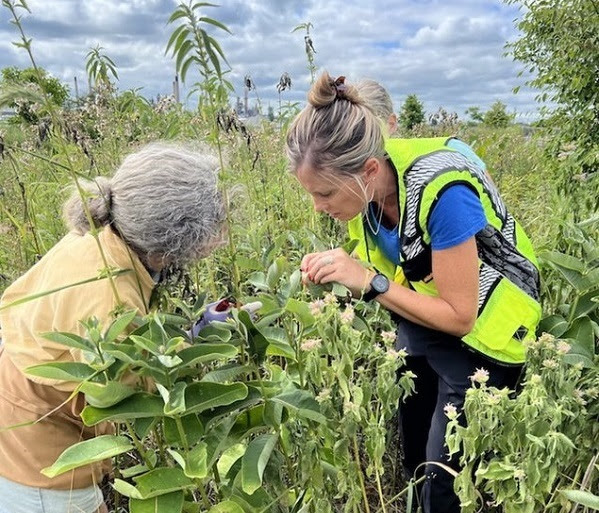
Two women in a tall-grass prairie lean in to closely examine a plant.DNR Logo 24 bit PNGDept of Environment, Great Lakes and Energy logoMDARD Logo

Find and fix leaks during Fix a Leak Week

Find and fix leaks during Fix a Leak Week

EGLE Main GovD banner
FOR IMMEDIATE RELEASE
March 20, 2023

EGLE Media Office, EGLE-Assist@Michigan.gov, 517-284-9278

Kristina Donaldson, Clean Water Public Advocate, DonaldsonK@Michigan.gov, 517-285-8140

Find and fix leaks during Fix a Leak Week


Gov. Gretchen Whitmer has issued a proclamation recognizing this week, March 20-26, as Fix a Leak Week. Fix a Leak week is an annual event created by the U.S. Environmental Protection Agency (EPA) and supported by WaterSense partners across the U.S. and Canada. During this week, EGLE’s Office of the Clean Water Public Advocate will provide some practical tips on finding and fixing household leaks and spotlight free home energy efficiency programs offered by some utilities within the state.

“Fixing water leaks in home plumbing can reduce consumer water bills and prevent water damage within the home” said Kris Donaldson, EGLE’s Clean Water Public Advocate. The EPA estimates that fixing easily corrected household leaks can save homeowners about 10 percent on their water bills.

Residents are encouraged to get involved and track down leaks in their home using EPA’s at-home checklist. Common types of leaks found in the home, like worn toilet flappers and dripping faucets (don’t forget to clean the aerators too!), are often easy and relatively cheap to fix. Share a photo and tag your post with #FixALeakWeek and #IFixLeaks!

Some energy utilities within the state offer free at-home energy efficiency assessments to qualifying customers. These can include a basic home walkthrough and installation of energy-efficient products, such as faucet aerators, lightbulbs, or showerheads. Contact your energy utility to find out what programs they offer.

More information and resources are available at Michigan.gov/FixALeakWeek. For more information about the Office of the Clean Water Public Advocate visit Michigan.gov/CleanWater.

To stay up to date on other EGLE news follow us at Michigan.gov/MIEnvironment.

Michigan marks progress against invasive species

State awards $3.6 million for invasive species projects

 
Michigan Invasive Species Program banner
Fresh, undisturbed snow blankets a long, peaceful line of trees.
March 1, 2023
Contact: Erin Campbell, 269-300-9698 or Joanne Foreman, 517-284-5814

State awards $3.6 million for invasive species projects

The state of Michigan today announced that 35 projects will share $3.6 million in grants through the Michigan Invasive Species Grant Program.

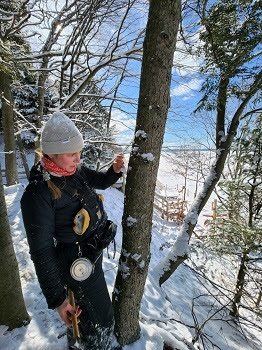
A woman dressed in outdoor winter gear is placing a small tag on the trunk of a hemlock tree on a snowy cliff above Lake Michigan.The program – cooperatively implemented by the Michigan departments of Agriculture and Rural Development; Environment, Great Lakes, and Energy; and Natural Resources – addresses prevention, detection, eradication and control of aquatic (water-based) and terrestrial (land-based) invasive species in Michigan through four key objectives:
  • Preventing the introduction of new invasive species.
  • Strengthening the statewide invasive species early detection and response network.
  • Limiting the spread of recently confirmed invasive species.
  • Managing and controlling widespread, established invasive species.

This year’s grantees have offered $532,300 in matching funds and services to support these projects, leveraging a total investment of $4,132,300.

Expanding prevention, detection and management

Grant funds will support several early detection and response efforts for watch list invasive species:

  • Continuing survey and treatment of hemlock woolly adelgid in Oceana, Mason, Benzie and other counties along the Lake Michigan shoreline.
  • Surveying and creating “trap trees” for spotted lanternfly across the Huron-Clinton Metroparks in Oakland and Macomb counties.
  • Refining the potential for early detection of didymo (rock snot) using environmental DNA and testing environmental variables that may lead to stalk-producing “blooms.”
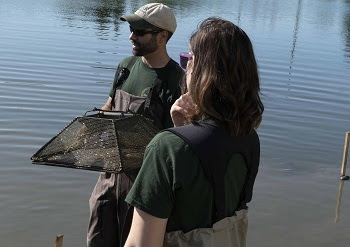
A man holding a small, trapezoid-shaped mesh trap and a woman, both in waders, stand in the water at the edge of a pond.

  • Coordinating red swamp crayfish surveys across the Clinton and Rouge river watersheds.
  • Initiating outreach and monitoring for watch list tree pests and diseases on the Pokagon Band of Potawatomi Indians’ tribal lands.
  • Treating known locations of mile-a-minute weed and expanding surveys in the vicinity of Albion in southwest Michigan.
  • Coordinating Himalayan balsam survey, removal and outreach across the Upper Peninsula.

Funding also will support efforts to prevent the spread of invasive species:

  • Testing the effectiveness of household cleaners to decontaminate waders, boats and equipment exposed to didymo and New Zealand mudsnails.
  • Training paddle sport enthusiasts to decontaminate boats between uses and to look for and report aquatic invasive species.
  • Spreading the “Clean, Drain, Dry” message using a mobile boat wash at popular boating access sites in southeast Michigan.
  • Evaluating nitidulid beetle and oak tree cycles in the Upper Peninsula to better predict risk periods for spreading oak wilt.

Support in every Michigan county

This year’s grants also support 21 regional cooperative invasive species management areas, the network of partnership organizations working to manage and control invasive species and provide service to all 83 counties in the state. CISMA projects include enhanced education and outreach, technical assistance to landowners, and survey and treatment of high-priority invasive species.

Program background and progress

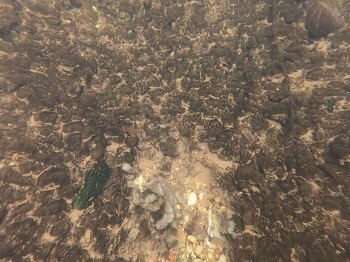
didymo mats in Manistee RiverIn 2014 the state Legislature designated $5 million in annual funding to address invasive species. This support substantially enhanced Michigan’s Invasive Species Program for aquatic organisms, supported a formal program for terrestrial species and initiated the Michigan Invasive Species Grant Program.


This cycle marks the ninth year of program funding. To date, over $32 million has been awarded to support 238 projects undertaken by units of government, nonprofits and institutions. Because of this program:

  • More than 592,000 acres of land and water have been surveyed for invasive species.
  • More than 51,000 acres have been treated for invasive terrestrial and aquatic plants.
  • Through direct contact, including face-to-face interactions at boat washes, workshops, trainings and other events, 292,000 people have been reached with information about invasive species.
  • An additional 41 million people were reached through grantees’ “passive impression” efforts, including mail, newspapers, social media and handouts.

Over $5 million requested

The program began accepting grant applications for this funding cycle in September 2022. A total of 42 applications were received, requesting approximately $5.1 million in support. Grant applicants were asked to commit to providing at least 10% of the total project cost in the form of a local match.

The full list of grant recipients, project descriptions and award amounts is available on the Michigan Invasive Species Grant Program website at Michigan.gov/MISGP.


Michigan’s Invasive Species Program is cooperatively implemented by the Michigan departments of Agriculture and Rural Development; Environment, Great Lakes and Energy; and Natural Resources.


/Note to editors: Accompanying photos are available below for download. Suggested captions and photo credit information follow:

Survey: A CISMA strike team member prepares to tag a hemlock tree during a winter survey for invasive hemlock woolly adelgid.

Trap: DNR staff prepare to deploy a trap to determine abundance of invasive red swamp crayfish in a drainage pond.

Didymo: Didymo (dark brown) blooms on cobble in the Manistee River./

Training open for Michigan Clean Water Corps

Training open for Michigan Clean Water Corps

 
EGLE Main GovD banner
FOR IMMEDIATE RELEASE
February 22, 2023
Jeff Johnston, EGLE public information officer, JohnstonJ14@Michigan.gov, 517-231-9304
Tamara Lipsey, Aquatic Biologist, LipseyT@Michigan.gov, 517-342-4372

Enrollment, training open for Michigan Clean Water Corps Cooperative Lakes Monitoring Program

The Michigan Clean Water Corps (MiCorps), a network of volunteer monitoring programs that collect and share surface water quality data statewide, is accepting enrollments for the 2023 Cooperative Lakes Monitoring Program (CLMP) season. Volunteer training will take place in person May 5, 2023, or online May 9, 2023.

CLMP volunteers monitor water quality, invasive species, and habitat conditions in Michigan lakes. Volunteers receive detailed instructions, training, and equipment, and the data they collect are added to the MiCorps Data Exchange, a public database that includes CLMP lake information dating back to 1974.

Interested volunteers are encouraged to enroll early, as some program options have March enrollment deadlines. Other options allow enrollment into May and into the summer. Details can be found on the CLMP Enrollment Web page.

There is no cost to attend either the May 5 in-person training or May 9 online training, although registration is required. The in-person training will take place concurrently with the Michigan Lakes and Streams Association annual conference May 5-6 at Crystal Mountain Resort in Thompsonville, Michigan, but conference attendance is not required. Training is required for new volunteers, and experienced volunteers are always welcome. Anyone interested in learning more about the CLMP is invited to participate regardless of their intent to enroll a lake and conduct monitoring this year.

Direct questions about the CLMP to Erick Elgin, Michigan State University Extension, at 218-340-5731 or ElginEri@MSU.edu; or Tamara Lipsey, Water Resources Division, Michigan Department of Environment, Great Lakes, and Energy (EGLE), at 517-342-4372 or LipseyT@Michigan.gov.

EGLE established MiCorps in 2004 to engage the public in collecting water quality data for use in water resources management and protection programs. MiCorps is sponsored by EGLE and is administered in partnership with Michigan State University Extension, the Michigan Lakes and Streams Association, and the Huron River Watershed Council.

To stay up to date on other EGLE news, follow us at Michigan.gov/MIEnvironment.

Historic Detroit automotive site into new housing

Historic Detroit automotive site into new housing

EGLE Main GovD banner
FOR IMMEDIATE RELEASE
Feb. 21, 2023
Dan Gough, EGLE Brownfield Coordinator, GoughD1@Michigan.gov, 517-281-8253
Jill A. Greenberg, EGLE spokesperson, GreenbergJ@Michigan.gov, 517-897-4965

EGLE approves financing to turn historic Detroit automotive site into new housing

The Michigan Department of Environment, Great Lakes, and Energy (EGLE) has approved a financing plan for environmental cleanup and management costs at the site of the former Studebaker factory in Detroit. When finished, plans call for 161 new studio and one-bedroom apartments.

The site at 411 Piquette Ave. was used by Studebaker, Cadillac, Kaltz Excavation and 3M over the years. It is now contaminated with metals and various chemical and organic compounds. Although there has been remediation work at this site in the past the contamination levels still exceed the threshold for direct contact and for potential vapor migration into the building.

EGLE has approved reimbursement to the developer for a Baseline Environmental Assessment, pre-demolition work, removing and disposing of contaminated soil, as well as installing and maintaining a vapor-mitigation system and surface cover at the site. The reimbursement of up to $714,943 will come from Tax Increment Financing (TIF). TIF allows the increase in property tax revenue on the finished project to be used to reimburse the developer until it has recouped the cost of eligible environmental activities. The Michigan Strategic Fund approved additional TIF reimbursement of up to $1,356,355. The land currently has a taxable value of $388,662. That’s estimated to go up to $4 million when the project is finished.

The developer plans to renovate the four-story building at 411 Piquette Ave. into 71 studio and 90 one-bedroom units. It will be across the street from the Piquette Square development, which was turned into housing for chronically homeless veterans with help from EGLE, the Michigan State Housing Development Authority and U.S Environmental Protection Agency. Both projects are part of Detroit’s Piquette Avenue Industrial Historic District.

Overall, in 2022 EGLE provided $20.7 million in brownfield funding to 67 projects statewide. More than half of EGLE’s budget each year flows into Michigan communities through grants, loans and other spending that supports local projects, protects public health and the environment, ultimately creating economic growth and jobs for Michigan workers. Redevelopment of brownfields – vacant or abandoned properties with known or suspected contamination – increases property values both on the revitalized site and on other nearby properties.

EGLE’s Remediation and Redevelopment Division provides financial and technical assistance including grants, loans, tax increment financing and free site assessments to facilitate the redevelopment of brownfield properties.

Historic Detroit automotive site into new housing

Roadmaps explore geothermal, solar, wind, clean tech

 
EGLE Main GovD banner
FOR IMMEDIATE RELEASE
Feb. 9, 2023
Jeff Johnston, EGLE public information officer, JohnstonJ14@Michigan.gov, 517-231-9304

Roadmaps explore geothermal, solar, wind, clean tech

EGLE informational webpage digs into Michigan clean energy assets

A new Michigan Department of Environment, Great Lakes, and Energy (EGLE) webpage serves up the latest details about three of the state’s key renewable energy sources: geothermal, solar, and wind.

For each source, the Clean Energy Assets page features a “roadmap” report focusing on demand, supply and value chains, workforce, growth, and recommendations. These roadmaps offer strategic guidance for economic development efforts to accelerate innovation and commercial activity and are expected to help set priorities, allocate resources, align stakeholders, and focus efforts statewide.

The webpage is intended for use by elected officials, government employees, business owners, planners, developers, industry and commercial stakeholders, and the public. It soon will add a database of clean energy technological assets and suppliers, with information including:

  • Which businesses have considered renewable and clean-energy technologies in their facilities.
  • Geographic locations of businesses providing technical resources for renewable and clean energy.

Renewable and clean-energy industries represent a multibillion-dollar economic opportunity for Michigan. They also align with the state’s obligation within the U.S. Climate Alliance to reduce greenhouse gas emissions and with MI Healthy Climate Plan goals for a prosperous, equitable, carbon-neutral state economy by 2050.

The roadmaps are the product of the state’s Clean Energy Asset Roadmap Program (CEARP). In 2021, EGLE announced nearly $412,000 in CEARP grants to two recipients: Lawrence Technological University, whose Centrepolis Accelerator received $299,965 to develop a renewable energy asset roadmap and a geothermal asset roadmap; and the University of Michigan, whose Economic Growth Institute received $111,950 to develop a clean-energy technology development roadmap.

The roadmaps aim to quantify or map each energy sector and identify, evaluate, and detail opportunities to significantly speed their growth. They focus specifically on industry and manufacturing adopting clean-energy technologies and techniques in energy production and energy efficiency. Each roadmap is available for download:

Industry roadmaps provide strategic guidance for economic development efforts to accelerate innovation and commercial activity and are a dynamic tool for setting priorities, allocating resources, aligning stakeholders, and focusing efforts. Findings will supply EGLE and the Council on Climate Solutions with critical information to support statewide strategy for decarbonization.

Learn more by registering for the following webinars: