New grants push number of clean-powered buses toward 900

New grants push number of clean-powered buses toward 900

EGLE Main GovD banner
FOR IMMEDIATE RELEASE: 
Oct. 13, 2025
Jeff Johnston, EGLE Public Information Officer, JohnstonJ14@Michigan.gov, 517-231-9304
Bob Wheaton, Michigan Department of Education Director of Public and Governmental Affairs, WheatonB1@Michigan.gov, 517-241-4395

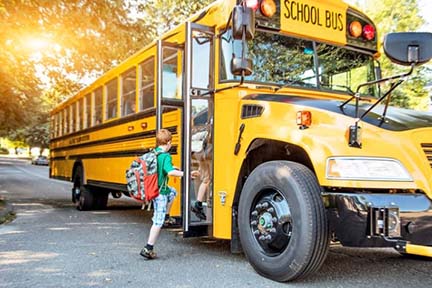
New grants push Michigan’s number of clean-powered school buses toward 900

State and federal funds support transition to benefit air quality, student health, school budgets

LANSING, Michigan – The number of clean-powered school buses in Michigan keeps rising.

A new round of investment totaling $35.9 million from the Michigan Department of Education’s (MDE) $125 million Clean Bus Energy Grant (CBEG) program will help 23 schools and districts add 87 electric buses and 10 propane buses to fleets across the state. Recipients are listed below.

“Children and others in their communities benefit from cleaner air,” said Interim State Superintendent Dr. Sue C. Carnell. “We are happy to work with our partners at the Michigan Department of Environment, Great Lakes, and Energy (EGLE) to make our state greener. The Clean Bus Energy Grant program helps us move toward Goal 3 in Michigan’s Top 10 Strategic Education Plan, to improve the health, safety, and wellness of all learners.”

The new grants are the latest step in a clean-power transition for Michigan school transportation. Milestones along the way include:

  • In 2019 and 2020, EGLE awarded about $13 million in grants through its now-closed Fuel Transformation Program toward the purchase of 317 electric, clean diesel, and propane school buses and support infrastructure for more than 25 districts across the state.
  • In November 2022, the U.S. Environmental Protection Agency (EPA) invested $54 million from its Clean School Bus Rebates program toward 138 new electric school buses and infrastructure for 25 Michigan school districts, from Southeast Michigan to the Upper Peninsula. The EPA’s Clean School Bus Program (CSBP) of grants and rebates provides $5 billion nationwide over fiscal years 2022-26.
  • In January 2024, three districts each received $5.9 million in CSBP funding to buy 15 clean-powered school buses apiece. Reports at the time said five additional Michigan districts were expected to receive a total of 21 new clean buses through multistate CSBP grants.
  • In May 2024, the CSBP rebate competition announced $23.98 million to help 27 Michigan schools and districts buy 97 buses powered by electricity and three powered by propane.
  • Also in 2024, MDE announced its first and second rounds of CBEG program funding: nearly $30 million in June to help 29 school districts and intermediate school districts buy a total of 114 buses powered by electricity, propane, or natural gas; and $15.2 million in October to help 21 districts buy 40 electric buses and 17 propane buses.

Together, grants and rebates so far account for nearly 900 buses – some yet to be purchased or enter service. The funds generally cover a significant portion of the costs for vehicles and infrastructure, with the balance paid from local sources.

EGLE has consistently supported clean power for Michigan’s nearly 17,000 buses transporting more than 800,000 students a year.

“The commitment by state and federal governments to provide schools with more environmentally friendly buses is good for our children, good for our schools, and good for our communities,” EGLE Director Phil Roos said. “Under Governor Whitmer’s leadership, we are investing in clean-powered school buses, improving air quality, and freeing up schools to invest in the classroom, and advancing the goals of the MI Healthy Climate Plan. These efforts are accelerating Michigan’s transition to a prosperous, healthy, equitable, clean energy future.”

Cleaner school buses offer many benefits, according to the EPA. With no or low emissions compared to diesel engines, they result in cleaner air on buses, in bus loading areas, and in the communities where they operate. Diesel exhaust can lower air quality and impact the environment and human health, especially for children who have a faster breathing rate than adults and whose lungs are not yet fully developed.

The new grants are Round 3 of the CBEG program, which to date has awarded more than $81 million to Michigan schools for buses and associated infrastructure.

Applications for a final CBEG round of up to approximately $44 million are due Dec. 18, 2025.

As part of the transition to clean buses, school districts across Michigan and nationwide are sharing solutions and working through challenges together. Groups such as the Michigan electric school bus coalition It’s Electric! advocate for school districts and support regular meetings with school transportation staff.

“We have enjoyed supporting school districts as they receive funds to transition their fleets from older, dirtier diesel buses to cleaner, quieter, newer models. This is a win for schools, kids, drivers, mechanics, and the surrounding community,” said Kindra Weid, It’s Electric! coalition coordinator. “We know change comes with challenges, but these buses are worth the effort, and school districts across Michigan are experiencing lower maintenance costs, quieter rides, and improved air quality as a result of their efforts pioneering new technology.”

Katrina Morris is executive director of the advocacy group Michigan Association of Pupil Transportation.

“Safety on the school bus is my top priority,” Morris said. “I want all kids to have a safe ride to and from school, so cleaner air for the kids, drivers, and the greater community is a victory. We are grateful for MDE and EGLE for supporting this transition to cleaner school buses.”

Here are the schools and districts awarded grant funding for the new CBEG round. Some awards include funding for charging infrastructure and related costs:

  • Anchor Bay School District: $984,738 for three electric buses.
  • Ann Arbor Public Schools: $4.09 million for 10 electric buses.
  • Athens Area Schools: $2.05 million for five electric buses.
  • Buchanan Community Schools: $161,530 for four propane buses.
  • Chippewa Valley Schools: $3.48 million for 10 electric buses.
  • Dearborn Academy: $334,001 for electric charging infrastructure.
  • Ferndale Public Schools: $1.078 million for three electric buses.
  • Godfrey-Lee Public Schools: $60,343 for one propane bus.
  • Gwinn Area Community Schools: $52,816 for one propane bus.
  • Lansing Public Schools: $4.31 million for 10 electric buses.
  • New Haven Community Schools: $78,927 for two propane buses.
  • North Branch Area Schools: $1.28 million for four electric buses.
  • Pellston Public Schools: $1.71 million for five electric buses.
  • Riverview Community School District: $57,294 for one propane bus.
  • Southfield Public Schools: $3.72 million for 10 electric buses.
  • Standish-Sterling Community Schools: $57,339 for one propane bus.
  • Stockbridge Community Schools: $3.49 million for six electric buses.
  • Traverse City Area Public Schools: $600,000 for two electric buses.
  • Troy School District: $961,330 for two electric buses.
  • Union City Community Schools: $2.18 million for six electric buses.
  • Van Buren Public Schools: $4.08 million for eight electric buses.
  • West Bloomfield School District: $308,741 for one electric buses.
  • Westwood Heights Schools: $778,669 for two electric buses.
Recount and audit report confirms MI elections are secure

Recount and audit report confirms MI elections are secure

Secretary Benson banner
FOR IMMEDIATE RELEASE
Oct. 13, 2025Contact: Cheri Hardmon

HardmonC@Michigan.gov

2024 post-election recount and audit report confirms Michigan’s elections are secure and accurate

Bureau of Elections report releases methods and results of nearly 500 audits across the state

LANSING, Mich. – Today, the Michigan Bureau of Elections (BOE) released its report on the recounts, ballot audits, and post-election procedural audits conducted after the 2024 General Election. The report affirms Michigan’s election integrity and accuracy in the state’s third consecutive election with record-breaking voter turnout.

“Careful, detailed, and thorough post-election audits are critical to election security and accuracy,” Secretary of State Jocelyn Benson said. “Hundreds of bipartisan state, county, and local election officials worked tirelessly to review the processes, procedures and results of Michigan’s historic 2024 election. I’m especially grateful for the professionalism of these election administrators, whose thorough preparation and attention to detail continue to ensure our elections are secure and the results are an accurate reflection of the will of the voters.”

BOE, along with county clerks and their staff, conducted three types of statewide reviews:

  • A statistical statewide ballot audit of the 2024 General Election in 166 randomly selected city and township precincts. The passage of Proposal 2018-3 amended the Michigan Constitution, requiring BOE to conduct these audits after every statewide general election.
  • Post-election procedural audits at the precinct level, including a hand count of the presidential race in each of 378 randomly selected precincts. The passage of Proposal 2018-3 amended the Michigan Constitution, requiring BOE to conduct these audits after every statewide general election.

Recount results

The original winner of the 44th State Representative District was confirmed by the recount. The vote differential went from 61 votes to 79 votes (a typical change found during a recount).

Statewide ballot audit results

Michigan’s statewide ballot audit is a statistical risk-limiting audit, reviewing a sufficient number of ballots to discover any tabulation error that would have changed the outcome of the election. The risk limit for the audit was set at 10%, which is the industry standard. Computer software randomly selected 166 precincts with a total of 119,567 ballots to be hand counted in the audit.

The audit found a total difference of 33 votes between the machine and hand counts – just .03% of audited ballots. Slight discrepancies between machine counts and hand counts are normal and typically have an average difference of 1 vote per precinct.

Both major party presidential candidates gained votes during the hand count. Kamala Harris (D) gained 11 votes (+.022%) and Donald Trump (R) gained 10 votes (+.014%).

Presidential Candidate

Nominating Party 

Machine Count

Hand Count

Difference 

Kamala Harris

Democratic

49,000

49,011

+11  (+.022%)

Donald Trump

Republican

67,443

67,453

+10  (+.014%)

Chase Oliver

Libertarian

576

577

+1  (+.17%)

Randall Terry

U.S. Taxpayers

115

116

+1  (+.87%)

Jill Stein

Green

763

757

-6  (-.78%)

Robert F. Kennedy Jr.

Natural Law

593

592

-1  (-.17%)

Joseph Kishore

Independent

48

47

-1  (-2.1%)

Cornel West

Independent

107

105

-2  (-1.9%)

Precinct procedural audit results

Procedural audits in 378 randomly selected precincts checked over 70 key points in the election process. The audits help ensure that election officials and election inspectors followed the required procedures before, during, and after Election Day. Procedural audits covered each voting method including early in-person voting, voting by mail, and Election Day voting.

Overall, the procedural audits met the standard of good general compliance with election requirements and verified the reported election outcomes were correct. BOE will strengthen future election trainings to help clerks, election workers, and election inspectors avoid common minor errors and compliance issues found in the audit.

All audit results found Michigan’s election system was effective, secure, and accurately tabulated the results of the 2024 General Election. The audits also show that clerks performed their duties well and voting machines accurately counted over 5.7 million ballots cast by Michiganders.

For more information on Michigan’s election administration, processes, and security, visit Michigan.gov/SOS/Elections.

Read the full report: 2024 November General Election: Recounts, ballot audits, and post-election procedural audits

and accurate

Bureau of Elections report releases methods and results of nearly 500 audits across the state

LANSING, Mich. – Today, the Michigan Bureau of Elections (BOE) released its report on the recounts, ballot audits, and post-election procedural audits conducted after the 2024 General Election. The report affirms Michigan’s election integrity and accuracy in the state’s third consecutive election with record-breaking voter turnout.

“Careful, detailed, and thorough post-election audits are critical to election security and accuracy,” Secretary of State Jocelyn Benson said. “Hundreds of bipartisan state, county, and local election officials worked tirelessly to review the processes, procedures and results of Michigan’s historic 2024 election. I’m especially grateful for the professionalism of these election administrators, whose thorough preparation and attention to detail continue to ensure our elections are secure and the results are an accurate reflection of the will of the voters.”

BOE, along with county clerks and their staff, conducted three types of statewide reviews:

  • A statistical statewide ballot audit of the 2024 General Election in 166 randomly selected city and township precincts. The passage of Proposal 2018-3 amended the Michigan Constitution, requiring BOE to conduct these audits after every statewide general election.
  • Post-election procedural audits at the precinct level, including a hand count of the presidential race in each of 378 randomly selected precincts. The passage of Proposal 2018-3 amended the Michigan Constitution, requiring BOE to conduct these audits after every statewide general election.

Recount results

The original winner of the 44th State Representative District was confirmed by the recount. The vote differential went from 61 votes to 79 votes (a typical change found during a recount).

Statewide ballot audit results

Michigan’s statewide ballot audit is a statistical risk-limiting audit, reviewing a sufficient number of ballots to discover any tabulation error that would have changed the outcome of the election. The risk limit for the audit was set at 10%, which is the industry standard. Computer software randomly selected 166 precincts with a total of 119,567 ballots to be hand counted in the audit.

The audit found a total difference of 33 votes between the machine and hand counts – just .03% of audited ballots. Slight discrepancies between machine counts and hand counts are normal and typically have an average difference of 1 vote per precinct.

Both major party presidential candidates gained votes during the hand count. Kamala Harris (D) gained 11 votes (+.022%) and Donald Trump (R) gained 10 votes (+.014%).

Presidential Candidate

Nominating Party 

Machine Count

Hand Count

Difference 

Kamala Harris

Democratic

49,000

49,011

+11  (+.022%)

Donald Trump

Republican

67,443

67,453

+10  (+.014%)

Chase Oliver

Libertarian

576

577

+1  (+.17%)

Randall Terry

U.S. Taxpayers

115

116

+1  (+.87%)

Jill Stein

Green

763

757

-6  (-.78%)

Robert F. Kennedy Jr.

Natural Law

593

592

-1  (-.17%)

Joseph Kishore

Independent

48

47

-1  (-2.1%)

Cornel West

Independent

107

105

-2  (-1.9%)

Precinct procedural audit results

Procedural audits in 378 randomly selected precincts checked over 70 key points in the election process. The audits help ensure that election officials and election inspectors followed the required procedures before, during, and after Election Day. Procedural audits covered each voting method including early in-person voting, voting by mail, and Election Day voting.

Overall, the procedural audits met the standard of good general compliance with election requirements and verified the reported election outcomes were correct. BOE will strengthen future election trainings to help clerks, election workers, and election inspectors avoid common minor errors and compliance issues found in the audit.

All audit results found Michigan’s election system was effective, secure, and accurately tabulated the results of the 2024 General Election. The audits also show that clerks performed their duties well and voting machines accurately counted over 5.7 million ballots cast by Michiganders.

For more information on Michigan’s election administration, processes, and security, visit Michigan.gov/SOS/Elections.

Read the full report: 2024 November General Election: Recounts, ballot audits, and post-election procedural audits

New trout regulations now in place for several UP inland lakes

New trout regulations now in place for several UP inland lakes

DNR banner with link to website

DNR News

Oct. 10, 2025
Contact: Christian LeSage, 517-449-7073 or Lucas Nathan, 517-599-9323

New trout regulations now in place for several UP inland lakes

A large brown trout captured during a fish survey by Department of Natural Resources staff. The Michigan Natural Resources Commission on Thursday enacted regulation changes on several inland trout lakes in the Upper Peninsula, effective Oct. 10, 2025. Four lakes have changed regulation types and four others have been removed from the list of designated trout lakes and no longer have a type designation. These changes will expand fishing opportunities for other species and better reflect the fish communities present in those waters.

The NRC, which is a public body whose members are appointed by the governor, has the exclusive authority to regulate the taking of game and sportfish in Michigan.

Michigan Department of Natural Resources fisheries managers use fish survey data to determine which regulations should apply to a waterbody and recommend changes to the NRC when necessary to benefit the resource and angling community.

Modifications

An angler in a float tube holds up a brook trout.

  • High Banks Lake (Chippewa County): This lake was changed from Type A to Type B trout fishing regulations. This will extend the season to the entire year and allow the use of all tackle and bait. Per a 2023 survey, panfish are present in the lake, which has primarily been managed for rainbow trout. Changing the regulations to Type B will expand fishing opportunities here to allow anglers to use live bait to target panfish, including allowing ice fishing.
  • Moon Lake (Luce County): Moon Lake has been changed from Type D to Type A trout fishing regulations to match trout growth potential with harvest opportunities. Recent survey information indicated a decline in the average size of brook trout collected. Type A trout lakes have a lower minimum size limit (10 inches) and a higher daily possession limit (up to five fish), which should result in more angler opportunities.
  • South Kidney Lake (Marquette County): This waterbody was modified from Type D to Type A trout fishing regulations, informed by a survey conducted in 2024 that demonstrated stocked brook trout were not reaching the 15-inch minimum size limit, limiting angler harvest there. The change will result in a lower minimum size limit and an increase in the daily possession limit for brook trout. In addition, it will also allow use of bait in South Kidney Lake (except for minnows, which are not allowed in Type A lakes).
  • Strawberry Lake (Marquette County): This lake was modified from Type D to type A trout fishing regulations to better align trout growth potential with harvest opportunities. A survey conducted in 2024 indicated that stocked brook trout in the lake are slow-growing, with few reaching the 15-inch minimum size limit. The change means a lower minimum size limit, an increase in the daily possession limit and removal of an artificial-only gear restriction for brook trout fishing.

Removals

The following waterbodies have been evaluated and found to lack adequate habitat to support stocked or naturally reproducing trout populations. Therefore, the previous trout fishing regulation types were no longer appropriate. Management in these lakes will focus on warmwater species better suited to the current conditions.

  • Brians Pond (Alger County): Type A trout fishing regulations have been removed; general fishing regulations apply.
  • Section 13 Lake (Marquette County): Type A trout fishing regulations have been removed; general fishing regulations apply.
  • Cedar Lake (Marquette County): Type B trout fishing regulations have been removed; general fishing regulations apply.
  • Sawaski Pond (Alger County): Type B trout fishing regulations have been removed; general fishing regulations apply.

These regulation changes are not reflected in the printed version of the 2025 Michigan Fishing Regulations. Anglers are reminded to check the digital version of the regulations online at Michigan.gov/DNRRegs or in the Michgan DNR Hunt Fish app for the most current regulatory information.


Note to editors: Accompanying photos are available below for download. Caption information follows.

  • Brown trout: A large brown trout captured during a fish survey by Michigan Department of Natural Resources staff. DNR fisheries managers use fish survey data to determine which regulations should apply to a waterbody and recommend changes to the Natural Resources Commission.
  • Brook trout: An angler in a float tube holds up a brook trout. Regulation changes on Moon Lake (Luce County) and South Kidney Lake (Marquette County) will expand brook trout fishing opportunities.
Michigan budget has good news for studying road usage charges

Michigan budget has good news for studying road usage charges

MDOT header (SOM branding)Talking Michigan Transportation (TMT) banner with the Mackinac Bridge.

Michigan budget has good news for studying road usage charges

With Michigan’s Fiscal Year 2026 budget agreement now signed into law, this week’s edition of the Talking Michigan Transportation podcast focuses on a long-discussed pilot project for a road usage charge (RUC) system, which received funding.

Michigan road funding.


Sen. Veronica KlinefeltFirst, State Sen. Veronica Klinefelt of Eastpointe, who chairs the Senate Transportation Appropriations Subcommittee and has been a strong advocate for studying alternative ways to fund transportation, explains why she advocated for the RUC pilot.
John Peracchio, a strategic adviser on intelligent transportation systems and mobility. Later, John Peracchio, a senior adviser to Michigan’s Council on Future Mobility and Electrification (CFME), offers his insights on how a RUC system has worked in other states and how the council can help with the education process.

Listen now at https://www.buzzsprout.com/1374205.

Stay connected by subscribing to Talking Michigan Transportation e-mail updates. 

MDARD: Use Disinfectants Safely This Cold and Flu Season 

MDARD: Use Disinfectants Safely This Cold and Flu Season 

bob new header
For immediate release: October 9, 2025

Media contact: Lynsey Mukomel, 517-290-1734

MDARD Reminds Michiganders to Use Disinfectants Safely This Cold and Flu Season

Follow these tips from MDARD’s Experts to Help Protect Your Household 

LANSING, Mich. —  As colder temperatures set in and cold and flu season begins, the Michigan Department of Agriculture and Rural Development (MDARD) is reminding Michiganders to use disinfectants safely and responsibly to help prevent the spread of illness.

Disinfectants used on surfaces are classified as pesticides and are regulated by both MDARD and the U.S. Environmental Protection Agency (EPA). Before using any disinfectant, MDARD urges consumers to:

  • Read the label to ensure the product is effective against the bacteria and virus that can make people sick.
  • Follow all label directions carefully.
  • Confirm the type of surface or area you plan to disinfect is listed on the product label.
  • Use personal protective equipment when directed by the label.
  • Apply the disinfectant to the surface or area for the length of time provided on  the label.
  • If specified on the product label, rinse food-contact surfaces with water that is safe to drink after applying the disinfectant.

When using and storing disinfectants:

  • Never apply disinfectants to skin or ingest them.
  • Do not combine or mix different cleaning products.
  • Keep containers sealed and out of reach of children and pets when not in use.
  • Always wash your hands with soap and water after using disinfectants or disinfectant wipes.
  • Keep people and pets away from treated surfaces until dry.
  • Routinely disinfect high-touch surfaces and handle waste responsibly.

Viruses, bacteria, and other harmful microbes often linger on high-touch surfaces such as shopping cart handles, doorknobs, and cell phones. While frequent handwashing remains the best defense, disinfectants can provide an important second layer of protection.

Disinfectants used on surfaces must have an EPA registration number on the label, indicating they are proven effective against the viruses or bacteria listed or similar ones. In contrast, products for use on human skin, like hand sanitizers and antiseptic wipes are not considered pesticides, though label directions should still be followed.

MDARD’s Pesticide and Plant Pest Management Division (PPPM) is responsible for regulating the sale, use, and disposal of pesticides in Michigan, ensuring they are used safely and in accordance with state and federal laws. This work plays an important role in supporting public health and ensuring the people of Michigan have the resources necessary to protect themselves against the spread of illness.

For more information about safe disinfectant use, visit: https://npic.orst.edu/videos/‌aapcc-chat.html.