
CELEBRATE 15 YEARS OF RECREATION AT OPEN HOUSE

CELEBRATE 15 YEARS OF RECREATION AT OPEN HOUSE

ORION TOWNSHIP INVITES COMMUNITY TO CELEBRATE 15 YEARS
OF RECREATION THROUGH FREE REC CENTER OPEN HOUSE

Orion Township, MI – Orion Township invites the community to celebrate 15 years of recreation at the
Parks & Progress Open House on Wednesday, November 12, at Great Lakes Athletic Club (GLAC). The
event highlights the newly redesigned recreational space at GLAC—whose new name, now narrowed to
two finalists, will be revealed at 5:30 PM—and showcases the township’s recreational achievements over
the past 15 years, as well as exciting plans for the future.
“Over the past 15 years, Orion Township has made significant investments in parks, green spaces, trail
connections, and recreational programming,” said Supervisor Chris Barnett. “This event is a celebration of
that progress and a chance for our community to experience all of the amenities at the new recreation
center, and everything else that makes Orion a place where living truly feels like a vacation.”
For additional background, see the attached feature story, Where Living is a Vacation and Recreation
Leads the Way. We welcome our media and community partners to use or adapt it for their own
publications.
More information about the Parks & Progress event is available at OrionTownship.org or through the
event’s Facebook page.
The evening’s timeline is as follows:
4:30 PM – Choose Your Adventure
 Heritage Park Ribbon Cutting: Explore our newest park at 3345 Pasadena, thoughtfully designed to
honor the families and history of our community.
 FREE Family Fitness Class (Ages 11+): Strength & Cardio with trainers Jen Pozzi & Regan Slocum.
5:30 PM – The Big Reveal at GLAC / New Recreation Center
 Celebrate the official transition of GLAC into the newly redesigned Recreation Center at 3800 S.
Baldwin Road.
 Witness the facility’s new name reveal and enjoy an evening of recreation, community connection,
and fun.
6:00 PM – Open House Highlights (for members and nonmembers)
 Tour the recreation center and explore the new children’s center
 Sample a “Taste of Orion” from local restaurants

 Take a FREE fitness class (Barre with Mykala or HIIT Core with Regan) or work out
independently
 Swim with the family
 Create crafts in the new art room
 Play family bingo and more activities for all ages
Special Bonus: Nonmember participants who are Orion residents will receive a virtual punch card
redeemable for three future visits.

Paint the Plow project designs

Paint the Plow project designs

newsroom

MDOT on facebook MDOT on Twitter MDOT on YouTube Mi Drive - Know before you go. MDOT on Instagram Sign up for E-mails form MDOT
FOR IMMEDIATE RELEASE
Nov. 6, 2025


MEDIA CONTACT
Jocelyn Garza
989-245-7117
GarzaJ10@Michigan.gov

Michigan students promote winter and road safety with their imaginative and colorful Paint the Plow project designs

LANSING, Mich. – Students from schools and educational organizations across Michigan unveiled their inspiring and colorful artwork as part of the Michigan Department of Transportation’s (MDOT) annual Paint the Plow project. This initiative invites students to paint snowplow blades with designs that promote safe driving and raise awareness for snowplow operators who help keep Michigan’s roads clear during the harsh winter months.

This year’s designs feature the safety message, “Give plows space; it’s not a race.” The theme urges drivers to slow down, stay alert and give snowplows plenty of room to work safely. Each design showcases the artistic talents and hard work of Michigan students and serves as a powerful reminder of the importance of safe driving and the state’s commitment to achieving zero deaths on our roads.

“It’s great that the students are helping us get the word out on the importance of giving us room to work,” said MDOT Transportation Maintenance Worker, Adam Westendorf. “I think it’s good that they’re involved with getting these important safety messages out in a fun way.”

Westendorf has helped coordinate plow blade drop off and pick up for Bay Region the last two seasons and always looks forward to seeing the students creativity on display.

Participating schools and organizations include:

  • Bay Region’s Heritage High School
  • Bay Region’s Bay City Boys and Girls Club
  • North Region’s Bear Lake High School

The painted plow blades will be visible along various state trunklines in Michigan through the winter, serving as both functional maintenance vehicles and striking reminders of the importance of safe driving practices. Beginning in late autumn, MDOT snowplow names and locations will be accessible on Mi Drive, the department’s construction and traffic information website. Mi Drive also allows motorists to view traffic cameras and speeds, locate incidents, and search for construction projects throughout Michigan. To locate MDOT plows in action, select the plow layer on Mi Drive. A list of complete snowplow names is available on the MDOT website.

Paint the Plow applications and theme for the 2026-27 season will be available beginning in March 2026. Applications require a draft of the intended design and commitment from the school to complete the plow blade before the winter season. Applications are open to all Michigan middle and high schools, as well as educational organizations.

As winter approaches, MDOT reminds all Michigan drivers to stay safe by following these essential winter driving tips:

  • Adjust your speed: Always drive for conditions. Snow and ice may require slower speeds and an increase in following distances to allow for safe stopping.
  • Stay alert: Always check the weather forecast and Mi Drive (gov/Drive) before traveling.
  • Prepare your vehicle: Keep your vehicle well maintained and stock it with supplies like an emergency kit and necessary fluids. Check out the Michigan State Police’s Winter Driving page for more tips.
  • Respect snowplows: Give snowplows room to work safely. Michigan law now requires individuals to keep at least a 200-foot distance between their vehicle and a snowplow.

Safe roads start with all of us! Drive smart, give plows space and let’s make this winter a safe one for Michigan.

Attention media:

For more information about the North Region project, contact MDOT North Region Communications Representative James Lake at 906-250-0993.

For more information about the Bay Region projects, contact MDOT Bay Region Communications Representative Caitlyn French at 989-573-1274.

Heritage High School art students show off their artistic design for MDOT’s 2025-2026 Paint the Plow program.

Heritage High School art students show off their artistic design

for MDOT’s 2025-2026 Paint the Plow program.

The Bay City Boys and Girls Club show off their artistic design for MDOT’s 2025-2026 Paint the Plow program.

The Bay City Boys and Girls Club show off their artistic design
for MDOT’s 2025-2026 Paint the Plow program.

Bear Lake High School art students show off their artistic design for MDOT’s 2025-2026 Paint the Plow program.

Bear Lake High School art students show off their artistic design
for MDOT’s 2025-2026 Paint the Plow program.

###

Give plows space, it’s not a race.

Choose winter pruning to help prevent oak wilt

Choose winter pruning to help prevent oak wilt

 
Michigan Invasive Species Program banner

News Release

Nov. 6, 2025
Contact: Cheryl Nelson, 231-287-1714 or Joanne Foreman, 517-284-5814

Choose winter pruning to help prevent oak wilt

Trees across Michigan are just wrapping up their display of fall color, with the reds, oranges and yellows of oak trees often taking center stage. That annual autumn color fest may be at risk, though, because oak trees across areas of the Lower Peninsula, as well as in Delta, Dickinson, Iron, Marquette and Menominee counties in the Upper Peninsula, are dying from oak wilt.

One of the best ways to help prevent oak wilt from infecting trees on your property is to avoid wounding them during the high-risk infection period, April 15 to July 15. Winter is a safe time to prune oak trees.

What is oak wilt?

Oak wilt infection seen in a cluster of four oak leaves that are brown on the outer edges but still green in the center.Caused by the fungus Bretziella fagacearum, oak wilt is fatal to oak trees, especially those in the red oak family, which includes black oak, northern red oak and northern pin oak – all identifiable by their pointed leaf tips.
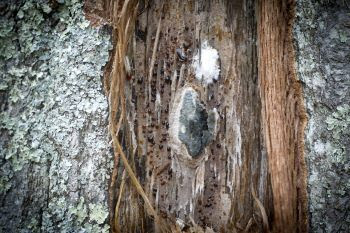
Once a tree is infected, the fungus may fruit, creating distinct, gray to black fungal pads under the tree’s bark. Fungal spores can be picked up by sap-feeding nitidulid beetles attracted by the pads’ yeasty odor. Sap beetles spread oak wilt when they visit pruned or damaged oaks to feed on their exposed sap.

Oak wilt often is first identified when green leaves turn yellow or brown on the edges and begin to drop during the summer.
Infected oaks can spread the disease to other oaks through underground root connections or grafts, creating an expanding circle of dead trees.

Avoid the high-risk period

A gray and black oak wilt fungal pad found underneath the bark of an infected oak tree.Research demonstrates April 15 through July 15 is the high-risk period for oak wilt infection in Michigan because nitidulid beetles are very active and lots of fresh oak wilt spore mats are available. During this time, pruning or damaging oak trees should be avoided to prevent infections.


Winter is the ideal time to prune trees because nitidulid beetles and other pests that cause harmful tree diseases are less active in cold temperatures.

Landscaping and construction projects that can damage oaks also should be avoided during the high-risk period. When possible, choosing to postpone land clearing or use of heavy equipment around oak trees until the winter helps avoid a potential low risk of infection that can persist into late summer.

Can other trees get oak wilt?

White oaks, those with rounded leaves, are susceptible to oak wilt but may survive for several years or succumb more slowly before dying.

Researchers from Michigan State University detected the oak wilt fungus in an orchard of dying colossal chestnut trees in 2022, suggesting that some chestnut trees, part of the same family as oaks (Fagaceae), also can be infected.

Where is oak wilt in Michigan?

The DNR maintains an interactive online map for viewing verified, reported and treated locations of oak wilt across the state. The tool also can be used to report suspected oak wilt infections.

What can be done?

  • If oak trees need pruning, trimming or removal, plan these activities for winter months when possible.
  • If construction or removal of other trees may damage nearby oaks, perform these activities outside of the high-risk period, April 15 to July 15.
  • If oaks are damaged during the high-risk period, immediately cover wounds with tree wound paint or a latex-based paint.
  • Don’t move firewood, especially if it comes from oak wilt-killed trees, as it can harbor and spread the fungus.

To learn more about oak wilt, visit Michigan.gov/ForestHealth or MichiganOakWilt.org.

Michigan’s Invasive Species Program is cooperatively implemented by the Michigan departments of Agriculture and Rural Development; Environment, Great Lakes, and Energy; and Natural Resources.


Note to editors: Accompanying photos are available below for download. Caption information follows.

  • Oak wilt fungus: A gray and black oak wilt fungal pad found under the bark of an infected oak tree.
  • Oak wilt leaves: Oak leaves that turn yellow or brown on the edges during the summer may be a sign of oak wilt infection. Photo courtesy of D. W. French, University of Minnesota, Bugwood.org.


DNR Logo 24 bit PNGDept of Environment, Great Lakes and Energy logoMDARD Logo
Operation Safe Neighborhoods Reaches New Milestone

Operation Safe Neighborhoods Reaches New Milestone

Governor Whitmer Header

FOR IMMEDIATE RELEASE

November 7, 2025

Contact: press@michigan.gov


Gov. Whitmer, Col. Grady, Dir. Washington Announce Operation Safe Neighborhoods Reaches New Milestone with 900+ Illegal Guns Off the Street


LANSING, Mich. — Today, Governor Gretchen Whitmer, Colonel James Grady, and Director Heidi Washington announced over 900 illegal guns have been taken off the streets as part of Operation Safe Neighborhoods. Since the operation began, law enforcement officials have conducted 9,405 check-ins with felony offenders, leading to over 900 illegal guns taken off the street. During sweeps, officers have also recovered illegal drugs and ammunition.


“Every Michigander deserves to feel safe in their community,” said Governor Whitmer. “That’s why I’m proud Operation Safe Neighborhoods has taken over 900 illegal guns off the street. Thanks to the partnership between state and local police, we’re making real progress to protect our communities and stop violence before it happens. Together, we’re building a safer Michigan for everyone. I’ll keep working to get the job done.”


“Removing hundreds of illegal guns from our streets will save lives and give more families peace of mind as they go about their daily schedules,” said Lt. Governor Garlin Gilchrist II. “Thanks to more than $1.6 billion in public safety funding across 7 bipartisan budgets and Operation Safe Neighborhoods, we are making a difference so more Michigan families can achieve health, wealth, and prosperity in Michigan. Let’s continue to build safer, more resilient communities where every Michigander can thrive.”


Operation Safe Neighborhoods is a statewide crackdown on crime aimed at reducing gun violence by getting illegal guns off the street and guns out of the hands of people who cannot legally possess them due to prior criminal history.


“Initiatives like Operation Safe Neighborhoods make a real, tangible difference in the communities we serve,” said Col. James F. Grady II, director of the Michigan State Police. “Removing firearms from people who are not allowed to legally possess them ensures they can’t be used to inflict violence against our neighbors and loved ones. In Michigan, we’re taking a comprehensive approach to safety through a variety of programs. Through our Youth Violence Prevention Summits, we are empowering young people to be leaders in their schools and choose the right path. We’re also making sure all Michiganders know they can ‘Stop a Plot’ by paying attention to the warning signs of violence and reporting them to law enforcement. And remember, if you lawfully possess a firearm, it is your responsibility to store it safely and use a gun lock, which we offer free at our MSP posts statewide.”


“Michigan Department of Corrections agents are committed to keeping our neighborhoods safe and ensuring those on probation and parole follow the conditions of their supervision,” said Heidi E. Washington, director of the Michigan Department of Corrections. “We have agents in every county in Michigan, and this initiative allows us to collaborate closely with local law enforcement to stop crime before it happens. We will continue to work every day to make sure that these illegally possessed firearms are off Michigan streets.”


Nearly one in three reported violent crimes in Michigan involve a firearm. This initiative builds on Governor Whitmer’s MI Safe Communities program that she launched in 2021 to invest in local police, get illegal guns off the street, and fund expanded opportunities in jobs, education, and the justice system.


About Operation Safe Neighborhoods 

Michigan Department of Corrections (MDOC) parole and probation agents team up with local law enforcement across the state and conduct enhanced compliance checks on probationers and parolees who are legally prohibited from possessing a firearm.


There are roughly 32,000 probationers and 8,600 parolees in the state, many of whom have been convicted previously of a gun crime. These individuals are supervised by more than 1,000 MDOC parole and probation agents. The plan the department devised and implemented is aimed at focusing on high-risk individuals who have weapons possession in their criminal history that could be used to commit further crime.


Governor Whitmer’s Record Breaking Public Safety Investments  

Since taking office, Governor Whitmer has worked closely with local leaders, law enforcement officers, and community organizations to ensure people feel safe in their neighborhoods. The governor has signed seven balanced, bipartisan budgets, each making record investments to help communities fund local law enforcement departments and hire more first responders.


Since taking office, Governor Whitmer has invested over $1.7 billion into public safety. This year’s budget includes $60 million for Public Safety Revenue Sharing grants to provide cities, villages, and townships with additional resources for police services and to support community violence intervention efforts and $15 million for community violence intervention grants to reduce gun violence and save lives.


The new budget also makes specific investments in Michigan State Police. She delivered funding to help hire and train new troopers and continue Secure Cities Partnership. She also secured $59 million to pay for raises, helping with retainment and recruitment.


In April 2023, Governor Whitmer signed commonsense gun violence prevention bills that established universal background checks for all firearm purchases and safe storage requirements. In May 2023, Governor Whitmer signed bills establishing extreme risk protection orders in Michigan, ensuring police officers, health care professionals, and family members concerned about someone who may harm themselves or others can seek a court order to temporarily confiscate their firearms. In November 2023, Governor Whitmer signed bills disallowing convicted domestic abusers from owning firearms. In June 2024, Governor Whitmer signed ED 2024-4 to establish the Michigan Gun Violence Prevention Task Force to further work in gun violence reduction.


Governor Whitmer proposed the commonsense gun violence prevention legislation during her 2023 State of the State address and has worked with the Michigan Legislature, community groups, law enforcement, students and parents following the shooting at Michigan State University in February 2023 and the shooting at Oxford High School in November 2021 to get these commonsense measures that will reduce gun violence signed into law.

Whitmer Makes Appointments to Boards and Commissions 

Whitmer Makes Appointments to Boards and Commissions 

Governor Whitmer Header

FOR IMMEDIATE RELEASE

November 6, 2025

Contact: press@michigan.gov


Governor Whitmer Makes Appointments to Boards and Commissions


LANSING, Mich. — Today, Governor Gretchen Whitmer announced appointments to the following boards and commissions: State Plumbing Board; Judicial Tenure Commission; Michigan Arts and Culture Council; Michigan Community Service Commission; Advisory Board for the Michigan Intelligence Operations Center for Homeland Security; Child Lead Exposure Elimination Commission; Horse Racing Advisory Commission; Michigan Law Enforcement Memorial Monument Fund Commission; Michigan Interagency Coordinating Council for Infants and Toddlers with Developmental Disabilities; Public Health Advisory Council; Michigan Board of Marriage and Family Therapy; Michigan Board of Barber Examiners; Barrier Free Design Board; State Boundary Commission; State Fire Safety Board; and the Governor’s Task Force on Child Abuse and Neglect.


State Plumbing Board

Tim Hicks, of Marshall, is a licensed master plumber and the training coordinator at Plumbers and Pipefitters Local 333. Tim Hicks is appointed to represent licensed plumbing contractors who hold a master’s license for a term commencing November 6, 2025, and expiring July 30, 2026. Hicks succeeds Scott Kalchik, whose term has expired.


The State Plumbing Board’s duties include making recommendations for plumbing code rules, licensing plumbers, and making all orders, rules, and regulations necessary for the enforcement of the provisions of the Skilled Trades Regulation Act.


This appointment is subject to the advice and consent of the Senate.


Judicial Tenure Commission

Siham Awada Jaafar, of Dearborn Heights, is the president and chief executive officer of 3D Consulting & Communications. Jaafar holds a Bachelor of Arts in public relations and communications from Wayne State University. Siham Jaafar will be reappointed as a member of the general public for a term commencing January 1, 2026, and expiring December 31, 2028.


The Judicial Tenure Commission serves to promote the integrity of the judicial process and preserve public confidence in the courts. The Commission strives to hold state judges, magistrates, and referees accountable for their misconduct without jeopardizing or compromising the essential independence of the judiciary. The basis for Commission action is a violation of the Code of Judicial Conduct or Rules of Professional Conduct, which are published with the Michigan Rules of Court.


This appointment is not subject to the advice and consent of the Senate.


Michigan Arts and Culture Council

Timothy Kuehnlein, of Alpena, is the first vice president of the Thunder Bay Arts Council and an instructor in the departments of political science and history at Alpena Community College. Kuhnlein holds a Bachelor of Arts in political science and history from Hillsdale College and a Master of Arts in political science and history from Western Michigan University. Timothy Kuehnlein is appointed for a term commencing November 6, 2025, and expiring September 1, 2028. Kuehnlein succeeds Cezanne Charles, whose term has expired.


The Michigan Arts and Culture Council serves to encourage, develop, and facilitate an enriched environment of creative and cultural activity in Michigan. The Council envisions a Michigan where every citizen celebrates the state’s cultural treasures and arts, and ensures cultural experiences are accessible to all its citizens.


This appointment is not subject to the advice and consent of the Senate.


Michigan Community Service Commission

Dr. Grace Lubwama, of Kalamazoo, is the president and chief executive officer of the Kalamazoo Community Foundation. Dr. Lubwama was previously the chief executive officer of the YWCA Kalamazoo. Dr. Lubwama holds a Bachelor of Arts in industrial art and design from Makerere University, a Master of Public Health from Boston University, and a PhD in policy, planning, and development from the University of Southern California. Dr. Grace Lubwama is appointed to represent Democrats and experts in the delivery of human, educational, environmental, or public safety services to communities and persons, for a term commencing November 6, 2025, and expiring October 1, 2028. Dr. Lubwama succeeds Kathleen Cain-Babbit, whose term has expired.


Marianne Grima, of Brighton, is a national programs lead at Deloitte and is the former Detroit social impact lead. Grima is also the founder and co-owner of Cowork Brighton. Grima holds a Bachelor of Science in criminal justice and Master of Science in intelligence analysis from the University of Detroit Mercy. Marianne Grima is appointed to represent Democrats and business for a term commencing November 6, 2025, and expiring October 1, 2028. Grima succeeds David Parent, whose term has expired.


The Michigan Community Service Commission strives to build a culture of service by providing vision and resources to strengthen communities through volunteerism. The Commission develops a three-year comprehensive national and community service plan for the state that shall be updated annually, oversees and submits the state’s applications to AmeriCorps and other public and private funding sources, establishes policies and procedures for the use of federal funds, and develops initiatives to promote community service in coordination with existing programs.


These appointments are not subject to the advice and consent of the Senate.


Advisory Board for the Michigan Intelligence Operations Center for Homeland Security

Merissa Kovach, of Ferndale, is the political director of the ACLU of Michigan. Kovach holds a Bachelor of Arts in political theory and constitutional democracy from Michigan State University. Merissa Kovach is appointed to represent a statewide non-profit organization advocating for civil liberties and privacy protections for a term commencing November 6, 2025, and expiring April 11, 2029.  Kovach succeeds Kimberly Buddin, whose term has expired.


The Advisory Board for the Michigan Intelligence Operations Center for Homeland Security collects, evaluates, collates, and analyzes information and intelligence and then, as appropriate, disseminates this information and intelligence to the proper public safety agencies so that any threat of terrorism or criminal activity will be successfully identified and addressed.


This appointment is not subject to the advice and consent of the Senate.


Child Lead Exposure Elimination Commission

Dr. Jennifer McDonald, of Ann Arbor, is a pediatrician at Trinity Health IHA Medical Group. Dr. McDonald holds a Bachelor of Arts in psychology from the University of Chicago, a Master of Public Health in epidemiology from the University of Michigan School of Public Health, and a Doctor of Medicine from the University of Michigan Medical School. Dr. Jennifer McDonald is appointed as a physician for a term commencing November 6, 2025, and expiring December 14, 2027. Dr. McDonald succeeds Allison Dickson, who has resigned.


Maggie Kabore, of Milan, is a nurse coordinator at the Washtenaw County Health Department. Kabore holds an associate degree in nursing from Washtenaw Community College and a Bachelor of Science in nursing from Eastern Michigan University. Maggie Kabore is appointed as a member of a local health department for a term commencing November 6, 2025, and expiring December 14, 2025. Kabore succeeds Jane Nickert, whose has resigned.


The Child Lead Exposure Elimination Commission focuses on implementing the recommendations of the former Child Lead Poisoning Elimination Board and monitoring the state’s efforts to eliminate lead exposure in children. The Commission acts in an advisory capacity to the Governor and DHHS director to coordinate and collaborate with all levels of government and stakeholders regarding programs and policies related to the elimination of child lead exposure.


These appointments are not subject to the advice and consent of the Senate.


Horse Racing Advisory Commission

Jeff Haarer, of Lansing, is the commodity section manager at the Michigan Department of Agriculture and Rural Development. Haarer holds a Bachelor of Arts in personnel administration from Michigan State University and a Juris Doctor from the Thomas Cooley Law School. Jeff Haarer is appointed as the designee of the Director of the Michigan Department of Agriculture and Rural Development for a term commencing November 6, 2025, and expiring October 31, 2028. Haarer succeeds Sylvia Renteria, whose term has expired.


The Horse Racing Advisory Commission was created within the Department of Agriculture and Rural Development to establish procedures governing the operation and promotion of horse racing in this state and make recommendations to the Legislature that would improve the regulatory structure of horse racing with a goal of maintaining its long-term viability in Michigan.


This appointment is not subject to the advice and consent of the Senate.


Michigan Law Enforcement Memorial Monument Fund Commission

Demetirus Davenport, of Detroit, is the chief chaplain for the Detroit Police Department and has served as a chaplain in the department for nine years. Demetirus Davenport is appointed as a police chaplain with 5 or more years’ experience for a term commencing November 6, 2025, and expiring June 30, 2028. Davenport succeeds Ronald Griffin, whose term has expired.


The Michigan Law Enforcement Officers Memorial Monument Fund Commission, created by Public Act 177 of 2004, was established to oversee the financing, design, and construction of Michigan’s Law Enforcement Officers Memorial.


This appointment is not subject to the advice and consent of the Senate.


Michigan Interagency Coordinating Council for Infants and Toddlers with Developmental Disabilities

Nerita Adams-Spillers, of Flint, is the Early Head Start Program manager at the Beecher Community School District. Adams-Spillers holds a Bachelor of Science in public health education from Central Michigan University and a Master of Education in early childhood education from Oakland University. Nerita Adams-Spillers is reappointed to represent Head Start programs for a term commencing November 6, 2025, and expiring October 31, 2029.


Vicki Thomas, of Sault Ste. Marie, is the director of Early Childhood Program at the CLM CAA Head Start. Vicki is also an adjunct instructor and course developer at Bay Mills Community College and formerly served as a teacher, disabilities coordinator, and program manager at CLM CAA Head Start. Thomas holds a Bachelor of Science in human ecology from Michigan State University and a Master of Education in curriculum and instruction in early childhood development from Concordia University – Portland. Vicki Thomas is reappointed to represent public or private providers of early intervention services for a term commencing November 6, 2025, and expiring October 31, 2029.


Amanda Rinna, of Sault Ste. Marie, is an education specialist for the Inter-Tribal Council of Michigan. Rinna was previously an early head start teacher for the Sault Tribe of Chippewa Indians. Rinna holds a bachelor’s degree in early childhood education from Lake Superior State University. Amanda Rinna is appointed for a term commencing November 6, 2025, and expiring October 31, 2029. Rinna succeeds Susan Morningstar, whose term has expired.


The Michigan Interagency Coordinating Council (MICC) is authorized and required by Part C of the Individuals with Disabilities Education Act (IDEA), as amended by Public Law 105-17. The MICC is charged with advising and assisting in the development and implementation of a statewide, comprehensive, coordinated, multidisciplinary, interagency system that provides early intervention services for infants and toddlers with disabilities and their families.


These appointments are not subject to the advice and consent of the Senate.


Public Health Advisory Council

Dr. Farah Jalloul, of Lansing, is the chief pharmacy officer at the Michigan Pharmacists Association. Dr. Jalloul is also a licensed pharmacist and registered nurse. Dr. Jalloul holds a Bachelor of Science in biochemistry from the University of Michigan, and both a Master of Business Administration and Doctor of Pharmacy from Ferris State University. Dr. Farah Jalloul is reappointed as a licensed pharmacist for a term commencing November 6, 2025, and expiring November 1, 2029.


Marianne Udow-Phillips, of Ann Arbor, is the senior advisor of the Center for Health and Research Transformation at the University of Michigan and is on the faculty at the University of Michigan School of Public Health. Udow-Phillips is also the principal consultant at Mu Consulting. Udow-Phillips previously served as the director of Michigan’s Department of Human Services under Governor Jennifer Granholm. Udow-Phillips holds a Bachelor of Arts in psychology and English from Hamilton/Kirkland Colleges, and a Master of Health Services Administration in public health from the University of Michigan. Marianne Udow-Phillips is reappointed as a member at-large for a term commencing November 6, 2025, and expiring November 1, 2029.


Sara Simmonds, of Grand Rapids, is an environmental health director at the Kent County Health Department. Simmonds was previously a long-term substitute teacher at Lakeville Community School District and a United States Peace Corps volunteer. Simmonds holds a Bachelor of Science in environmental studies and applications from Michigan State University and a Master of Public Administration from Grand Valley State University. Sara Simmonds is reappointed as an environmental health expert for a term commencing November 6, 2025, and expiring November 1, 2029.


The Public Health Advisory Council was created within the Michigan Department of Health and Human Services at the recommendation of the Public Health Advisory Commission. The Council will develop an action plan for implementing the recommendations of the Commission and is tasked with providing advice about emerging issues in public health, monitoring the effectiveness of Michigan’s public health response system, and reviewing multiagency efforts to support collaboration and a unified approach on public health responses.


These appointments are not subject to the advice and consent of the Senate.


Michigan Board of Marriage and Family Therapy

Dr. Erica Mitchell, of Brighton, is an assistant professor and clinic director of the Couple and Family Therapy Clinic at Michigan State University. Dr. Mitchell is also a licensed marriage and family therapist and an AAMFT approved supervisor. Dr. Mitchell holds a Bachelor of Arts in psychology and a PhD in human development and family studies from Michigan State University, and a Master of Science in clinical psychology from Eastern Michigan University.  Dr. Erica Mitchell is appointed as a marriage and family therapist for a term commencing November 6, 2025, and expiring June 30, 2028.  Dr. Mitchell succeeds Kendal Holtrop, whose term has expired.


Illami Romero Martinez-King, of Holt, is a marriage and family therapist and owner of Holistic Vida Therapy, LLC. Romero Martinez-King holds a Bachelor of Arts in family community service from Michigan State University and a Master of Science in marriage and family therapy from Northwestern University. Illami Romero Martinez-King is reappointed as a licensed marriage and family therapist for a term commencing November 6, 2025, and expiring June 30, 2029.


The Michigan Board of Marriage and Family Therapy was created to license and regulate the practice of marriage and family therapy in Michigan, which is the provision of guidance, testing, discussions, therapy, instruction, or advice that is intended to avoid, eliminate, relieve, manage, or resolve marital or family conflict or discord, to create, improve, or restore marital or family harmony, or to prepare couples for marriage. Underlying all duties is the responsibility of the Board to promote and protect the public’s health, safety, and welfare.


These appointments are subject to the advice and consent of the Senate.


Michigan Board of Barber Examiners

Pete Lopez, of Livonia, is the program supervisor for training and IT for Detroit Public Schools Community District. Lopez holds a Bachelor of Science in criminal justice and computer science from the University of Detroit Mercy and Master of Science in instructional design and technology from Wayne State University. Pete Lopez is reappointed as a member of the general public for a term commencing November 6, 2025, and expiring September 30, 2028.


Bill Ceasar, of Lansing, is a retiree from Lansing Community College. Caesar holds a Bachelor of Arts in history from Western Michigan University. Bill Ceasar is appointed as a member of the general public for a term commencing November 6, 2025, and expiring September 30, 2029. Ceasar succeeds Lorin Cumberbatch, whose term has expired.


The Michigan Board of Barber Examiners was created to regulate the services of barbers, barber students, barber colleges, barber instructors, student instructors, and barbershops in Michigan. The statute defines a barber as a person who shaves or trims the beard of a person; cuts, trims, shampoos, relaxes, curls, permanently waves, dresses, tints, bleaches, colors, arranges, or styles the hair of a person; massages the face and head of a person; or renders personal services of a similar nature customarily done by a barber.


These appointments are subject to the advice and consent of the Senate.


Barrier Free Design Board

Sean Haskin, of Williamston, is the owner of Capital Maintenance Solutions, LLC. Haskin holds a Bachelor of Arts in criminal justice from Michigan State University.