
by orionontv | Nov 21, 2025 | Feature Writers, High School Sports
Written Thursday November 20th at 10:30 PM

Can the Black Hawks do it???
Can they win the OAA’s first State Championship in volleyball since Lake Orion in 2018???
Bloomfield Hills will have a chance to do that on Saturday when they play Farmington Hills Mercy in the Division One State Finals on Thursday evening at the Kelloggs Center in Battle Creek.
The Black Hawks behind the play of star Kayla Nwabueze pulled off a five set thriller against Rockford winning 25-19, 22-25, 21-25, 25-22, 15-13 earning a trip to Saturday’s final. The Marlins knocked off Byron Center in a reverse sweep to get to this match and is coached by one of the best in the game in Loretta Vogel.
Bloomfield Hills has had an incredible season winning the Red along with winning over Birmingham Marian in the district final. They had to get by Groves and Oxford before getting to this game. A lot of credit has to be given to Nwabueze and also Coach Brian Kim who has done a great job with the Black Hawks.
This should be a very interesting matchup, set by set, can the Black Hawks do it???
by orionontv | Nov 21, 2025 | Feature Writers, High School Sports
Written Wednesday November 19th at 1:43 PM
The Berkley Bears will have a new football coach next season
According to Inside the OAA, Bears Coach Casey Humes has stepped down coaching the program.
Humes went 6-12 in his two years with Berkley which included two wins over Royal Oak along with a win over Avondale. He went 4-5 this past season but didn’t make the postseason.
Humes before taking the varsity coaching job was the junior varsity coach and worked his way up to become the varsity coach in 2023 and has turned the program around.
It will be very interesting to see what happens with the Bears next season and who takes over the program.
Stay tuned to OAA Now for the latest on this developing story.
Here is the tweet from Inside the OAA
https://x.com/InsideTheOAA/status/1991213458369454417

by orionontv | Nov 20, 2025 | Agriculture
| For immediate release: November 20, 2025
Media contacts: Lynsey Mukomel, 517-290-1734
MDARD Awards More than $1.3 Million Toward Forestry Assistance
Funding helps conservation districts maintain foresters
Lansing, Mich. — The Michigan Department of Agriculture and Rural Development (MDARD) today announced over $1.3 million in funding for 18 conservation districts as part of the Forestry Assistance Program.
“Michigan’s world-class forests are an economic driver for rural communities, serving as the setting for unforgettable adventures and the source of high-quality timber,” said MDARD Director Tim Boring. “These Forestry Assistance Program grants will support active and sustainable management of our forests so that they can be enjoyed by future generations of Michiganders.”
Today’s Forestry Assistance Program grants support sustainable forestry projects in the following 18 conservation districts across Michigan:
- Barry Conservation District – $81,000
- Clare Conservation District – $72,000
- Mecosta Conservation District – $75,000
- Alcona Conservation District – $81,000
- Alpena-Montmorency Conservation District – $81,000
- Kalkaska Conservation District – $72,000
- Leelanau Conservation District – $72,000
- Manistee Conservation District – $81,000
- Oscoda Conservation District – $72,000
- Presque Isle Conservation District – $78,000
- Chippewa-Luce-Mackinac Conservation District – $72,000
- Delta Conservation District – $72,000
- Dickinson Conservation District – $75,000
- Gogebic Conservation District – $72,000
- Houghton-Keweenaw Conservation District – $72,000
- Iron-Baraga Conservation District – $72,000
- Marquette Conservation District – $81,000
- Oceana Conservation District – $81,000
The Forestry Assistance Program provides outreach and technical assistance by working with conservation district foresters to help private landowners make decisions about how to care for their land. Conservation district foresters help educate private forest owners about active forest management and connect landowners with private sector professionals for management plan development, timber valuation and sustainable harvests.
In addition to helping private landowners reach their goals, conservation districts help Michigan landowners enroll in MDARD’s Qualified Forest Program (QFP). QFP helps protect the health of Michigan’s forests by offering a property tax exemption from certain school operating mills for landowners who follow a professionally prepared forest management plan and who conduct sustainable timber harvests.
The Forestry Assistance Program grant is funded through State General Funds and the Private Forestland Enhancement Fund – revenue that is derived from landowner participation in QFP.
|

by orionontv | Nov 20, 2025 | Transportation
MDOT commits $11 million to local agencies
for vulnerable road user safety improvements
LANSING, Mich. – The Michigan Department of Transportation (MDOT) has announced the commitment of $11 million in federal funds for nine Transportation Alternatives Program (TAP) grants. At this stage, MDOT is issuing Conditional Commitments reserving federal transportation funds designated by Congress for state-approved projects.
TAP is a competitive grant program that funds specific transportation projects, like separated pathways, pedestrian crossings, sidewalks, bike lanes and other facilities, that improve vulnerable road user safety. These enhancements provide safe alternative transportation options embodying the “mobility for everyone” concept.
“The TAP, including its Safe Routes to School (SRTS) category, truly delivers on MDOT’s strategic vision seeking original and innovative projects and investing in mobility options that improve Michiganders’ quality of life,” State Transportation Director Bradley C. Wieferich said. “TAP receives modest funding to address large-scale public health and safety concerns, enhance local and regional economic development and provide citizens with alternative mobility options.”
The following nine approved projects received Conditional Commitments:
| County |
Applicant Name |
Project Name |
Project Work |
Total Grant Request |
| Ionia |
Ionia County Road Department, MDOT Grand Rapids Transportation Service Center (TSC) |
Tuttle Road/M-66 Connector |
Shared-use pathway |
$349,802 |
| Muskegon |
City of Montague |
SRTS: Montague Area Public Schools |
Pedestrian crossings, crosswalk lighting |
$1,200,000 |
| Oceana |
Village of Shelby |
SRTS: Shelby Public Schools |
Sidewalk construction |
$1,073,804 |
| Oakland |
City of Rochester Hills, MDOT Oakland TSC |
M-150 Active Transportation Connectivity |
Sidewalk and bridge design and construction |
$1,436,765 |
| Iosco |
City of Tawas, East Tawas, MDOT Alpena TSC |
US-23 Tawas Bay Iron Belle Trail |
Shared-use pathway and pedestrian lighting |
$4,386,880 |
| Oscoda |
Oscoda County Road Commission |
SRTS: Mio-AuSable Schools |
Sidewalk construction |
$954,000 |
| Delta |
City of Escanaba, MDOT Superior Region |
US-2/US-41/M-35 Corridor Project, Section 1 (2027) |
Active transportation and safety improvements |
$151,416 |
| Delta |
City of Escanaba, MDOT Superior Region |
US-2/US-41/M-35 Corridor Project, Section 2 (2028) |
Active transportation and safety improvements |
$952,811 |
| Dickinson |
Dickinson County Road Commission |
Pine Mountain Road/ Westwood Avenue nonmotorized project |
Paved shoulders for bike lanes construction |
$872,680 |
Recognized by the Federal Highway Administration as a best practice, MDOT’s management of TAP and its projects meet stringent federal and MDOT design standards, requiring extensive teamwork. MDOT partners with a variety of agencies to include county road commissions, cities, villages, etc. to facilitate grant application and project implementation. MDOT reserves the funds being committed today subject to applicants meeting certain requirements for implementation. Awards are given when all the conditions have been met.
“Receiving this grant is a tremendous win for our community and we’re absolutely thrilled,” said Tawas City Mayor Jackie Masich. “Rebuilding and widening the existing bike path will meet the requirements of the Iron Belle Trail and will better help connect neighbors, promote healthier living and create a safer, more accessible way for everyone to enjoy the outdoors.”
“The TAP grant is a truly exciting development for the City of East Tawas,” said East Tawas Mayor Bruce Bolen. “Replacing the existing deteriorated pathway will result in a wider, smoother, safer walking/biking pathway that will enable residents and visitors to better enjoy outdoor activities, while appreciating the scenic beauty of Tawas Bay.”
“With Tawas being awarded a grant to extend the bike path as a part of the Iron Belle Trail, I am excited to see how that transforms our community,” said Brian M. Pritchett, Tawas City resident, cyclist and advocate. “The stretch along US-23 provides some of the most scenic views in the state. This pathway is something that will enhance our community experience and support tourism for generations to come. I am excited to see the Tawas area be a part of the statewide initiative to develop a pathway from Belle Isle to Ironwood!”
Visit the TAP website to learn more about the three application cycles each year for Statewide TAP, the schedule, online application and instructions. Please contact Michael Smith, TAP manager, at 517-335-1069 or SmithM13@Michigan.gov, or refer to MDOT’s region contact map for further information.
### Give plows space, it’s not a race.
by orionontv | Nov 20, 2025 | Uncategorized
|
|
 |
News Release
|
|
Nov. 20, 2025
Contact Cheryl Nelson, 231-287-1714, or Joanne Foreman, 517-284-5814
Invasive pest now confirmed in 11 Michigan counties
The Michigan departments of Natural Resources and Agriculture and Rural Development encourage those who have eastern hemlock trees on their property to take time this winter to inspect the trees for signs of hemlock woolly adelgid – tiny, soft-bodied insects that consume the trees’ stored nutrients, slowly sucking the life from the trees.
 Anyone taking to the woods also can help by looking for signs of this invasive insect while hunting, hiking or enjoying other outdoor activities. Anyone taking to the woods also can help by looking for signs of this invasive insect while hunting, hiking or enjoying other outdoor activities.
Winter is the best time to look for evidence of an infestation, according to Robert Miller, MDARD’s invasive species prevention and response specialist.
“Cooler temperatures trigger feeding activity,” Miller said. “As the hemlock woolly adelgid feeds, it secretes a white, waxy material that creates ovisacs. The presence of these small, round, white masses makes it possible to identify infested trees.”
These insects are considered invasive because they are not native to the state and can cause significant harm to Michigan’s estimated 170 million hemlock trees.
Infestations of hemlock woolly adelgid have been confirmed in Allegan, Antrim, Benzie, Leelanau, Manistee, Mason, Muskegon, Oceana, Ottawa, Van Buren and Washtenaw counties. |
Winter surveys underway
 Throughout the winter, survey crews from the DNR and multiple cooperative invasive species management areas, or CISMAs, will look for signs of hemlock woolly adelgids. Crews will focus their efforts along the northern edge of the infestation, conducting surveys within a 5-mile border along the Lake Michigan shoreline. Throughout the winter, survey crews from the DNR and multiple cooperative invasive species management areas, or CISMAs, will look for signs of hemlock woolly adelgids. Crews will focus their efforts along the northern edge of the infestation, conducting surveys within a 5-mile border along the Lake Michigan shoreline.
Because hemlock trees can be protected from these insects with proper insecticide treatments, infested trees and any other hemlocks within the area will be mapped and tagged, then prioritized for summer treatment.
If designated survey areas include private lands, CISMAs first will seek landowner permission. CISMA survey efforts are supported by funds from the Michigan Invasive Species Grant Program and the U.S. Forest Service and are provided at no cost to these landowners. |
Your help is needed
Though dozens of staff will assist in the surveys, they won’t be able to check every hemlock. If you have hemlocks on your property, whether it’s within or beyond the 5-mile shoreline border, take some time to look for signs of hemlock woolly adelgid.
Anyone spending time outdoors is encouraged to do the same. Remember to take precautions and wear hunter orange during hunting seasons.
In Michigan’s northern forests, hemlock trees are found in moist soils along streams and riverbanks and along coastal dunes. Hemlock also is popular as a landscape tree in parks and residential areas.
Identify hemlock trees
 Since these adelgids feed and form ovisacs only on eastern hemlock trees in Michigan, it is important to distinguish hemlocks from other conifers like pines or spruces. Look for: Since these adelgids feed and form ovisacs only on eastern hemlock trees in Michigan, it is important to distinguish hemlocks from other conifers like pines or spruces. Look for:
- Cone- or egg-shaped trees up to 75 feet tall.
- Drooping or feathery branches.
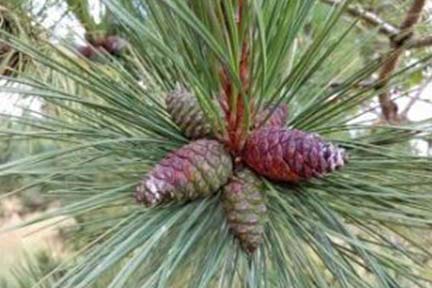
- Flat needles growing individually from the sides of twigs.
- Needles that are dark green on top with two parallel, white stripes underneath.
- Papery cones about three-quarters of an inch long that hang downward from branches.
|
Look for signs
Late fall through early spring is the best time to check hemlock trees. Look on the undersides of branches for evidence of round, white ovisacs near the base of the needles.
Up close, ovisacs look like tiny cotton balls and may appear alone or in clusters. The short video “Hemlock woolly adelgid: invasive species in Michigan” provides helpful identification tips.
Report your findings
Report infested hemlock trees by using the Midwest Invasive Species Information Network, available online at MISIN.MSU.edu or as a downloadable smartphone app. The MISIN smartphone app will take a GPS location point if a report is made at the site; it also will allow you to upload photos with a report.
Reports also can be made by email to MDA-Info@Michigan.gov or by phone to MDARD’s Customer Service Center at 800-292-3939.
Identify the location of infested trees and, whenever possible, take one or two pictures of infested branches to help confirm identification. To avoid spreading the insect, do not collect sample branches or twigs.
Manage your trees
 If you find hemlock woolly adelgid on your property, it is important to know that certain insecticides are effective in treating the infestation if used correctly. You can plan now for spring or summer treatment. If you find hemlock woolly adelgid on your property, it is important to know that certain insecticides are effective in treating the infestation if used correctly. You can plan now for spring or summer treatment.
Without treatment, infested trees will die within four to 10 years. A qualified arborist, such as one certified by the International Society of Arboriculture, can diagnose and assist with treating infested trees.
If you are able to handle treatment on your own, follow the guidance provided in the Michigan State University Extension bulletin “How to treat hemlock trees for hemlock woolly adelgid.”
Reporting infested trees, even if you will be managing them on your own, is important to help determine how far hemlock woolly adelgid has spread. This information also indicates where additional surveys may be needed. |
Find more information
For more information on identification, reporting or treatment, visit the Michigan Invasive Species Program’s hemlock woolly adelgid page at Michigan.gov/HWA.
Michigan’s Invasive Species Program is cooperatively implemented by the Department of Environment, Great Lakes, and Energy; the Department of Natural Resources; and the Department of Agriculture and Rural Development.
Note to editors: Accompanying photos are available below for download. Caption information follows.
- Infested branch: Round, white hemlock woolly adelgid ovisacs are found on the undersides of branches near the base of the needles.
- Tagging tree: A cooperative invasive species management area staff member tags an infested hemlock tree in a forest. Photo courtesy of West Michigan CISMA.
- Hemlock branch: Hemlock trees have small, papery cones and short needles that are dark green on top.
- Tree injection: A certified pesticide applicator prepares to inject an infested hemlock tree with pesticide. Photo courtesy of West Michigan CISMA.
|
   |
|