MPSC alerts utility customers about utility scams

FOR IMMEDIATE RELEASE   October 21, 2020

Media Contact: Matt Helms 517-284-8300
Customer Assistance: 800-292-9555
Michigan.gov/MPSC
Twitter

As the COVID-19 pandemic continues, the Michigan Public Service Commission wants utility customers to be on alert about scammers trying to con people out of money by threatening to cut off their service.

The MPSC’s Customer Assistance Division staff have heard from an increasing number of utility customers about scams in recent weeks. Frequently, callers threaten shutoffs if the customer doesn’t act immediately to pay a fraudulent balance. Callers demand payment by gift card, prepaid debit card, Bitcoin, credit card or other form of payment. In some instances, callers make it appear on caller ID that the call is coming from a utility, a deliberate falsification referred to as caller ID spoofing.

Utility customers should know that utility companies will not contact customers by phone with bullying tactics such as demanding immediate payment to keep services from being shut off in a matter of hours. That kind of a behavior is a red flag that the caller is trying to scam you.

Utility companies also do not:

  • Endorse or require a prepaid debit card, gift card, Bitcoin or other cryptocurrency for payments;
  • Collect payment at customers’ homes or businesses; or
  • Ask for Social Security numbers, bank account or credit card information by phone.

In addition, utility companies do not use coercive tactics to try to get into your home. They require employees or contractors to always wear a company identification badge that the employees will be glad to show if asked.

The MPSC urges customers to be mindful about providing their account numbers or personal information such as name, address, date of birth or Social Security number. If you suspect that a call may be fraudulent, you should hang up and call your utility right away at the phone number on your most recent bill and ask to speak with a customer service representative.

Utility customers who have mistakenly provided bank account information to someone they suspect might have been an impostor should call their bank and local police department. They also may file a complaint with the Attorney General’s Consumer Protection Division at www.michigan.gov/ag and the Federal Trade Commission at 877-382-4357.

For information about the MPSC, visit www.Michigan.gov/MPSC, sign up for one of its listservs, or follow the Commission on Twitter.

MDHHS COVID-19 guidance for holidays

MDHHS banner with logo no names

Press Release


FOR IMMEDIATE RELEASE: Oct. 21, 2020

CONTACT: Lynn Sutfin, 517-241-2112, SutfinL1@michigan.gov

MDHHS provides COVID-19 guidance for holiday travel and gatherings

­­­­­LANSING, Mich. – The holiday season will be different for Michiganders this year due to the COVID-19 pandemic. To ensure families do not miss out on being together during the holidays, the Michigan Department of Health and Human Services (MDHHS) has issued guidance on how to travel and gather safely during the holidays.

“Celebrating the holiday season with family and friends is one of our most cherished traditions,” said Dr. Joneigh Khaldun, chief medical executive and chief deputy for health. “Even though the way we celebrate may have to be different, the guidance issued today shows there are still many ways to spend quality time with family and friends safely during this festive season.”

Traveling and in-person gatherings increase the chances of getting and spreading COVID-19. Staying home is the best way to protect yourself and others. However, if you decide to travel for the holidays, follow these safety measures to protect yourself and others from COVID-19:

  • Wear a mask and keep your nose and mouth covered when in public places.
  • Avoid close contact by staying at least 6 feet apart from anyone who is not from your household.
  • Wash your hands often with soap and water for at least 20 seconds or use hand sanitizer (with at least 60% alcohol).
  • Avoid contact with anyone who is sick.
  • Avoid touching your eyes, nose and mouth.

In addition to the MDHHS guidance, the Centers for Disease Control and Prevention has the following resources to help determine if you should travel during the holidays:

Individuals who should avoid attending or hosting in-person holiday celebrations with people who do not live in their household, include those who:

  • Have been diagnosed with COVID-19 and have not met the criteria for when it is safe to be around others.
  • Have symptoms of COVID-19 or are waiting for COVID-19 viral test results.
  • May have been exposed to someone with COVID-19 in the last 14 days.
  • Are at increased risk for severe illness from COVID-19, or live or work with someone at increased risk of severe illness.

The new guidance also urges Michiganders to consider hosting virtual festivities instead of in-person holiday gatherings if there is a risk of community spread based on the risk identified in the MI Safe Start map. If an in-person gathering is hosted, it should be held outdoors if possible. Indoor festivities should avoid crowded, poorly ventilated or fully enclosed indoor spaces, and should be limited to 10 people or less per MDHHS Oct. 9 Emergency Epidemic Order. In addition, attendees of indoor or outdoor festivities should:

  • Social distance.
  • Wear cloth masks.
  • Wash hands frequently with soap and water for at least 20 seconds.
  • Keep safe around food drinks, including following good hygiene and limiting the amount of people in areas where food is prepared.
  • Bring food and drinks for themselves and members of their household. Avoid potluck gatherings.
  • Have one person serve all shareable food and consider using single-use items for condiments, plates and utensils.

Read the full “Celebrating the Holidays During COVID-19” guidance for additional tips to consider before, during and after a gathering to stay safe this holiday season.

Information around this outbreak is changing rapidly. The latest information is available at Michigan.gov/Coronavirus and CDC.gov/Coronavirus.

Whitmer Provides Update on COVID-19

Whitmer Provides Update on COVID-19

Governor Gretchen Whitmer Banner - headshot with bridge graphic

FOR IMMEDIATE RELEASE

October 21, 2020

Media Contact: Press@Michigan.gov


PHOTOS AND VIDEO: Governor Whitmer Provides Update on COVID-19 in Michigan


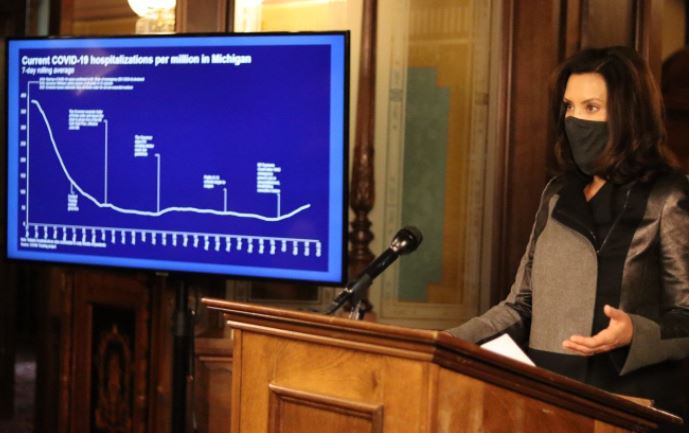
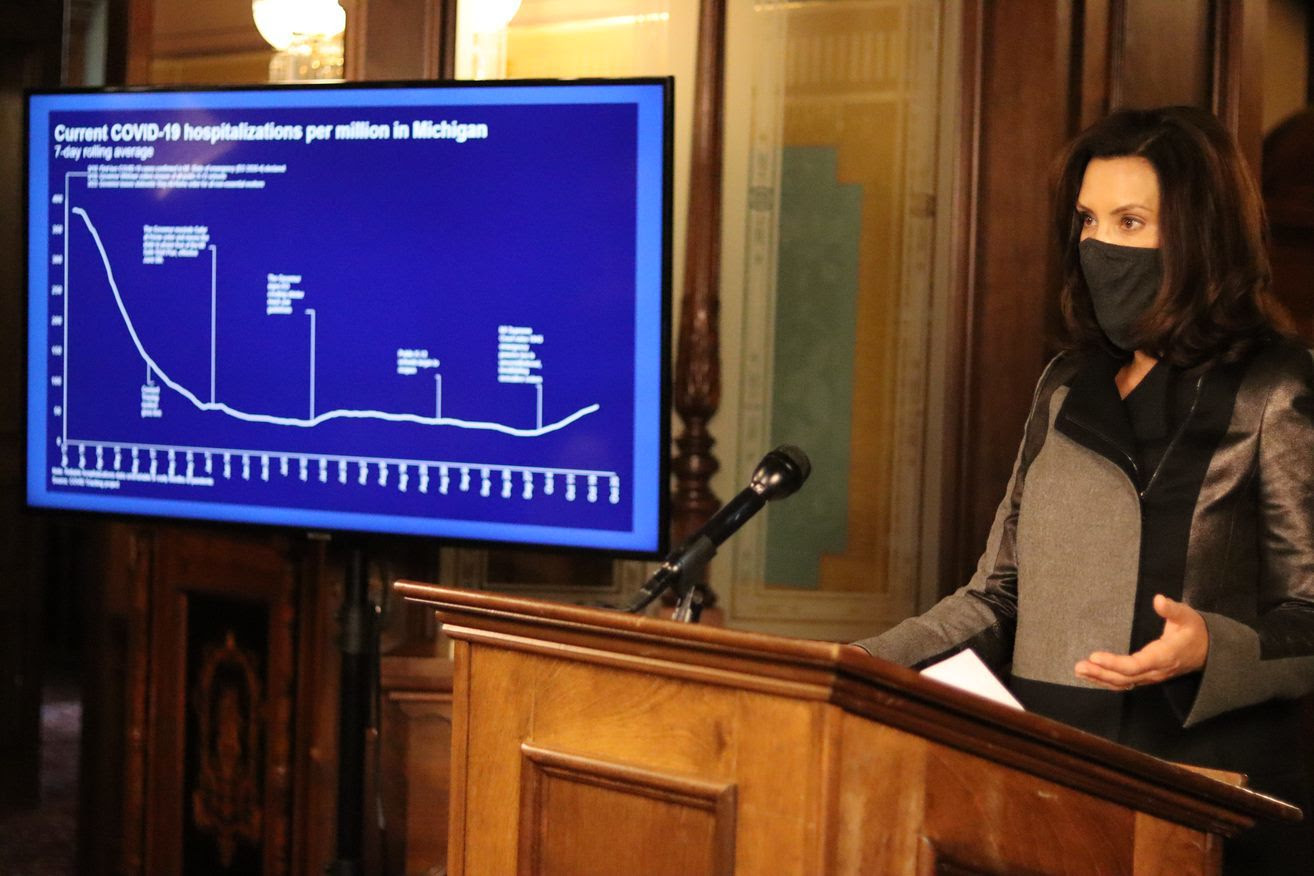
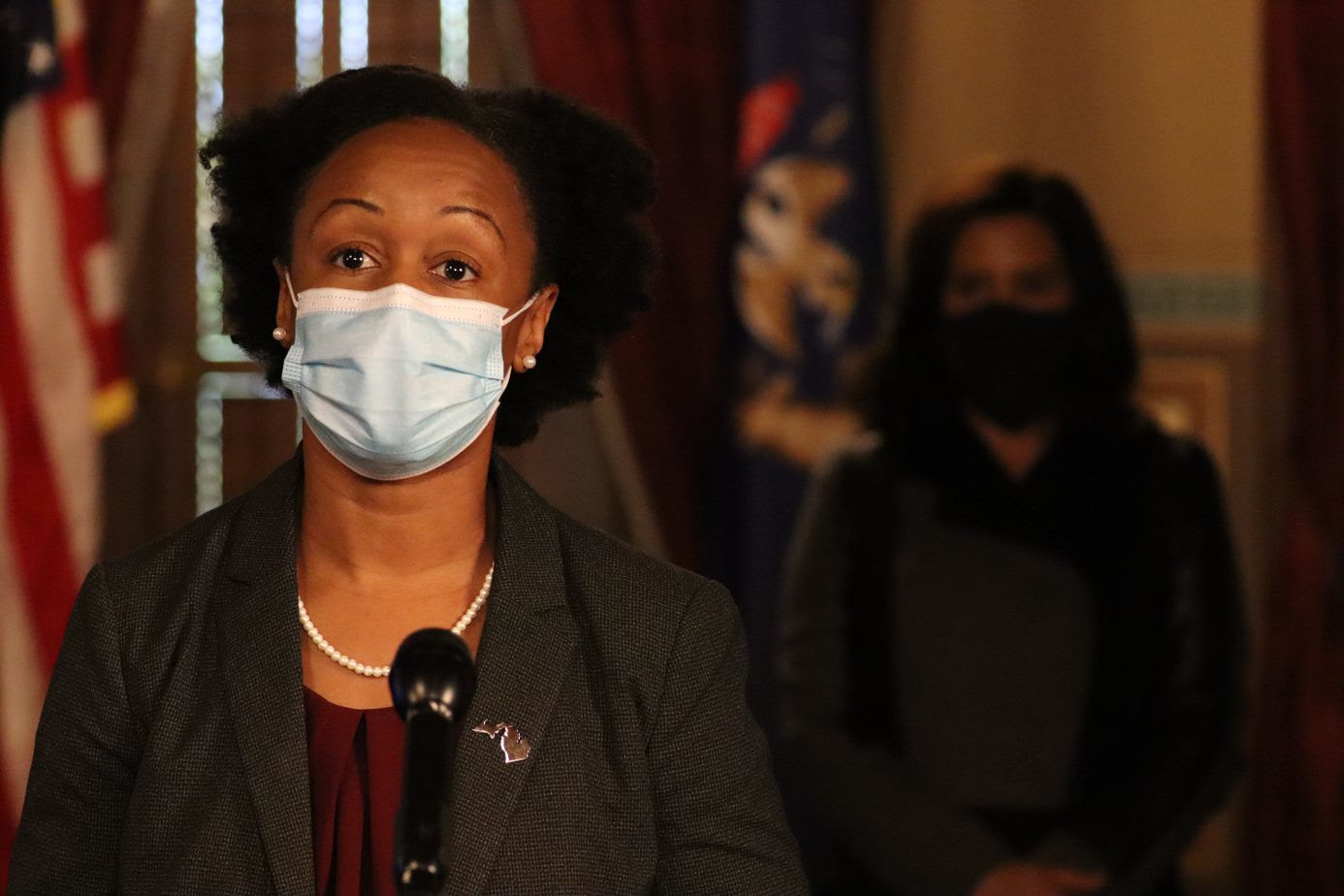
LANSING, Mich. — Today, Governor Gretchen Whitmer and MDHHS Chief Deputy for Health and Chief Medical Executive Dr. Joneigh Khaldun provided an update on COVID-19 in Michigan.


To view the graphs the governor used in her PowerPoint presentation, click the link below:

See below for photos from the governor’s press conference:


G

2

J


residential care facilities allow for indoor visitation

residential care facilities allow for indoor visitation

FOR IMMEDIATE RELEASE
October 21, 2020
Contact: Lynn Sutfin, 517-241-2112

LANSING, MICH. Michigan Department of Health and Human Services (MDHHS) Director Robert Gordon today issued an Emergency Order under MCL 333.2253 that updates and further expands requirements for residential care facilities, while also permitting indoor visitation in residential care facilities in certain circumstances. Throughout the pandemic, MDHHS has used a range of public health tools and guidance to contain the spread of COVID-19 and protect the public health, including emergency orders.

“As we grapple with both colder weather and rising cases, our task is to increase access to visitation in ways that do not increase the spread of the virus,” Gordon said. “Visitation is a substantial source of risk.  This order provides a plan for visitation that mitigates risk and continues necessary protections in facilities across the state.”

The residential care order continues to limit communal dining and internal and external group activities consistent with Center for Medicare and Medicaid Services guidance and it requires quick notification in the event an employee or resident is confirmed as positive for COVID-19.

Under the order, visitation rules are linked to the risk level of the county. A list of county risk levels is available on the MI Safe Start Map.

Indoor visitation is now allowed in areas where the current risk level is A, B, C, or D, so long as the facilities have had no new cases, including those involving residents or staff, originating within the prior 14 days. Indoor visitation is not allowed when the county is at risk level E, which means there is an elevated incidence growth rate with average daily cases/million greater than 150 or a positivity rate greater than 20%. It is also not allowed if the local health department has made a determination that it would be unsafe. Outdoor visitation is allowed throughout the state so long as the facility assures that the outdoor visitation area allows for at least six feet between all persons and adequate protection from weather elements is provided.

Based on county risk levels and the type of visit, some visitors will be required to receive COVID testing prior to entry. Most nursing homes now are able to conduct point-of-care testing with a rapid turnaround.

Visitors will be required to wear facemasks (or other PPE when required by the facility) at all times. In general, visitors will need to maintain six feet from residents. However, visitors who are providing support for Activities of Daily Living (ADLs), medical services or non-medical services requiring physical contact are not expected to abide by social distance requirements between the visitor and the resident while providing services. Visitors participating in visits at the end of life may have physical contact with a resident if that resident is not COVID-19 positive, the visitors are wearing appropriate PPE and the time spent within six feet of the resident is no longer than 15 minutes.

“This is a delicate balance of trying to prevent the further spread of the virus while still allowing for family members and friends to visit their loved ones in residential care facilities,” said Dr. Joneigh Khaldun, chief medical executive and chief deputy for health at MDHHS. “I remain concerned about the increase in case levels across the state, so it will be vitally important that the order be followed closely in order to keep the facilities safe and prevent the spread of the virus.”

Visits will be allowed by appointment only and facilities may impose reasonable time limits on visits, with requirements that visitors log arrival and departure times, provide their contact information and attest, in writing, that they will notify the facility if they develop symptoms consistent with COVID-19 within 14 days after visiting. The number of visitors per scheduled visit will be limited to two persons or fewer and will exclude visitors who are unwilling or unable to wear a face covering. A health evaluation of all visitors will be required to enter the facility, including tests for fever, and facilities must restrict anyone with fever, symptoms or known exposure from entering the facility.

Consistent with MCL 333.2261, violation of this order is punishable by a civil fine of up to $1,000, and may also be treated as a misdemeanor punishable by imprisonment for not more than six months, or a fine of not more than $200, or both. This order is effective Oct. 26, 2020 and remains in effect until lifted. Persons with suggestions and concerns are invited to submit their comments via email to COVID19@michigan.gov.

Information around this outbreak is changing rapidly. The latest information is available at Michigan.gov/Coronavirus and CDC.gov/Coronavirus.


UIA offers new phone appointment option

October 21, 2020

Contact: Lynda Robinson, 313-348-8220

The Unemployment Insurance Agency (UIA) is now offering telephone appointments for customers with specific claim issues beginning today, Oct. 21.

“We’re excited to offer this additional option for customer service,” said UIA Director Steve Gray. “This new scheduling system is another tool to help us ensure continued service to Michigan’s residents who are facing unemployment during the COVID-19 pandemic.”

By scheduling a phone appointment, customers will be able to get assistance with issues at their convenience. A customer service agent will call the customers on the designated day and time they choose from the agency’s customer service line – 866-500-0017. Claimants should be prepared to verify their identity with their Social Security Number and Driver’s License/State Identification Number.

Customers can schedule an appointment online up to one week in advance at Michigan.gov/uia for the following issues:

  • I filed under the wrong Social Security Number
  • My claim is inactive
  • I am unable to certify for all weeks needed
  • I need to file a claim, but one is already filed in my name
  • I do not have the link in MiWAM to file a claim

Phone appointments are available Monday through Friday from 8:15 a.m. – 4:25 p.m. Each appointment is expected to take no more than 20 minutes. While the COVID-19 pandemic has forced local UIA offices to remain closed, this new service expands the agency’s customer service options. UIA expects to schedule up to 800 appointments per day utilizing a dedicated group of customer service agents.

Since March 15, nearly $25 billion in benefits have been paid to 2.2 million Michigan workers.