
$2 Million In Oakland Together Grants Split Among 78 Non-Profits

$2 Million In Oakland Together Grants Split Among 78 Non-Profits

More Than $2 Million In Oakland Together Cultural Institution COVID-19 Support Grants Split Among 78 Non-Profits

Pontiac, Michigan – Seventy-eight Oakland County arts, cultural and environmental stewardship organizations were awarded grants of up to $50,000 from the $2.06 million Oakland Together Cultural Institution COVID-19 Support Grant pool.

The grants, made possible through federal CARES Act funding, will help the organizations preserve jobs while continuing to offer services and programming to Oakland County residents. The grants can be used for salaries, rent or mortgage, purchasing personal protective equipment or utility payments, among other things.

“I’m pleased we were able to assist so many of these arts, cultural and environmental stewardship organizations and help them when their normal sources of income have been interrupted or eliminated altogether,” Oakland County Executive David Coulter said. “We value our partnerships with these organizations which provide cultural understanding and diversity, conservation and stewardship while enhancing the quality of life for Oakland County and Southeast Michigan.”

The grants ranged from several thousand dollars to a maximum $50,000 and were awarded to non-profit organizations located throughout the county. Recipients included:

  • Chaldean Cultural Center, West Bloomfield
  • Clarkston Family Discovery Farm, Clarkston
  • Creative Art Center, Pontiac
  • Commerce Township Area Historical Society, Walled Lake
  • Cranbrook Institute of Science
  • Holly Historical Society, Holly
  • Meadow Brook Hall, Rochester
  • Oakland County 4-H Fair Association, Davisburg
  • Friends of Royal Oak Township, Royal Oak Township
  • Polly Ann Trail Management Council, Leonard
  • Stagecrafters, Royal Oak
  • Village Fine Arts Association (VFAA), Milford

The recipients were grateful the county had made grants available to non-profit organizations.

“I just felt compelled to express our deepest gratitude to Oakland County and all the great people working there to help the cultural community through these times,” Executive Director Susan Gollon said. “The VFAA has been very fortunate to be able to weather this COVID storm by innovating constantly to answer the needs of our community. This grant award will help us continue and enhance the momentum we have moving forward.”

Clarkston Family Discovery Farm officials said they were beyond grateful for the grant.

“This will make all the difference in our ability to continue to fulfill our mission of educating kids of all ages and abilities about the value of nature and sustainability,” Chelsea Anne O’Brien wrote.

Arlene Somerville of the Commerce Township Historical Society was more to the point.

“Thank you,” she wrote. “You just made me cry!”

A list of the recipients is found at https://www.oakgov.com/covid/grants/Pages/cultural-institution-support.aspx. Oakland County Commissioners Marsha Gershenson, Shelley Goodman Taub, Helaine Zak and Michael Spisz performed oversite of the grants for the Board of Commissioners.

To be eligible, an organization had to be a non-profit with tax-exempt status that is physically located in Oakland County and provides most of its services to county residents.

Oakland County allocated all $219 million it received in federal Coronavirus Aid, Relief, and Economic Security (CARES) Act funding, including more than $140 million in grants to help stabilize and support small businesses, residents and communities in every part of the county since the beginning of the pandemic. Grants were awarded to more than 10,000 local businesses, which employ 65,000 employees; 22 local chambers of commerce; 28 local school districts; residents having trouble making rent or mortgage payments, retailers, restaurants and communities.


AG Reminds Consumers to Donate Wisely

AG Reminds Consumers to Donate Wisely

Attorney General Dana Nessel

Media Contacts:

Ryan Jarvi
(c) 517-599-2746

FOR IMMEDIATE RELEASE:
Tuesday, Dec. 1, 2020

Attorney General Nessel Reminds Consumers to Donate Wisely in Festive Video

LANSING – The holiday season can spark feelings of generosity and the desire to donate to charities, but the giving season can also open the door to bad actors and scammers trying to take advantage of unsuspecting philanthropists. 

Michigan Attorney General Dana Nessel is reminding residents of some important tips to keep in mind when making a donation this holiday season, and recorded another amusing and informational video message as part of her office’s 20 Days of Scams consumer protection series.

“Every donation makes an impact, and I am proud to hold public office in a state with such a strong philanthropic foundation,” Nessel said. “But as Michigan’s Attorney General, I am committed to ensuring those donated dollars are going to the people and organizations they are intended for. If you are thinking about making a charitable donation this holiday season, there are some simple steps you can take to make sure your gift is being put to good use.”

To avoid falling victim to a potential scam, consider these important questions to ask before making a donation to a charitable organization:

  • What is the name, address, and phone number of your organization?
  • Is your organization registered to solicit donations by the Michigan Department of Attorney General? What is your registration number?
  • How much of my donation will actually be used for the charity’s purpose?
  • What’s going to happen to my donation?
  • Is my donation tax-deductible?
  • Can I use the internet to donate?

The Michigan Nonprofit Association, in coordination with the Council of Michigan Foundations and the United Way have also provided a valuable resource in their Giving Wisely brochure, a joint publication which helps Michigan residents make smart choices when donating during the holiday season, while also reminding residents of the importance of giving their time by volunteering.

Attorney General Nessel has been actively working to protect Michiganders from falling victim to phony charities, including issuing consumer alerts related to Charities and Donations, and even taking legal action to dissolve fraudulent organizations posing as charitable nonprofits.

For more information and things to watch for before donating to a charity, visit the Attorney General’s Charitable Trust website or call the AG’s Charitable Trust Section at 517-335-7571.

Flags Lowered to Honor Former State Sen. Tom Casperson 

1

FOR IMMEDIATE RELEASE 

December 1, 2020

Contact: Press@michigan.gov   


Gov. Whitmer Lowers Flags to Honor Former State Sen. Tom Casperson


LANSING, Mich. – Governor Gretchen Whitmer has ordered U.S. and Michigan flags within the State Capitol Complex to be lowered to half-staff on Wednesday, December 2, 2020, to honor the life and service of former state Senator Tom Casperson.


“Tom Casperson was an unwavering public servant, who made sure Yoopers always felt like their voices were being heard in our state Capitol at every point during the legislative process,” said Governor Whitmer. “While our politics varied, Tom proved that it was still possible to find common ground and work together to do right by the people of Michigan.


“As Senate Democratic Leader, I was proud to work across the aisle with state Senator Casperson to expand health care coverage through the Healthy Michigan plan, which now ensures coverage for more than 800,000 Michiganders across our state. Despite his diagnosis, Tom remained committed to doing the people’s work as he battled this vicious disease. My thoughts are with Tom’s family during this difficult time.”


Tom Casperson was first elected to the Michigan Legislature in 2002, where he served residents of the western Upper Peninsula in the state House of Representatives and then the state Senate until he was term limited in 2018.


While in the legislature, state Senator Tom Casperson cast a crucial vote to expand the state’s Medicaid program under the Affordable Care Act to ensure health care for hundreds of thousands of Michiganders.


Former state Senator Tom Casperson passed away on Sunday, November 29 after battling lung cancer.


The State of Michigan recognizes the duty, honor and selfless service of former state Senator Tom Casperson by lowering flags to half-staff. Michigan residents, businesses, schools, local governments and other organizations are encouraged to display the flag at half-staff.


To lower flags to half-staff, flags should be hoisted first to the peak for an instant and then lowered to the half-staff position. The process is reversed before the flag is lowered for the day.


Flags should be returned to full-staff on Thursday, December 3, 2020.

Time to check trees for hemlock woolly adelgid

Time to check trees for hemlock woolly adelgid


Program contact: Rob Miller, 517-614-0454
Media contact: Joanne Foreman, 517-284-5814

Time to check trees for hemlock woolly adelgid

Invasive pest already confirmed in five southwest Michigan counties

The recent discovery of hemlock woolly adelgid as far north as Ludington State Park in Mason County is a reminder of the importance of checking hemlock trees for signs of the invasive insect.

The Michigan departments of Natural Resources and Agriculture and Rural Development encourage those who have eastern hemlock trees on their property to take time this winter to inspect the trees for signs of hemlock woolly adelgid. Anyone taking to the woods can help by looking for signs of the insect while hunting, hiking or enjoying any outdoor activities.

Winter is the optimum time to look for evidence of an infestation, according to Robert Miller, MDARD’s invasive species prevention and response specialist.

“Cooler temperatures trigger feeding activity,” Miller said. “As hemlock woolly adelgids feed, they secrete a white, waxy material that creates ovisacs. The presence of these small, round, white masses makes it possible to identify infested trees.”

As they feed, these tiny, soft-bodied insects consume a hemlock’s stored nutrients, slowly sucking the life from the tree.

These insects are considered invasive because they are not native to the state and can cause significant harm to Michigan’s hemlock resource, estimated at 170 million trees.

Infestations of hemlock woolly adelgid have been confirmed in Allegan, Ottawa, Muskegon, Oceana and Mason counties, all bordering Lake Michigan.

Winter surveys underway

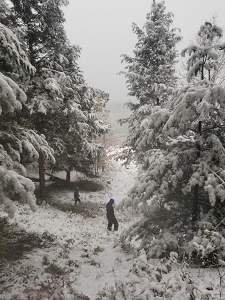
Workers survey for hemlock woolly adelgid in a snowy forestThroughout the winter, survey crews from several Cooperative Invasive Species Management Areas will take to the woods looking for signs of hemlock woolly adelgid. Surveys will be conducted within a 5-mile border along the Lake Michigan shoreline in both the Lower and Upper peninsulas.
At the same time, DNR staff will survey state parks and federal lands in the vicinity of Lake Michigan.

Because hemlock trees can be protected from these insects with proper insecticide treatments, infested trees and any other eastern hemlocks within the area will be mapped and tagged, then prioritized for summer treatment.

CISMAs will seek landowner permission to conduct surveys of hemlocks on private lands within the shoreline border. CISMA survey efforts are supported by funds from the Michigan Invasive Species Grant Program and the U.S. Forest Service and are provided at no cost to landowners.

Your help is needed

Though dozens of crew members will assist in the surveys, they won’t be able to check all trees. If you have eastern hemlocks on your property, whether it’s within or beyond the 5-mile shoreline border, take some time to look for signs of hemlock woolly adelgid. Anyone spending time outdoors is encouraged to do the same.

In Michigan’s northern forests, hemlock trees are found in moist soils along streams and riverbanks and along coastal dunes. Hemlock also is popular as a landscape tree in parks and residential areas.

Identify hemlock trees

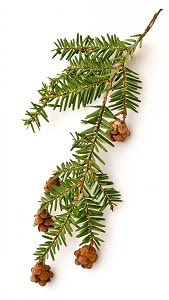
Hemlock twig with conesSince adelgids feed and form ovisacs only on eastern hemlock trees in Michigan, it is important to distinguish hemlocks from other conifers like pines or spruces. Look for:
  • Cone- or egg-shaped trees up to 75 feet tall.
  • Drooping or feathery branches.
  • Flat needles growing individually from the sides of twigs.
  • Needles that are dark green on top with two parallel, white stripes underneath.
  • Papery cones about three-quarters of an inch long that hang downward from branches.

Look for signs

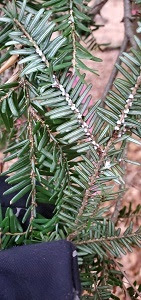
Late fall through early spring is the best time to check hemlock trees. Look on the undersides of branches for evidence of round, white ovisacs near the base of the needles.

Up close, ovisacs look like balls of spun cotton and may appear alone or in clusters. The short video “Hemlock woolly adelgid: invasive species in Michigan” provides helpful identification tips.

Report your findings

A hemlock branch with adelgidsReport infested hemlock trees by using the Midwest Invasive Species Information Network, available online at MISIN.MSU.edu or as a downloadable smartphone app. The MISIN smartphone app will take a GPS location point if a report is made at the site; it also will allow you to upload photos with a report.

Reports also can be made by email to MDA-Info@Michigan.gov or by phone to the MDARD Customer Service Center at 800-292-3939.

Identify the location of infested trees and, whenever possible, take one or two pictures of infested branches to help confirm identification. To avoid spreading the insect, do not collect sample branches or twigs.

Manage your trees

If you find hemlock woolly adelgids on your property, it is important to know that certain insecticides are successful in treating the infestation if used correctly. Without treatment, infested trees can die within four to 10 years. A qualified arborist, such as one certified by the International Society of Arboriculture, can diagnose and assist with treating infested trees.

If you are able to handle treatment on your own, follow the guidance provided in the MSU Extension Bulletin: “How to treat hemlock trees for hemlock woolly adelgid.

Reporting infested trees, even if you will be managing them on your own, is important to help determine how far hemlock woolly adelgid has spread. This information also indicates where additional surveys may be needed.

Find more information

On Jan. 22, 2021, “Hemlock Rescue” is featured in the NotMISpecies webinar series. This free program will take a look at the labor-intensive effort to inventory and treat trees infested with hemlock woolly adelgid. A question and answer period will follow the presentation. Register for the webinar at Michigan.gov/EGLEEvents.

For more information on identification, reporting or treatment, visit the Michigan Invasive Species Program’s hemlock woolly adelgid page at Michigan.gov/HWA.


Michigan’s Invasive Species Program is cooperatively implemented by the Department of Environment, Great Lakes, and Energy, the Department of Natural Resources, and the Department of Agriculture and Rural Development.

/Note to editors: Accompanying photos are available below for download. Suggested captions and photo credit information follow:

Snow: A CISMA survey crew checks for hemlock woolly adelgid in a snowy forest. Photo courtesy of West Michigan CISMA.

Hemlock twig: Hemlock trees have small, papery cones and short needles that are dark green on top.

Infested branch: Round, white hemlock woolly adelgid ovisacs are found on the undersides of branches near the base of the needles.

EGLE logoDNR Logo 24 bit PNGMDARD Logo


Whitmer Recognizes World AIDS Day in Michigan

Whitmer Recognizes World AIDS Day in Michigan

1

FOR IMMEDIATE RELEASE

December 1, 2020

Contact: Press@Michigan.gov


Governor Whitmer Recognizes World AIDS Day in Michigan


LANSING, Mich. — Governor Gretchen Whitmer recognized the millions of individuals whose lives have been impacted or taken by HIV/AIDS by proclaiming today as AIDS Day in Michigan.


“Today Michigan joins together with people across the globe to show solidarity for the millions of people living with HIV and to raise awareness for the fight against this devastating virus,” said Governor Whitmer. “This year we have been reminded of the impact a virus can have on our families and friends, and of the disproportionate impact it can have on marginalized communities. As we recognize today as AIDS Day, we must continue to push to make improvements to both our health care systems and inequities that exist in this country.”


The recognition coincides with World AIDS Day which aims to unite the world in the fight against HIV, show support for those living with HIV, as well as commemorate those who have died AIDS or an AIDS-related illness.


According to the World Health Organization, approximately 690,000 people died from AIDS-related illnesses worldwide in 2019. Additionally, approximately 1.2 million individuals in the United States are living with HIV today, and there are a number of health disparities related to HIV infection with a disproportionate risk of infection for gay and bisexual men, Black and Latinx individuals, people who inject drugs, transgender people, and younger age groups.


The governor signed an Executive Directive in July that instructs the Department of Licensing and Regulatory Affairs (LARA) to begin developing rules that will require implicit bias training as part of the knowledge and skills necessary for licensure, registration and renewal of licenses and registrations of health professionals in Michigan.


To view the full proclamation, click the link below: