Small Business Administration Relief for Businesses Impacted by Cold Weather 

Governor Gretchen Whitmer Banner - headshot with bridge graphic

FOR IMMEDIATE RELEASE

December 4, 2020

Media Contact: Press@Michigan.gov


Gov. Whitmer Announces U.S. Small Business Administration Relief for Eligible Businesses Impacted by Cold Weather

LANSING, Mich. — Today, Governor Gretchen Whitmer announced that the U.S. Small Business Administration (SBA) is making Economic Injury Disaster Loans of up to $2 million available to eligible small businesses, agricultural cooperatives, and nonprofits impacted by frost and freeze that occurred in May of this year. SBA extended the loans following the Secretarial Disaster Declaration obtained by Governor Whitmer from U.S. Department of Agriculture (USDA) Secretary Sonny Perdue in September.


These loans are available in Antrim, Benzie, Charlevoix, Crawford, Grand Traverse, Leelanau, Kalkaska, Manistee, Missaukee, Otsego and Wexford counties.


“This is good news for our small businesses and farmers who have routinely faced extreme weather conditions in our state,” said Governor Whitmer. “I’m glad the federal government has recognized the need for this support, and I am eager to continue working with them to further assist Michigan businesses.”


Last June, Governor Whitmer requested a USDA Secretarial Disaster Designation to provide relief to Michigan fruit growers and farmers who incurred damage and losses to their crops caused by a hard freeze in the spring. USDA ultimately designated more than 10 Michigan counties as primary disaster areas beginning in September 2020. When the Secretary of Agriculture issues a disaster declaration to help farmers recover from damages and losses to crops, SBA issues a declaration to eligible entities, affected by the same disaster.


Applicants may apply online, receive additional disaster assistance information and download applications at https://disasterloan.sba.gov. Applicants should apply under SBA declaration #16760. Applicants may also call SBA’s Customer Service Center at (800) 659-2955 or email disastercustomerservice@sba.gov for more information.


Applications are due to SBA no later than July 26, 2021.

Flags lowered for Pearl Harbor Remembrance Day 

Flags lowered for Pearl Harbor Remembrance Day 

1

FOR IMMEDIATE RELEASE

December 6, 2020

Contact: Press@michigan.gov


Governor Whitmer Lowers Flags for Pearl Harbor Remembrance Day


LANSING, MICH. — Governor Gretchen Whitmer has ordered U.S. and Michigan flags throughout the state to be lowered to half-staff on Monday, December 7, 2020 to honor the 79th anniversary of the attack on Pearl Harbor.


“As President Franklin Delano Roosevelt said, December 7 truly is ‘a day that will live in infamy,’” said Governor Whitmer. “We remember the courage and bravery of the men and women at Pearl Harbor, and honor the thousands of Americans who lost their lives during this tragic attack on our nation. I hope this day serves as a reminder of unity in the face of tragedy. I encourage each of us to draw upon these ideals as we work together to eliminate COVID-19 from Michigan.”


The State of Michigan extends its sincere gratitude to the men and women who served in the United States Armed Forces during World War II. Their selflessness and courage continue to inspire us to make sacrifices for our fellow Americans.


The State of Michigan observes Pearl Harbor Remembrance Day by lowering flags to half-staff. Michigan residents, businesses, schools, local governments and other organizations are encouraged to display the flag at half-staff.


To lower flags to half-staff, flags should be hoisted first to the peak for an instant and then lowered to the half-staff position. The process is reversed before the flag is lowered for the day.


Flags should be returned to full-staff on Tuesday, December 8, 2020.

Whitmer Secures      Extension of Michigan National Guard

Whitmer Secures  Extension of Michigan National Guard

Governor Gretchen Whitmer Banner - headshot with bridge graphic

FOR IMMEDIATE RELEASE

December 3, 2020

Media Contact: Press@Michigan.gov


Governor Whitmer Secures Extension of Michigan National Guard Through March 31 to Assist With COVID-19


LANSING, Mich. — Today, Governor Gretchen Whitmer issued the following statement after securing the extension of Michigan National Guard forces for COVID-19 response through March 31, 2021. Title 32 authority, which allows Guard members to receive federal pay and benefits, was previously set to expire on December 31, 2020, due to a deadline set by the Trump Administration.


“The Michigan National Guard continues to be a crucial part of our fight against the COVID-19 pandemic. I want to thank our men and women in uniform for their dedication and round-the-clock work to protect the people of our state by expanding testing in our communities and ensuring they have what they need to get through this crisis. I implore the president once again to listen to public health experts and work with Mitch McConnell and Nancy Pelosi on a bipartisan recovery package that protects American families, frontline workers, and small business owners,” said Governor Whitmer. “COVID-19 cases and hospitalizations are skyrocketing in Michigan and across the country, and if we’re going to get through this winter, we need the federal government to step up and provide this crucial support.”


In anticipation of rapid vaccine approvals from the Food and Drug Administration, Michigan will look to the Michigan National Guard to provide logistical support and transportation support to help distribute the vaccines.


Since the COVID-19 pandemic began, Michigan National Guard members have helped distribute more than 14 million pounds of food at food banks, delivered tests and protective equipment across the state, and assisted with testing more than 200 thousand Michiganders for COVID-19. The Guard is partnering with the Michigan Department of Health and Human Services and local health departments to offer COVID-19 testing, provide antigen training for health care practitioners, and to provide informational assistance in call centers.

Firefighters return to Michigan

– Showcasing the DNR –

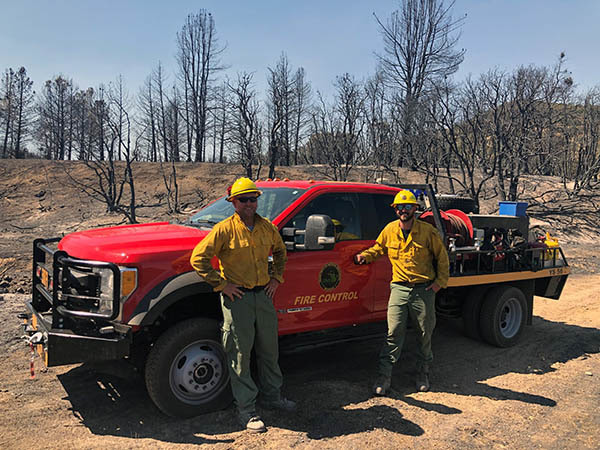
Two Michigan DNR firefighters are shown standing in front of their truck out west.

Firefighters return to Michigan after assisting with historic western wildfire season

By KATHLEEN LAVEY
Michigan Department of Natural Resources

Paul Dunn has been fighting wildfires in Michigan for 15 years, the last two of them as a full-time firefighter for the Michigan Department of Natural Resources.

Late this summer, he got his first chance to go west, driving a DNR Type 6 off-road engine with colleague Ben Osterland, arriving at the Lake Fire near Santa Clarita, California on Aug. 24. The fire burned more than 31,000 acres of big-cone Douglas fir, oak and gray pine between Aug. 12 and Sept. 28.

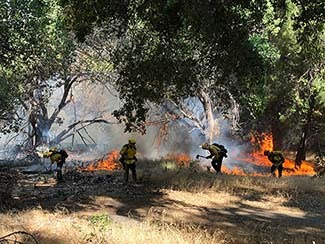
Once on site, the duo from Michigan was assigned to mop-up duties in areas where the fire had already passed through. They made many trips up and down the mountain to look for hot spots, pulled hose out of the area and restored the landscape, as much as possible, to its native state.

They were up at 5 a.m., working in remote country in 90-degree heat, wearing 25-40 pounds of gear while working at their jobs.

For Dunn, the experience offered a chance to take in the breathtaking beauty of the west, as well as an opportunity to build firefighting skills he can use back home in Michigan.
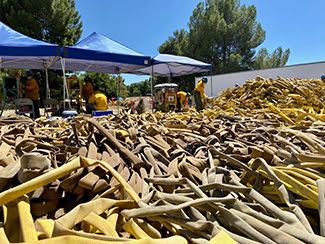
More than 70,000 feet of fire hose is shown piled for rerolling from the Lake Fire in California.“Before I was full-time, I did this for fun on my days off from my other jobs in Michigan,” Dunn said. “Coming out to California is like a big bonus. You get to see the country. You meet a lot of good people from all over.”

Dunn and Osterland are among DNR staffers who filled 90 out-of-state assignments during the 2020 wildfire season, even though COVID-19 kept them from traveling until the middle of August.

This year, DNR individuals and teams have taken seven fire engines west, worked on direct fire lines and served various leadership positions on fire management teams in California, Colorado, Oregon, Arizona, Utah and Wyoming.

Their help was essential.

Spurred by hot, dry conditions in much of the west during 2020, wildfires have burned more than 8 million acres across western landscapes, with record-setting blazes sometimes forcing quick evacuations of towns and cities.

DNR staffers Glenn Palmgren and Keith Murphy are part of an interagency Eastern Area Type 2 Incident Management Team. They were summoned to California’s capital city of Sacramento in early September to be placed on emerging fires as needed.

Firefighters working along the Lake Fire in Los Angeles County in California in August.Their first assignment was the Bobcat Fire in suburban Los Angeles, which started Sept. 6 and burned more than 115,000 acres. The fire destroyed or damaged more than 170 homes and other structures, which made for some scary moments.

“That was the most intense incident management experience that Keith and I have ever had, with tens of thousands of homes being threatened,” Palmgren said.

Managers had to make fast decisions as the fire moved across the landscape toward heavily populated areas.

“There’s a lot of triage involved in firefighting,” Palmgren said. “Things like human life always take first-priority, and we have to work with local units of government on evacuations.

“Next, after human life is property, and we work really hard to try to keep the fire from destroying people’s homes and businesses. When we’re in that kind of a mode, and the fire is moving fast, we call that ‘point protection.’

“We can’t put the fire out during the most extreme conditions. We’re trying to protect people and their homes. It’s a matter of meeting the highest priorities that we can while trying to stop the fire.”

The Type 2 team Murphy and Palmgren were assigned to was called off as the Bobcat Fire continued to expand. The team was replaced with a Type 1 team rated for more complex events.

A hot shot crew works on a burnout operation as part of the Dolan Fire response.Murphy and Palmgren were then reassigned to the Brattain Fire, eight hours north near Paisley, Oregon. It started Sept. 7 and burned more than 50,000 acres as firefighters worked to cope with extremely dry conditions and high winds.

“Once the town was secured and protected, it was about trying to protect the grazing lands and timber,” Palmgren said. “Fire can leave cattle without food in that part of the country, so protecting grazing land was important.”

Palmgren and Murphy spent two weeks in Oregon, working with firefighters from across the eastern region of the country, including 10 firefighters from New York City.

Palmgren said he enjoys the challenge of diving into a new fire situation.

“It’s everything from saving people’s lives to saving their livelihoods and their property,” he said. “And it helps us keep our own skills sharp. We learn valuable lessons that can help us do a better job here in Michigan.”

After coming home for a few weeks, Palmgren and Murphy returned to California to spend two weeks on the Dolan Fire, which has burned about 125,000 acres south of Big Sur, since it was reported on Aug. 18.

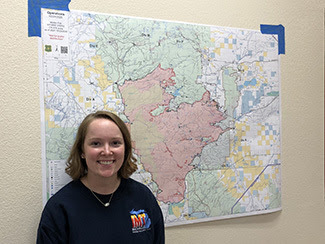
The DNR's Paige Gebhardt stands in front of a map she helped create on the Mullen Fire in Wyoming.Paige Gebhardt, a resource analyst with the DNR’s Forest Resources Division, makes maps that include layers of data to help firefighters get to where they’re going and assess what’s happening there.

Gebhardt is currently in training on fire duty. Her first assignment was as part of a mapping team on the 1 million-acre August Complex fire in California in early September. She was also invited to work on the 176,000-acre Mullen Fire south of Centennial, Wyoming in October.

Maps are key in fighting fires, and the technology for creating them is evolving. Paper maps are important and are updated every day. But more and more, maps are going digital.

“Staff can go in and change information in real-time based on what is happening on the ground,” Gebhardt said.

Gebhardt also created “story maps” that combine journalistic-style text and photos displayed online with maps, to relay information to the public.

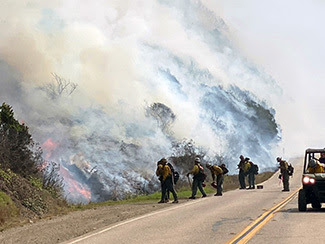
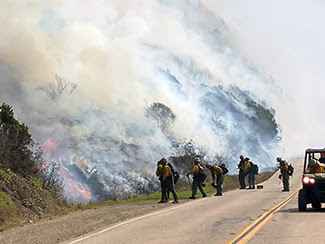
The Palomar Interagency Hotshot Crew assists with a burnout along California Highway 1 as part of the response to the Dolan Fire. “There are definitely tight deadlines,” Gebhardt said. “Major stress came in when we couldn’t produce maps fast enough and get them to the people on the ground.”

Gebhardt didn’t know what to expect going into the experience, but she came away with better skills and higher confidence.

“I just didn’t really know what to expect from me and my job,” she said. “But I learned I can produce the maps quickly and interact with people and a team.”

Michigan is always compensated fully for expenses related to western fire assignments, and there are always firefighters ready at home to handle things that come up here.

“Out-of-state assignments are just a great way for the team to build skills,” said Dan Laux, fire section chief for the DNR’s Forest Resources Division. “These assignments are a win for the states that need help and for our DNR team.”

Check out previous Showcasing the DNR stories in our archive at Michigan.gov/DNRStories. To subscribe to upcoming Showcasing articles, sign up for free email delivery at Michigan.gov/DNR.


/Note to editors: Contact: John Pepin, Showcasing the DNR series editor, 906-226-1352. Accompanying photos and a text-only version of this story are available below for download. Caption information follows. Credit Michigan Department of Natural Resources, unless otherwise noted.

Text-only version – Firefighters on assignment

Brattain: The Brattain Fire is shown burning along a roadway near Paisley, Oregon in September. (InciWeb photo)

Dolan: The Palomar Interagency Hotshot Crew assists with a burnout along California Highway 1 on Sept. 18 as part of the response to the Dolan Fire. (InciWeb photo)

Firefighters: Firefighters from an unidentified crew working along the Lake Fire in Los Angeles County, California in August. (InciWeb photo)

Gebhardt: Resource analyst Paige Gebhardt, of the Michigan Department of Natural Resources’ Forest Resources Division, helped make digital and paper maps at two western fires this year, in California and in Wyoming. This photo was taken during the Mullen Fire south of Centennial, Wyoming.

Hose: Firefighters are shown with more than 70,000 feet of hose brought back from the fireline on the Lake Fire in southern California in late August. (InciWeb photo)

Lake: A smoke column rises over the Lake Fire north of Los Angeles, California on Aug. 15. (InciWeb photo)

Michigan: Paul Dunn and Ben Osterland, two Michigan Department of Natural Resources firefighters, drove an off-road fire truck from Michigan to California to help with the Lake Fire outside of Los Angeles.

Pine: Support vehicles parked along Pine Canyon Road, north of Los Angeles, California, while the Lake Fire is visible in the background. (Judy Nathan, U.S. Forest Service photo)/

DNR COVID-19 RESPONSE: For details on affected DNR facilities and services, visit this webpage. Follow state actions and guidelines at Michigan.gov/Coronavirus.
Report Shows Progress in Protecting Communities of Color from the Spread of COVID-19

Report Shows Progress in Protecting Communities of Color from the Spread of COVID-19

Governor Gretchen Whitmer Banner - headshot with bridge graphic


FOR IMMEDIATE RELEASE

December 3, 2020

Media Contact: Press@Michigan.gov


Governor Whitmer, Racial Disparities Task Force Release Interim Report Showing Significant Progress in Protecting Communities of Color from the Spread of COVID-19


LANSING, Mich. — Today, Governor Gretchen Whitmer and the Michigan COVID-19 Task Force on Racial Disparities, Chaired by Lieutenant Governor Garlin Gilchrist II, released an interim report detailing the significant progress Michigan has made in protecting communities of color from the spread of COVID-19.


“From the beginning, our administration has listened to medical experts and taken a fact-based approach to eliminating COVID-19 in our most vulnerable communities, and we have seen significant progress,” said Governor Whitmer. “Lieutenant Governor Gilchrist and the leaders on the Task Force have been crucial in helping us dramatically reduce the number of cases, hospitalizations, and deaths in communities of color by expanding testing and providing crucial support to community organizations. Our work is far from over, and cases and hospitalizations are still rising statewide, but this team remains dedicated to working with medical experts and protecting our communities, frontline workers, and small businesses. Our immediate focus now is holding our progress, flattening the infection curve, and remaining vigilant with mask wearing and social distancing.”


“The coronavirus pandemic has shined a light on the health, economic, and educational challenges that communities of color face daily,” Lt. Governor Gilchrist said. “Today’s report shows that significant progress has been made toward our goal to reduce these disparities over the past six months. But as cases continue to rise, we need to recognize that our work is not done because each of us have a role to play to make sure that we defeat this virus. When we successfully make it to the other side of this pandemic, we will hug each other a little tighter, check in on each other a little more, and be proud of the work we did to make each other’s lives better.”


The Task Force’s interim report details a number of actions the state has taken to protect communities of color, frontline workers, and small businesses from the spread of COVID-19. As of November 16, more than 24,000 tests have been administered in previously underserved communities across 21 Neighborhood Testing sites. These state-operated sites provide COVID-19 testing on a consistent schedule, several days per week. All sites offer free testing, and a prescription is not required for someone to be tested, nor is any form of ID required.


From March and April to September and October, the average cases per million per day for African American Michiganders dropped from 176 to 59. In the same period, the number of probable deaths per million per day among African American Michiganders dropped significantly – from 21.7 to 1.


“As a member of the Michigan Task Force on Racial Disparities, I am proud of the hard work we have done to protect communities of color from the spread of COVID-19,” said M. Roy Wilson, Task Force Member and president of Wayne State University. “I want to thank Governor Whitmer and Lieutenant Governor Gilchrist for their leadership as we have fought to eliminate this virus. Our work on the task force is far from over, but the data is clear – we have taken swift, meaningful action to protect Michigan’s most vulnerable communities and save lives, and we will continue to do so until this fight is over.”


“When it became clear that the Black community was disproportionately impacted by the COVID-19 pandemic, Governor Whitmer and her administration took crucial action to eliminate that disparity and save lives,” said Maureen Taylor, Task Force member and state chair of the Michigan Welfare Rights Organization. “Michigan has been recognized as a nationwide leader in addressing health disparities that have come to light as a result of the COVID-19 pandemic because the governor and lieutenant governor have dedicated themselves to ensuring equitable support for our most vulnerable communities throughout this crisis. We have made great strides, but we will remain vigilant and work day and night to protect the Black community from COVID-19 until this virus is gone for good.”


“It’s clear that the work of this task force, created by Governor Whitmer and spearheaded by Lieutenant Governor Gilchrist, has made significant progress in protecting families, frontline workers, and small businesses in communities of color,” said Celeste Sanchez Lloyd, Task Force member and community program manager for Strong Beginnings at Spectrum Health. “As the weather gets colder and as we head into the holiday season, our most vulnerable communities will continue to need crucial support. We are committed to continuing to provide that support and work closely with the governor as she listens to health experts and takes a fact-based approach to ending the COVID-19 pandemic.”


NEXT STEPS FOR THE TASK FORCE

In order to sustain the progress made and to better address ongoing disparities, the Task Force will continue working around the clock to protect our most vulnerable communities. The Task Force has identified a number of areas to focus on as we head into the holiday season and the cold winter months, including:

  • Closing the digital divide in telehealth and virtual learning to ensure equitable access for all Michiganders;
  • Increasing enrollment in health insurance plans by making it easy for Michiganders to find out about their options for affordable care, such as Medicaid and federal marketplace plans;
  • Building mobile testing infrastructure that can also be extended for other health services such as vaccine administration;
  • And raising awareness of racial- and ethnic disparities in medical care to ensure that every Michigander, no matter their race, can get safe and quality care in Michigan.


The Task Force has already taken steps to address these issues, and will continue working toward these goals as the State of Michigan continues to fight the COVID-19 pandemic.

The Michigan COVID-19 Task Force on Racial Disparities consists of a variety of leaders from government, academia, and the private sector, health care, economic development, education, and other disciplines. Click here to learn more about the Task Force.


To view the Task Force’s full interim report, click the link below: