EGLE awards second round of EV charger grants

EGLE awards second round of EV charger grants

EGLE Main GovD banner
FOR IMMEDIATE RELEASE
Dec. 16, 2020
Nick Assendelft, Public Information Officer, AssendelftN@Michigan.gov, 517-388-3135

EGLE awards second round of EV charger grants

Nine more locations in Michigan will soon offer electric vehicle fast charging stations under a second round of grants that total $448,204 awarded today by the Michigan Department of Environment, Great Lakes, and Energy.

The installations will continue to build out a network of direct current fast chargers (DCFC) that EGLE is partially funding at strategic locations around the state to provide drivers worry-free travel. EGLE’s Charge Up Michigan Program offers up to $70,000 per charging station to public or private entities in partnership with the host site and local utility for site preparation, installation, signage and network fees. The goal is to have the network, funded through Michigan’s allocation from the Volkswagen diesel settlement, completed by 2030.

Today’s grant announcement includes six new charger locations and three expansions of previously awarded projects, for a total of 18 charging ports.

New grants


Grantee

Number
of chargers

Total
granted

 Coyne Oil Corp. (Mt. Pleasant) 2 $50,850
 Maple Hill Auto Group Transit, LLC (Kalamazoo) 2 $50,850
 Clearview Auto Wash Inc. (Shelby Township) 2 $50,000
 Marlette Oil and Gas Co. (Marlette) 2 $50,000
 Merle Boes, Inc. (Grand Rapids) 2 $46,845
 City of Owosso 2 $44,257

Modified grants


Grantee

Added
chargers

Total
granted

 Walters Dimmick Petroleum (Marshall)1 2 $65,565
 Blarney Castle Oil and Propane (Indian River) 2 $49,837
 Meijer, Inc. (Northville) 2 $40,000

1 Project through the City Utility of Marshall, in which the city supports a third of the project cost

Grant funding is still available and priority consideration will be given to future applicants who propose installing DC fast chargers in the Upper Peninsula, northwest or northeast Lower Peninsula, southwest Michigan near the border with Indiana and southeast Michigan near the border with Ohio. The Charge Up Michigan website provides a state map and preferred locations list of funded chargers and where they are still needed under the build-out plan.

Questions about the program, grant opportunities and possible charger locations should be directed to Julie Staveland, State Energy Program Specialist, at StavelandJ@Michigan.gov.

In August, EGLE awarded $1.7 million in grants for 36 DC fast charging stations with a total of 76 plug-in points for automobiles and light-utility vehicles. Many of those stations are in operation and others should be available soon.

EGLE is committed to the future of mobility through investment in infrastructure that is needed to support EVs and it has identified optimal charger locations across Michigan. An expanded EV fast charging network in Michigan will boost driver confidence that chargers will be available and operational in a well-lit, safe environment, improve air quality, reduce vehicle emissions, and protect public health and the environment.

DNR: A journey of 1,200 feet

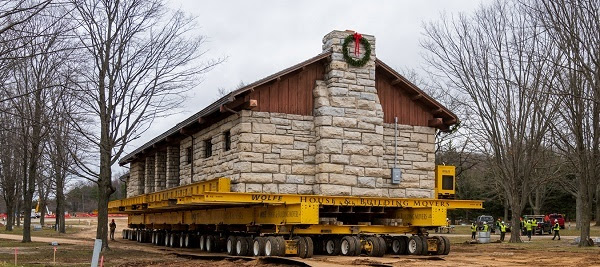
The historic shelter building at Orchard Beach State Park sits atop of a flatbed as it moves to new site further inland.
Dec. 15, 2020
Contact: Doug Barry, 517-614-7226

A journey of 1,200 feet moves state park’s historic building out of harm’s way

After months of planning, Orchard Beach State Park’s historic shelter building now sits a safe 230 feet back from the eroding Lake Michigan shoreline. The necessary, winding, 1,200-foot journey through this popular park in Manistee, Michigan, wasn’t swift; the entire move took 23 hours over three days, from Thursday, Dec. 10, to Saturday, Dec. 12.

For more than 70 years, the building sat perched high atop a bluff overlooking the Great Lake. However, high water and wave action have made the bluff unstable, requiring that the 850-ton building be relocated within the park to preserve its story, protect public safety and keep the building open for future recreation.

“The DNR proudly preserves and protects both natural and cultural assets,” said Ron Olson, chief of the Parks and Recreation Division within the Michigan Department of Natural Resources. “Investing in this important place is an investment in the story of Michigan and preserves the memories of those who have enjoyed this iconic destination.”

Efforts to stabilize the bluff to protect the building have been in development since 2017. However, ongoing erosion at the toe of the bluff, compounded by rising water levels, and the sloughing of the high, steep slope put the future use and existence of the building at risk.

“I’m proud and excited that this community and the state joined together to save this historic building,” said Doug Barry, unit manager for Orchard Beach State Park. “So many families have held events here over the years because of the unique charm of this park shelter. Now its legacy can continue for many generations into the future.”

The building now will serve as the centerpiece for the 200-acre park’s revitalized day-use area, offering improved accessibility for shelter visitors and, eventually, a new playground.

Park and area history

Orchard Beach was first opened and operated by the Manistee, Filer City and Eastlake Railway Company in 1892. After World War I, when the trolley line ended service to the park, the Manistee Board of Commerce purchased the parcel. The board, in turn, deeded the property to the state in 1921 so Orchard Beach would become part of Michigan’s new state parks system.

Included on the National Register of Historic Places, Orchard Beach State Park is home to buildings designed by Ernest F. Hartwick and built by the Depression-era Civilian Conservation Corps. The CCC spent several years building the structure, which was completed in 1947. Orchard Beach – and the DNR – will celebrate a centennial anniversary in 2021, along with the successful effort to improve the site and preserve history for future generations.

Orchard Beach State Park is at 2064 N. Lakeshore Road in Manistee. The park entrance is located on M-110, 1 ½ miles north of U.S. 31. The park will remain closed to the public, likely through spring, to complete site investment including restoring the campground along the building’s travel path, a redesign of the park’s stormwater management system to minimize further erosion, and accessibility improvements at the shelter’s new location.

Project stats

  • The project cost $3.6 million for the engineering study, design and construction to move the building and protect it for the future.
  • The building followed a 1,200-foot route to complete the move and now sits 230 feet from the Lake Michigan shoreline.

Project partners

  • Hallack Contracting Inc. (Hart, Michigan).
  • Wolfe House & Building Movers, LLC (Bennville, Pennsylvania).
  • GEI Consultants (Lansing and Marquette, Michigan, offices).

Project factors and highlights

Data collection and studies began in 2017. It became clear from early evaluations of existing conditions, causes, historical rate of erosion, etc., that the accelerated shoreline erosion was placing several buildings and underground infrastructure at risk. These features, including underground utilities, stairs to the beach and the shelter building, need to be protected so the DNR can continue operating the Orchard Beach State Park campground and day-use amenities. The stairs, closed for more than a year, will remain closed until water levels recede.

Lake Michigan water levels naturally fluctuate from periods of high water to periods of low water; storm frequency and magnitude are other influencing factors. Protection of the park’s features against these natural forces must be carefully considered against what is known as a “managed retreat,” where the most appropriate, cost-effective options have been weighed and decisions are made in the interest of long-term protection and preservation of those amenities.

High water has created the need to stabilize shorelines and historic structures around Michigan, including upcoming work at nearby Big and Little Sable lighthouses. As waters recede statewide, the DNR likely will uncover other necessary infrastructure repairs in public parks, trails and waterways.


NOTE TO EDITORS: For interviews, contact park manager Doug Barry at BarryD1@michigan.gov or 517-614-7226.

DNR COVID-19 RESPONSE: For details on affected DNR facilities and services, visit this webpage. Follow state actions and guidelines at Michigan.gov/Coronavirus.
Orion Township ZBA Meeting of 12-14-2020

Orion Township ZBA Meeting of 12-14-2020

MDHHS asks Michiganders to “Mask Up, Mask Right”

MDHHS asks Michiganders to “Mask Up, Mask Right”

MDHHS banner with logo no names

Press Release


FOR IMMEDIATE RELEASE: Dec. 15, 2020

CONTACT: Lynn Sutfin, 517-241-2112, SutfinL1@michigan.gov

MDHHS asks Michiganders to “Mask Up, Mask Right”

LANSING, MI – The Michigan Department of Health and Human Services (MDHHS) is launching an initiative to not only get Michiganders to mask up, but to mask right.

“The science is now settled: Masks protect others from COVID – and they protect the wearer,” said Robert Gordon, MDHHS director. “It’s important to wear the right mask and wear it the right way. We want all Michiganders to Mask Up, Mask Right as we continue to battle the virus in our state.”

Masking right includes wearing one of three options of masks that provide stronger protection: three-layered washable cloth face coverings, medical-grade disposable masks or approved KN95 masks. It also includes wearing the approved mask correctly and having it secured over the nose and face and tightly fitting without gaps.

CDC has recommended the use of masks to protect the community by reducing emission of the virus and to protect the wearer by reducing inhalation. CDC cites a number of studies showing that masks have been effective. For example, one study showed that use of masks onboard the USS Theodore Roosevelt was associated with a 70% reduced risk of COVID; another showed that, in a contact tracing investigation, those who reported wearing masks had a 70% lower risk of infection than those who did not. Published research by Beaumont Hospital in Southeast Michigan also showed that mask wearing was associated with lower levels of infection by COVID and, among those infected, lower levels of symptoms.

Bandanas, gaiters and face shields without masks do not provide adequate protection for the wearer or others and are not recommended.

“The delivery of the first COVID-19 vaccines in Michigan means there will be an end to this pandemic,” said Dr. Joneigh Khaldun, chief medical executive and chief deputy for health. “However, it will take several months before we are able to have enough vaccine to widely distribute it to all Michiganders. Until then, and even for individuals who receive the vaccine, we should all be doing our part to slow the spread of this virus by wearing masks correctly, avoiding large gatherings, and washing hands.”

Residents in need of masks can pick one up from partner sites across the state, which includes most MDHHS local offices and Community Action Agencies. Find a distribution site at Michigan.gov/MaskUpMichigan or call the COVID-19 hotline at 888-535-6136.

Information around this outbreak is changing rapidly. The latest information is available at Michigan.gov/Coronavirus and CDC.gov/Coronavirus.

The Lake Orion Village Council Meeting of 12-14-2020

The Lake Orion Village Council Meeting of 12-14-2020