AG’s Office Signs Agreement After Alleged Price-gouging

AG’s Office Signs Agreement After Alleged Price-gouging

Attorney General Dana Nessel

Media Contacts:

Ryan Jarvi
(c) 517-599-2746

FOR IMMEDIATE RELEASE:
Monday, Dec. 21, 2020

AG’s Office Signs Agreement with Oakland County Business After Alleged Price-gouging

LANSING – While the COVID-19 pandemic persists, the Michigan Department of Attorney General remains active in its efforts to protect consumers from predatory and deceptive business practices.

Attorney General Dana Nessel’s office recently signed an agreement with Smokehouse Distribution, an Oakland County business in Commerce Township that allegedly violated the Michigan Consumer Protection Act (MCPA) by engaging in practices like price-gouging.

The business was advertising excessively priced face masks for sale on a website called BeamerSmoke. The Attorney General’s office began receiving consumer complaints about the business in April, and sent a cease and desist letter in early May. The Assurance of Voluntary Compliance (AVC) agreement with the business follows an investigation by the Attorney General’s office after it received approval for civil investigative subpoenas from the Oakland County Circuit Court on June 23, 2020.

The AVC requires the business to refund customers who purchased the over-priced personal protective equipment and refrain from selling such products again for COVID-19 purposes.

“From the outset, my office has been committed to protecting consumers from retailers who try to use this pandemic as an excuse to prey on the vulnerabilities of hard-working people,” Nessel said. “We will continue to be vigilant and follow through on credible consumer complaints to ensure Michigan residents are not being taken advantage of.”

Smokehouse Distribution advertised surgical-type masks at two for $18 and admitted to investigators that the masks were purchased for about 56 cents apiece. The proprietor also said the higher price was an error that was addressed as soon as it was discovered. However, the price for two masks then dropped to $12 and $10, still a significant markup.

The owner indicated only 17 sales of face masks occurred through the website, but an invoice provided to the Attorney General’s office shows the business purchased nine cases of 2,000 masks each from a supplier. After the Attorney General’s office contacted the business about consumer complaints it had received, the business returned much of its mask inventory to its supplier.

Under terms of the AVC, the seller will provide full refunds to specific consumers who purchased face masks and gloves on the company’s website in April. Customers who will receive a refund will be contacted by the business. Refunds must be provided to consumers within 60 days.

The AVC also requires:

  • A $2,000, one-time payment made to the Michigan Department of Attorney General to cover investigation costs;
  • An assurance by the seller that no face masks will be sold or advertised for any medical or COVID-19 protection purposes.

An Assurance of Voluntary Compliance agreement is a tool provided for in the MCPA that allows the Attorney General’s office to settle disputes with businesses that have allegedly violated the MCPA without litigation.

To view more about the MCPA and the Attorney General’s efforts to protect consumers, visit the department’s website.

Consumer complaints may also be filed online by visiting the Attorney General’s Consumer Protection website.

Click here to view a copy of the AVC agreement.

MDHHS Begins Cautious Re-Openings

MDHHS Begins Cautious Re-Openings

Gatherings remain limited, but high schools, casinos, bowling alleys, theaters can reopen

FOR IMMEDIATE RELEASE
December 18, 2020
Contact: Lynn Sutfin, 517-241-2112

LANSING, MICH.  The Michigan Department of Health and Human Services (MDHHS) updated its epidemic order today to allow indoor activities where Michiganders can remain masked, as this has been scientifically shown to slow the virus. This includes in-person learning at high schools and indoor entertainment venues. Casinos, bowling centers and movie theatres will be allowed to reopen with total capacity capped at 100; food and drink concessions closed; and social distancing requirements in place. The new order is effective Monday, Dec. 21 and will last until Friday, Jan. 15.

“These past few weeks, Michiganders across the state stepped up and did their part to slow the spread of COVID-19, and because of our collective hard work, we are now able to begin the steps to carefully lift some of the protocols we have in place,” said Gov. Gretchen Whitmer. “I am encouraged by the progress we have made since early November, and will continue to monitor the data closely during and after the holidays. One of the most important things Michiganders can do right now is make a plan to get the safe and effective vaccine as soon as it’s available to you. And as always: mask up, practice safe social distancing, and avoid indoor gatherings where COVID-19 can easily spread from person to person. We will eradicate this virus together.”

“We have made some progress in our fight against this pandemic, and this was a historical week as we started to distribute life-saving vaccines,” said Dr. Joneigh Khaldun, chief medical executive and chief deputy for health at MDHHS. “It is important that everyone continues to do their part. Start planning for when you will get a vaccine when it is available to you, and let’s avoid a surge in cases after the holidays by avoiding gatherings, wearing our masks, and continuing to socially distance.”

Previously, MDHHS had identified stabilization or declines in three metrics as critical for relaxing protocols. Michigan saw improvements across all three following the “pause” implemented in mid-November:

  • Hospital capacity dedicated to COVID-19 patients:13-day decline; current capacity is at 17.3% for beds with COVID-19 patients. Peaked at 20.1% on Tuesday, Dec. 1.
  • Overall case rates: 27-day decline; currently at 439 cases per million. Peaked at 739 cases per million on Saturday, Nov. 14.
  • Positivity rate: 11-day decline; currently at 10.6% positive tests. Recently peaked at 14.3% on Friday, Dec. 4.

“Michiganders should be proud: we have made incredible progress over the last month. But we could easily lose that progress and endanger our hospitals again over the next two weeks,” said MDHHS Director Robert Gordon. “At Thanksgiving, most Michiganders sacrificed and avoided family get-togethers. We need to do the same thing this holiday season. Then we can re-engage more activities sooner and more safely.”

Indoor residential gatherings remain limited to 10 people and two households. MDHHS continues to urge families to avoid indoor gatherings or to pick a single other household to interact with consistent with guidance already released by the department. Families are encouraged to stay home this holiday season to maintain the positive momentum that has developed and to protect loved ones. Families are also encouraged to Mask Up, Mask Right, using new guidance for what masks to wear and how to wear them.
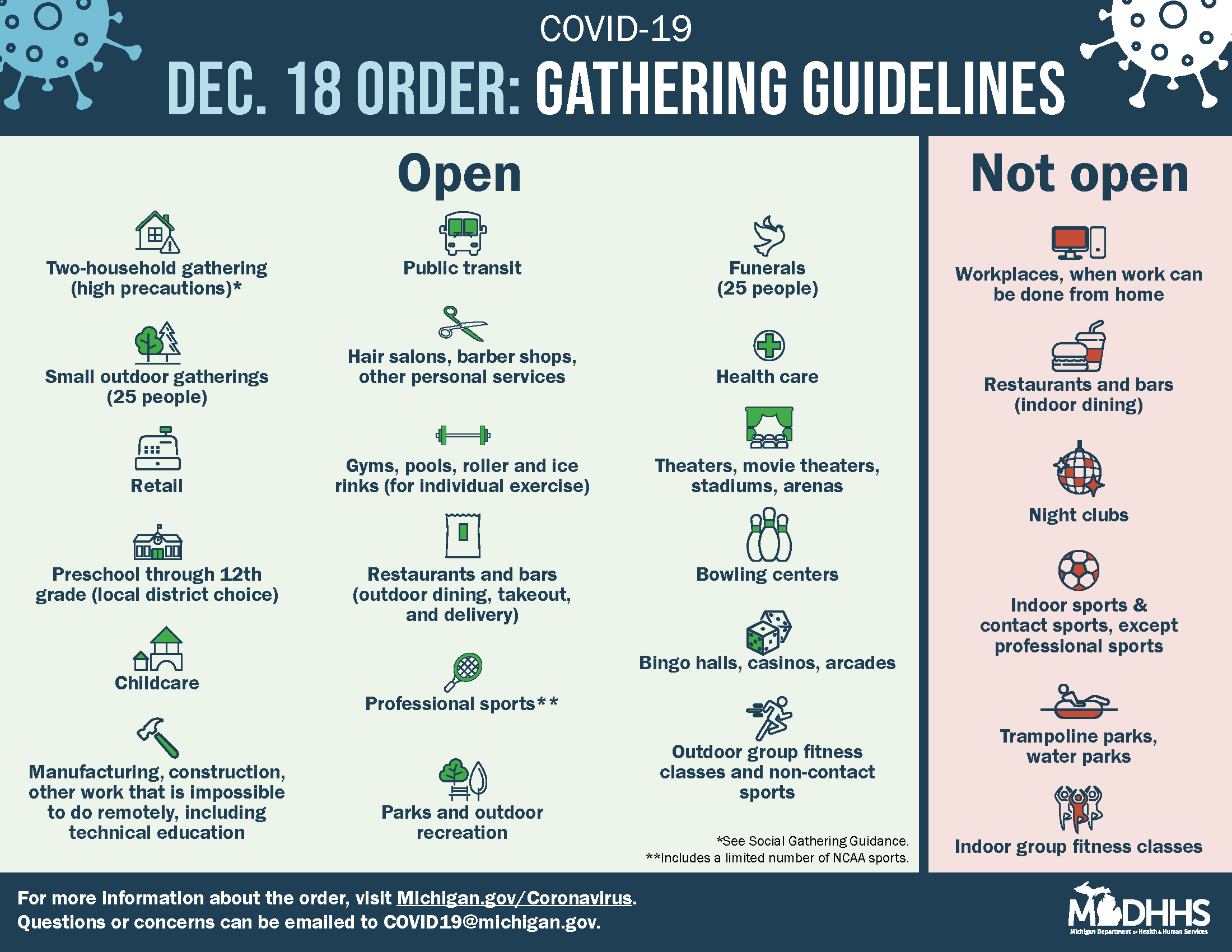
December 18 Epidemic Order infographic

The epidemic order continues to temporarily pause indoor dining in bars and restaurants, but they can continue to offer outdoor dining, carry-out, and delivery. Colleges and universities will be able to have students return to campus for the winter semester, with a voluntary commitment to wait until Jan. 18 to restart in-person courses.

Gyms remain open for individual exercise with strict safety measures in place. Outdoor group fitness and outdoor non-contact sports will again be allowed, including running, downhill and cross-country skiing.

Under this new order, reopened indoor entertainment venues will not be required to collect names and contact information. With the amount of community spread that currently exists across the state and the heavy burden on contact tracing teams to keep up with these cases, it has become too challenging to meaningfully use this data for timely follow up. As case counts fall and contact tracing becomes able to keep up with the volume again, MDHHS expects to reinstate this information-gathering requirement.

As before, employees who work in jobs that cannot be performed from home can continue to go to work, while employees who can work from home should continue to do so. Individualized activities with distancing and face masks are still allowed: retail shopping; public transit; restaurant takeout; personal-care services such as haircuts, by appointment; and individualized exercise at a gym, with extra spacing between machines.

“As we continue to fight the COVID-19 pandemic, the health and safety of our employees and patrons remains a top priority,” said Joel Kincaid, vice president of operations with MJR Digital Cinemas. “We are grateful for MDHHS’s partnership and are prepared to reopen with strict safety measures in place. We look forward to working with the governor and her entire administration as we combat this virus together.”

Information around this outbreak is changing rapidly. The latest information is available at Michigan.gov/Coronavirus and CDC.gov/Coronavirus.

To learn more about the COVID-19 vaccine, visit Michigan.gov/COVIDVaccine.

MI COVID Alert hits half a million downloads

MI COVID Alert hits half a million downloads

MDHHS banner with logo no names

Press Release


FOR IMMEDIATE RELEASE: Dec. 17, 2020 

CONTACT: Bob Wheaton, 517-241-2112, wheatonb@michigan.gov

MI COVID Alert hits nearly half a million downloads in first month
New app anonymously shares test results in continued effort to slow COVID-19 spread

LANSING, Mich. – A month after its statewide launch, the MI COVID Alert app has reached nearly 500,000 downloads.

Today the Michigan Department of Health and Human Services (MDHHS) and Michigan Department of Technology, Management & Budget (DTMB) announced there have been 461,192 downloads of MI COVID Alert. The state also rolled out a second option for users to receive the PIN required to anonymously share a positive COVID-19 test result.

“So much about fighting COVID is hard, but this is easy: Please download MI COVID Alert on your phone,” said Robert Gordon, director of MDHHS. “It protects your privacy, and it will help protect us all. If we hit even a million downloads by January 2021, we’ll be safer until a vaccine is available to the broader population.”

Even when just 15% of a population used an exposure notification app like MI COVID Alert, researchers from Oxford University found a potential to reduce infections and deaths. Already, nearly 9% of Michigan residents ages 18 to 64 have downloaded MI COVID Alert.  When a person tests positive for COVID-19, they are eligible to receive a randomly generated PIN. This PIN allows people to share test results anonymously in MI COVID Alert.

After a positive test result is entered into the app, close contacts – people who have been within six feet for 15 minutes or more over a 24-hour period – will receive an anonymous push notification letting them know they may have been exposed to COVID-19 and the number of days since the possible exposure took place. No personally identifiable information is required or shared with other users. With the total number of COVID-19 cases and people exposed to the virus recently, some COVID-positive residents may not receive a call from their local health department right away.

However, app users can now retrieve a PIN two more ways by:

  • Calling their local health department; or,
  • Contacting the Michigan COVID-19 hotline at 2-1-1 or 888-535-6136 from 8 a.m.-5 p.m., Monday through Friday.

MI COVID Alert uses randomly generated phone codes and low-energy Bluetooth technology to gauge proximity between phones with the app instead of using GPS. The use of this technology protects the privacy of all users and prevents tracking someone’s exact location. Michigan worked with Apple and Google to make MI COVID Alert compatible with similar apps in other states. The exposure notification feature included in recent iOS and Android operating system updates only works with a companion app like MI COVID Alert, which is available for iOS and Android phones by visiting Apple and Google app stores.

Or for more information about the app, go to the MI COVID Alert webpage. The app works in conjunction with traditional contact tracing, mask wearing, hand washing and social distancing, but is not a replacement for these precautions or participation in contact tracing. People who are exposed to COVID-19 should get tested and consider quarantining for 14 days from the date of possible exposure. If a person is still symptom-free on day 10, they can end quarantine early. However, they should continue monitoring for symptoms for four additional days.

Anyone who needs testing may visit the COVID-19 website to find a testing location near them. They may also contact the Michigan COVID-19 hotline to locate and schedule an appointment.

Other states, including Virginia, Arizona, New York, Alabama and New Jersey, launched similar exposure notifications apps. Additional states have apps in development.

Whitmer announces Healthy Michigan Plan top 850,000 enrollees

Whitmer announces Healthy Michigan Plan top 850,000 enrollees

Governor Gretchen Whitmer Banner - headshot with bridge graphic

FOR IMMEDIATE RELEASE:

December 17, 2020

Contact: Bob Wheaton, WheatonB@michigan.gov, 517-241-2112


Gov. Whitmer announces Healthy Michigan Plan top 850,000 enrollees

Expanded Medicaid program helps low-income residents afford coverage


LANSING, Mich. – The Healthy Michigan Plan is now providing health care coverage to more than 850,000 low-income residents for the first time, Gov. Gretchen Whitmer announced today.


There are now 853,211 people enrolled in the Healthy Michigan Plan, the state’s expanded Medicaid program.


“Every Michigander deserves quality, affordable health care, especially during a pandemic. As Senate Democratic Leader, I was proud to work across the aisle with a Republican governor and legislature to expand health coverage for Michiganders through the Healthy Michigan plan,” said Governor Whitmer. “Now, as we continue working to eradicate COVID-19 and with the Affordable Care Act under constant attack in the courts, it’s more important than ever that we protect the Healthy Michigan plan and ensure health care for Michiganders across the state. I will continue working with everyone who wants to protect and expand health care for Michiganders.”


COVID-19 affected the finances and health of so many Michiganders that the number of Healthy Michigan Plan beneficiaries jumped from just under 682,000 in late March to more than 850,000 now. Michigan instituted policies to help families access affordable health care coverage such as deciding to avoid terminating Healthy Michigan Plan coverage and freeze premiums for as long as the COVID-19 public health emergency exists. The state qualified for additional Medicaid funding from the federal government through the Families First Coronavirus Response Act.


The Michigan Department of Health and Human Services (MDHHS) has also worked to streamline the application process over the past few years to ensure people eligible to receive benefits are able to access them without unnecessary burdensome requirements.


Gov. Whitmer and (MDHHS) have strongly supported the Healthy Michigan Plan. When she was State Senate Democratic leader, Whitmer helped pass the bipartisan legislation that created the Healthy Michigan Plan, which was enacted in April 2014.


In March, Whitmer and MDHHS preserved Healthy Michigan Plan coverage for tens of thousands of people by supporting swift action on the legal challenge of work requirements that had been adopted by the Republican Legislature. Policies like work requirements that take away health insurance undermine the purpose of Medicaid which is to provide health care coverage to low income and vulnerable populations.


“MDHHS is committed to expanding access to health care coverage for Michiganders,

said MDHHS Director Robert Gordon. “I’m proud that Michigan has been able to provide this coverage to hundreds of thousands of our residents. Coverage has improved their health outcomes – and when people are healthier they are better able to take care of their families and our state is more productive.”


Healthy Michigan Plan coverage is available to Michiganders ages 19-64 years old who have an income at or below 133 percent of the federal poverty level – or $16,971 annually for a single person – and meet other eligibility requirements, such as not qualifying for other Medicaid programs. Expanded Medicaid plans are allowed under the federal Affordable Care Act if states decide to implement them.


According to 2017 research from the University of Michigan, the Healthy Michigan Plan more than doubled primary care usage, reduced enrollees’ reliance on the emergency room by 58 percent, cut uncompensated care by nearly 50 percent, and added $2.3 billion to our state’s economy.


Apply for the Healthy Michigan Plan at www.michigan.gov/MIBridges or by calling the Michigan HealthCare Helpline at 855-789-5610. For more information, visit www.michigan.gov/HealthyMiPlan.


MDHHS updates priority group information for vaccination

MDHHS updates priority group information for vaccination

FOR IMMEDIATE RELEASE
December 16, 2020
Contact: Lynn Sutfin, 517-241-2112

LANSING, MICH. – The Michigan Department of Health and Human Services (MDHHS) has updated information in its priority groups for vaccination administration document and launched a COVID-19 Vaccine Dashboard to help Michiganders track information about the vaccine across the state.

MDHHS expanded its guidance to allow Michiganders 16 years of age and older to receive the vaccine and also provided updated information on pregnant women and the vaccine. While there is not currently data on the safety and efficacy of Pfizer’s COVID-19 vaccine in pregnant women, the Centers for Disease Control and Prevention has recommended that pregnant women may be offered the vaccine within the priority groups upon consultation with their medical provider.

“The arrival of the COVID-19 vaccine is an important step toward reducing the toll the virus is taking on our state,” said Dr. Joneigh Khaldun, MDHHS chief medical executive and chief deputy for health. “As we receive further guidance from our federal partners, these prioritizations may change. While we roll these vaccines out across the state, it is important everyone continues to do their part in fighting this pandemic by wearing masks, washing hands, and avoiding gatherings.”

The COVID-19 Vaccine Dashboard includes data from the Michigan Care Improvement Registry on the number of providers enrolled to provide the vaccine, the amount of vaccine received and doses administered. The dashboard will be expanded over the coming weeks to include vaccination coverage rates by age and race.

MDHHS is following the Centers for Disease Control and Prevention recommendations for prioritization of distribution and administration of COVID-19 vaccines. CDC recommendations are based on input from the Advisory Committee on Immunization Practices (ACIP). ACIP is a federal advisory committee made up of medical and public health experts who develop recommendations on the use of vaccines in the United States. MDHHS has also obtained input from a stakeholder group of Michigan public health and health care leaders and reviewed correspondence from the public.

Phases are as follows:

  • Phase 1A includes paid and unpaid persons serving in health care settings who have direct or indirect exposure to patients or infectious materials and are unable to work from home, as well as residents of long-term care facilities.
  • Phase 1B includes some workers in essential and critical industries, including workers with unique skill sets such as non-hospital or non-public health laboratories and mortuary services.
  • Phase 1C includes individuals age 16 years or older who are at high risk for severe COVID-19 illness due to underlying medical conditions, and people 65 years and older.
  • Phase 2 is a mass vaccination campaign for all individuals aged 16 years or older.

MDHHS has provided additional prioritization guidance within these categories. It is important to note that vaccination in one phase may not be complete before vaccination in another phase begins. Vaccination in these phases will likely overlap. The timing of the start of vaccination in a phase is dependent on guidance from CDC and ACIP, the supply of vaccine from the manufacturer, how vaccine is allocated from the federal level to Michigan and the capacity to administer the vaccine to populations.

Vaccine distribution will roll out over a series of weeks, and current estimates are that by late Spring 2021 enough vaccine will be available for everyone who is recommended to receive it. There will be no out-of- pocket costs to individuals for the vaccine, however, healthcare providers may bill insurance for administrative costs. The COVID-19 vaccine will require two doses, separated by three or four weeks depending on the manufacturer. Michiganders should receive both doses in order to have full protection from the virus. Individuals who receive the vaccine may experience mild side effects such as low-grade fever, sore arm and fatigue, which indicate that the vaccine is working. There is a robust state and national process for tracking vaccines and reporting side effects.

MDHHS stresses Michiganders should continue to wear masks, social distance from those not in their household and wash their hands often, even after receiving the vaccine.

Michigan residents seeking more information about the COVID-19 vaccine can visit Michigan.gov/COVIDvaccine. As additional information and resources become available, it will be posted to this site.

Information around this outbreak is changing rapidly. The latest information is available at Michigan.gov/Coronavirus and CDC.gov/Coronavirus.

# # #

Michigan COVID-19 Vaccination Interim Prioritization Guidance