Michigan AG Helps to Stop Robocalls from Disrupting Hospitals  

Michigan AG Helps to Stop Robocalls from Disrupting Hospitals  

Attorney General Dana Nessel

Media Contacts:

Courtney Covington
(c) 517-290-1560

FOR IMMEDIATE RELEASE:
Tuesday, Dec. 29, 2020

Michigan AG Office Helps Craft FCC Advisory Committee’s Best-Practices Report to Stop Robocalls from Disrupting Hospitals

LANSING — Recommendations on how the telecom industry, hospitals and the federal and state governments can prevent illegal robocalls from disrupting communications in hospitals were presented to the Federal Communications Commission (FCC) recently by a federal advisory committee, which includes Michigan Attorney General Dana Nessel’s office.

The Hospital Robocall Protection Group (HRPG) issued its report to the FCC Dec. 14, outlining best practices for preventing unlawful robocalls from being made to hospitals. The report was a requirement established for the HRPG under the Pallone-Thune Telephone Robocall Abuse Criminal Enforcement and Deterrence Act (TRACED Act).

One of Nessel’s assistant attorneys general was appointed to the HRPG in July as one of only three state officials from around the country.

“Under my administration, Michigan has been a national leader in responding to illegal robocalls and I am proud of the role my office has had in creating best-practices guidelines for hospitals, governments and voice service providers. These guidelines will strengthen the protection for hospitals from robocalls that interfere with their operations,” Nessel said. “I am committed to keeping Michigan at the forefront as our nation continues to develop appropriate measures and protocols to fight this persistent issue.”

Hospitals currently face many unlawful calling activities, including telephone denial-of-service attacks, targeted social engineering and phishing schemes.  These calls can disrupt critical communications, threaten patients’ privacy, facilitate unauthorized access to prescription drugs, and divert important hospital resources.

Recognizing that efforts made by a single entity will not adequately protect hospitals from illegal robocalls, the HRPG recommendations focus on collective efforts and encourage a coordinated response among hospitals, phone companies, telecom carriers and government agencies to mitigate the impact of these calls.  Some of the best practices in the report include:

  • Telecom carriers should analyze, identify and monitor traffic on their network for patterns consistent with unlawful robocalls, and establish a method to ensure hospitals can quickly notify the provider about unlawful robocalls that interfere with patient care and hospital operations.
  • Hospitals should educate staff and raise awareness of robocall incidents through staff training and preparing robocall incident response plans, as well as evaluate robocall events to capture relevant information about calling activity.
  • Federal and state governments should create and implement policies to facilitate the telecom industry’s ability to prevent unlawful robocalls from reaching hospitals and improve communication methods among hospitals and law enforcement agencies.

A full copy of the HRPG report is available online at the HRPG website.

COVID-19 vaccinations begin in Michigan

COVID-19 vaccinations begin in Michigan

FOR IMMEDIATE RELEASE: Dec. 28, 2020

CONTACT: Bob Wheaton, 517-241-2112

LANSING, MICH. – Skilled nursing home residents and staff began receiving the safe and effective COVID-19 vaccine made by Moderna today through the Pharmacy Partnership for Long-term Care Program.

The pharmacy partnership is a national initiative to provide COVID-19 vaccine to the Phase 1A priority groups of long-term care facility residents and staff. The Michigan Department of Health and Human Services (MDHHS) is partnering with CVS and Walgreens through the program to manage and facilitate safe vaccination of this patient population, while reducing burden on long-term care facilities and local health departments.

“This is a great day for older Michiganders, their families and the dedicated men and women who care for them. We know this virus is a killer that preys on our most vulnerable populations, which is why my administration has prioritized testing in our nursing homes from the beginning. Now, we have developed a plan that will help us distribute a safe and effective vaccine to our nursing home residents and staff,” said Gov. Gretchen Whitmer. “Remember: it will take some time for the vaccine to be widely distributed to everyone. That’s why it’s so important that we all do our part by continuing to properly mask up, practice safe social distancing and avoid indoor gatherings where the virus can easily spread from person to person. We will get through this together.”

“We know the residents of these facilities are at high-risk for severe illness and death from the virus, and early vaccination of both residents and those caring for them is critical to help protect this population,” said Dr. Joneigh Khaldun, MDHHS chief medical executive and chief deputy for health. “We are pleased that more than 5,000 long-term care facilities – including more than 400 skilled nursing facilities – have been enrolled in the program in Michigan to receive the safe and effective COVID-19 vaccine.”

There are about 91,000 people including residents and staff at nursing facilities, and it is expected to take about three weeks to complete vaccinations. Additional eligible facilities will soon begin receiving vaccinations including assisted living, personal care homes, residential care, adult family home, adult foster home, HUD supportive housing for the elderly and veterans’ homes. The list of sites enrolled in the program is available at Michigan.gov/COVIDvaccine.

To ensure the safety of residents and staff, vaccinators are required to adhere to all applicable Centers for Medicare & Medicaid Services COVID-19 testing requirements for long-term care facility staff. In addition, the pharmacists themselves will be vaccinated with the COVID-19 vaccine as part of this program.

“Nursing facility providers are eager to begin the process of vaccinating residents and staff,” said Health Care Association of Michigan President/CEO Melissa Samuel. “The coronavirus has been most unmerciful to the residents we care for. We are very hopeful this vaccine will not only be a lifesaver for residents and staff, but also expedite the reopening of our facilities to family members and loved ones.

“We want all our residents and staff vaccinated,” Samuel said. “Until we reach those levels, we will all need to remain vigilant in our efforts to mitigate further spread of the virus. I want to thank everyone that has made this day possible.”

MDHHS is following the Centers for Disease Control and Prevention recommendations for prioritization of distribution and administration of COVID-19 vaccines. CDC recommendations are based on input from the Advisory Committee on Immunization Practices, the federal advisory committee made up of medical and public health experts who develop recommendations on the use of vaccines in the United States. Phase 1A includes paid and unpaid persons serving in healthcare settings who have the potential for direct or indirect exposure to patients or infectious materials and are unable to work from home as well as residents in long term care facilities. Additional information on the state’s vaccination phases is available in the prioritization guidance.

Vaccine prioritizations may change as more information on vaccine effectiveness and additional vaccination products become available. MDHHS has provided additional prioritization guidance within these categories. It is important to note that vaccination in one phase may not be complete before vaccination in another phase begins. There may be vaccination of individuals in different phases that occur simultaneously. The timing of the start of vaccination in a phase is dependent on the supply of vaccine from the manufacturer, how vaccine is allocated from the federal level to Michigan and the capacity to administer the vaccine to populations. Decisions on moving to the next phase will be made at the state level.

Even with COVID-19 vaccinations starting in Michigan and worldwide, Khaldun urges everyone to continue to practice preventative measures such as properly wearing masks, social distancing and frequent handwashing to reduce the spread of the virus until the vast majority of people have been vaccinated.

Michigan health officials have set a goal of vaccinating 70% of Michiganders over age 16, about 5.6 million people, by the end of 2021. There will be no out-of-pocket costs to individuals for the vaccine, however, healthcare providers may bill insurance for administrative costs. The COVID-19 vaccine will require two doses, separated by three or four weeks depending on the manufacturer. Michiganders should receive both doses in order to have full protection from the virus. Individuals who receive the vaccine may experience mild side effects such as low-grade fever, sore arm and general discomfort, which indicate that the vaccine is working. There is a robust state and national process for tracking vaccines and reporting side effects.

“Walgreens is very proud to be a part of this historic milestone to begin administering Pfizer’s COVID-19 vaccine to our most vulnerable populations in Michigan and across the country,” said John Standley, president, Walgreens. “With more than a decade of experience administering various vaccines, we have the deep expertise to support this unprecedented effort to allow our nation to emerge from this pandemic.”

Added Larry J. Merlo, president and chief executive officer of CVS Health: “Today’s rollout is the culmination of months of internal planning and demonstrates how the private sector can use its expertise to help solve some of our most critical challenges. I’m grateful for the herculean efforts of everyone involved, including our health care professionals who will be deployed throughout the country to bring peace of mind to long-term care facility residents, staff, and their loved ones.”

Michigan residents seeking more information about the COVID-19 vaccine can visit Michigan.gov/COVIDvaccine.

Information around the COVID-19 outbreak is changing rapidly. The latest information is available at Michigan.gov/Coronavirus and CDC.gov/Coronavirus.

Relief Package Extends Federal Unemployment

Relief Package Extends Federal Unemployment

EXISTING PUA AND PEUC CLAIMANTS WILL EXPERIENCE DELAYED CERTIFICATIONS AND PAYMENTS UNTIL IMPLEMENTATION

Monday, Dec. 28, 2020
Contact: Lynda Robinson, 313-348-8220

LANSING, Mich.— A COVID-19 emergency relief package has been signed into law that continues and expands federal unemployment insurance (UI) programs.

Due to the timing of the legislation’s finalization, there will be a delay in cetification and payment of benefits for those currently enrolled in the federal PUA and PEUC programs beginning dec. 26. Thiw will onlu be a disruption and claimants will be made whole once the extensions are fully implemented.

Existing PUA and PEUC claimants should ensure they complete any outstanding certifications through Dec. 26. To do this, log in to you MiWAM account and click on the inactive PUA or PEUC claim. Outstanding certifications will appear under the “Alerts” tab should there be any to be completed.

Michigan, like all states, must wait until guidance is issued by the U.S. Dept. of Labor before it can begin processing the benefits provided under the new legislation. This guidance will include new rules and instructions that will require updates to the state’s UI system, but rest assured that Michigan’s Unemployment Insurance Agency (UIA) is making program adjustments with what information is available and will work tirelessly to implement any remaining changes as soon as it can in order to get benefits out the door as quickly as possible.

Claimants do not need to contact the UIA regarding these changes at this time.

UI extensions and expansions include:

  • Pandemic Unemployment Assistance (PUA): Extends and phases out PUA, a temporary federal program covering self-employed and gig workers, to March 14 (after which no new applicants) through April 5, 2021.
    • Provides additional weeks for those who would otherwise exhaust benefits by extending PUA from 39 to 50 weeks— with all benefits ending April 5, 2021.
    • New PUA program eligibility requirements: New and active claimants must provide documentation to substantiate employment (not just self-certification as is currently the case) starting at the end of January.
  • Pandemic Unemployment Compensation (PUC): Provides all unemployment recipients with an additional $300 per week from Dec. 27 through Mar. 13, 2021.
  • Pandemic Emergency Unemployment Compensation (PEUC): Extends and phases out PEUC, which provides additional weeks when state unemployment runs out, to March 14 (after which no new applications) through April 5, 2021.
    • Provides additional weeks for those who would otherwise exhaust benefits by increasing weeks available from 13 to 24—with all benefits ending April 5, 2021.

“This federal extension will bring much needed relief to nearly 700,000 Michigan workers who are currently receiving benefits under the PUA and PEUC programs,” said Liza Estlund Olson, acting director of the Unemployment Insurance Agency. “The continuation of these benefits coupled with the additional $300 in weekly payments for all claimants will provide our workers with the emergency financial assistance to buy essential items like groceries and prescription drugs.”

The relief package also includes:

  • Extension of 100% federal financing for the use of the WorkShare program
  • Extension of Emergency Unemployment Relief for Governmental Entities and Nonprofit Organizations through Mar. 14

Visit the UIA website at Michigan.gov/uia for more information as it becomes available.

Whitmer Makes Appointments to University Boards 

Whitmer Makes Appointments to University Boards 

Governor Gretchen Whitmer Banner - headshot with bridge graphic

FOR IMMEDIATE RELEASE 

December 28, 2020

Contact: press@michigan.gov


Governor Whitmer Makes Appointments to University Governing Boards


LANSING, Mich. – Governor Gretchen Whitmer today announced the following appointments to the Eastern Michigan University Board of Regents, Ferris State University Board of Trustees, Grand Valley State University Board of Trustees, Northern Michigan University Board of Trustees, Michigan Technological University Board of Trustees, and the Western Michigan University Board of Trustees.


Eastern Michigan University Board of Regents


Nathan K. Ford, of Detroit, is the associate vice president and director of public engagement for HNTB Corporation. Mr. Ford is a member of the COMTO Michigan Board and vice president of the Morehouse College Alumni Association Detroit Chapter. He holds a Bachelor of Arts in Business Administration from Morehouse College. Mr. Ford is appointed for a term commencing January 1, 2021 and expiring December 31, 2028. He succeeds Mary Treder Lang whose term expires December 31, 2020.


Jessie Kimbrough Marshall, M.D., M.P.H., of Grosse Pointe Farms, currently volunteers at community mobile clinics with COVID-19 testing and flu vaccinations in several counties in Michigan. She previously served as the medical director for the Washtenaw County Health Department and as a practicing clinical assistant professor at the University of Michigan Medical School. She earned her Bachelor of Science from Eastern Michigan University, Doctor of Medicine from Wayne State University School of Medicine, and Master of Public Health from the Harvard School of Public Health. Dr. Kimbrough Marshall is appointed for a term commencing January 1, 2021 and expiring December 31, 2028. She succeeds Jim Webb whose term expires December 31, 2020.


Ferris State University Board of Trustees


George K. Heartwell, III, of Newaygo, is the former mayor of Grand Rapids. Mr. Heartwell currently serves as a member of the Great Lakes Water Quality Board, Muskegon River Watershed Assembly, Newaygo Economic Development Corporation, Environmental Law and Policy Center Michigan Board, and the Zoning Board of Appeals for the City of Newaygo and for Garfield Township. He holds a Bachelor of Arts in Economics and English Literature from Albion College and a Master of Divinity from the Western Theological Seminary. Mr. Heartwell is appointed for a term commencing January 1, 2021 and expiring December 31, 2028. He succeeds Robert Hegbloom whose term expires December 31, 2020.


Ronald E. Snead, Sr., of Stanwood, is retired from Dixien, LLC, a supplier of metal stampings and plastic molded parts to the automotive industry, where he served as vice president of corporate relations. Mr. Snead is a former member of the Board of Trustees and was the first African American alumnus of Ferris to chair the Board of Trustees. He is the recipient of the 1995 Ferris Distinguished Alumnus Award and the Giants William Glenn Trailblazer Award in 2011. Mr. Snead is appointed for a term commencing January 1, 2021 and expiring December 31, 2028. He succeeds Lori Gwizdala whose term expires December 31, 2020.


Grand Valley State University Board of Trustees


Mikyia S. Aaron, of Taylor, is the general counsel and external business affairs director for the Laborers’ International Union of North America (LiUNA!) Local 1191. Ms. Aaron currently serves as a member of the Michigan Council for Rehabilitation Services, Detroit Economic Growth Corporation Board of Directors, and the Metro Detroit AFL-CIO Labor Council. She holds a Bachelor of Science in Criminal Justice and Psychology from Grand Valley State University, a Master of Science in Criminal Justice from Wayne State University, and a Juris Doctor degree from the University of Detroit Mercy School of Law. Ms. Aaron is appointed for a term commencing January 1, 2021 and expiring December 31, 2028. She succeeds John Russell whose term expires December 31, 2020.


Noreen K. Myers, of East Grand Rapids, is an attorney and the owner of Noreen K. Myers, PLC. She currently serves as a trustee of the GVSU Foundation, as a member of the advisory council for the GVSU Hauenstein Center for Presidential Studies and chairs their Common Ground Initiative, and is a former member and chair of the Board of Trustees. Ms. Myers is a recipient of the 2013 Presidential Leadership Award, 2015 Distinguished Alumni Award, and an Honorary Doctorate in 2016.  She holds a Bachelor of Arts in Political Science from Grand Valley State University and earned her Juris Doctor degree from Thomas M. Cooley Law School. Ms. Myers is appointed for a term commencing January 1, 2021 and expiring December 31, 2028. She succeeds Mary Kramer whose term expires December 31, 2020.


Northern Michigan University Board of Trustees


Jason T. Morgan, of Ann Arbor, currently serves as the 8th district commissioner and chair of the Washtenaw County Board of Commissioners. Commissioner Morgan is also a service member with the United States Coast Guard Auxiliary and a member of the Ann Arbor SPARK Executive Committee, the Washtenaw County Environmental Council, Homeland Security Task Force, Public Works Board, and the Criminal Justice Community Collaborative. He holds a Bachelor of Science in Political Science from Northern Michigan University and a Master of Public Administration from the University of Michigan Gerald R. Ford School of Public Policy. Commissioner Morgan is appointed for a term commencing January 1, 2021 and expiring December 31, 2028. He succeeds Steve Mitchell whose term expires December 31, 2020.


Gregory J. Seppanen, of Marquette, is a retired teacher who taught U.S. History, Government, World History, and Economics in the Marquette Public Schools for 24 years. Mr. Seppanen has also served as a Marquette County Commissioner, supervisor of Chocolay Township, and as a member of the U.S. Army Presidential Honor Guard. He holds a Bachelor of Science in History and Geography from Northern Michigan University and attended trade skill training in welding at the Northern Michigan University Skill Center. Mr. Seppanen is appointed for a term commencing January 1, 2021 and expiring December 31, 2028. He succeeds James Haveman whose term expires December 31, 2020.


Michigan Technological University Board of Trustees


Andrea Dickson, of Grosse Pointe Farms, is the former CEO and co-founder of ENT Biotech Solutions, Inc. and is currently a principal at the start-up telemedicine company Quintree. Ms. Dickson previously served as executive vice president and chief of staff of Wayne State University and as outside general counsel for Michigan Technological University. She is a current member of the Detroit Institute of Arts Board of Directors and the board of Invest Michigan. She holds a Bachelor of Arts from Smith College and a Juris Doctor degree from Wayne State University Law School. Ms. Dickson is appointed for a term commencing January 1, 2021 and expiring December 31, 2028. She succeeds Bob Jacquart whose term expires December 31, 2020.


Jon E. Jipping, of Ada, is the executive vice president and chief operating officer for ITC Holdings Corp. Mr. Jipping is the past chair of the board for the North American Transmission Forum, a former chair and current advisory board member for the Michigan Tech College of Engineering, and a former board member for the Michigan Chamber of Commerce. He holds a Bachelor of Science in Electrical Engineering from Calvin College and a Master of Science in Electrical Engineering from Michigan Technological University. Mr. Jipping is appointed for a term commencing January 1, 2021 and expiring December 31, 2028. He succeeds Linda Kennedy whose term expires December 31, 2020.


Matthew D. Johnson, of Marquette, is the manager of government and community relations for Eagle Mine. Mr. Johnson previously served as a division director for Governor Jennifer Granholm and a district administrator for U.S. Congressman Bart Stupak. He is a currently the co-chair of the Committee on Michigan’s Mining Future. He holds a Bachelor of Science in Public Administration and Master of Arts in Public Administration from Northern Michigan University. Mr. Johnson is appointed for a term commencing January 1, 2021 and expiring December 31, 2022. He succeeds William Johnson who resigned effective December 31, 2020.


Western Michigan University Board of Trustees


Kurtis Trevan, of Grand Rapids, is the co-founder and chief executive officer of Gun Lake Investments. He is a citizen of the Match-E-Be-Nash-She-Wish Band of Pottawatomi Indians and previously served as the treasurer for the Tribal Council and a member of the Gun Lake Casino Board of Directors. He holds a Bachelor of Business Administration from Western Michigan University, a Master of Science in Finance from Walsh College, and a Master of Business Administration from the University of Michigan. Mr. Trevan is appointed for a term commencing January 1, 2021 and expiring December 31, 2028. He succeeds David Behen whose term expires December 31, 2020.


A. Alan Turfe, of Northville, serves as chairman of the board of DocShop Pro and the advisory boards of NEMO Health and STEL Technologies. He currently serves as a private equity consultant and strategic advisor related to medical devices, life science, and healthcare mergers and acquisitions. Mr. Turfe formerly served as chairman and CEO of J M Smith Corporation, president of Anatomical Pathology at Thermo Fisher Scientific, and held senior executive leadership roles at Fresenius Medical Care, Covidien, IDEX Corporation, and General Motors.  He holds a Bachelor of Science and a Master of Business Administration from the University of Michigan. Mr. Turfe is appointed for a term commencing January 1, 2021 and expiring December 31, 2028. He succeeds James Bolger whose term expires December 31, 2020.


Article VIII § 6 of the Michigan Constitution of 1963 establishes that Michigan’s institutions of higher education, that are established by law as having authority to grant baccalaureate degrees, shall each be governed by a Board of Control which shall be a body corporate. The Board has general supervision of the institution and the control and direction of all expenditures from the institution’s funds. The Board also, as often as necessary, elects a president of the institution under its supervision. Each Board of Control consists of eight members appointed by the Governor for eight-year terms.


These appointments are subject to the advice and consent of the Senate.

NOCC: Parent Huddle

NOCC: Parent Huddle

MAKING CONNECTIONS | CREATING CHANGE
Because Sometimes Parents Need A Game Plan

Research suggests social media is increasing student anxiety and depression, eclipsing any positive role it could potentially play. According to a recent report from the Pew Research Center, 95% of teens use a smartphone, and 45% say they are online almost constantly. About 70% of teens are on Snapchat and Instagram, while 85% are on Youtube (www.nea.org). Join us as we hear from Deputy Jen Eriksen about the social media issues our students are facing. Start a conversation with other local parents and work together to help our kids. Click the image above to register for the Parent Huddle on January 21st at 7:00pm.

An Honest, Humorous & Relatable Approach to Mental Health

Ross Szabo has spent over half of his life finding ways to make mental health approachable for everyone. He was the Director of Outreach for the National Mental Health Awareness Campaign from 2002-2010 and had the opportunity to make challenging mental health messages relevant to large audiences. His achievements in the youth mental health field have earned him the Didi Hirsch Removing the Stigma Leadership Award and his advocacy work was entered into the Congressional Record by Congressman Patrick Kennedy.

The North Oakland Community Coalition is excited to bring Ross Szabo to our community in early 2021. Make sure to follow us on social media and subscribe to our email updates at www.noccmi.org.

Your Choices Matter…

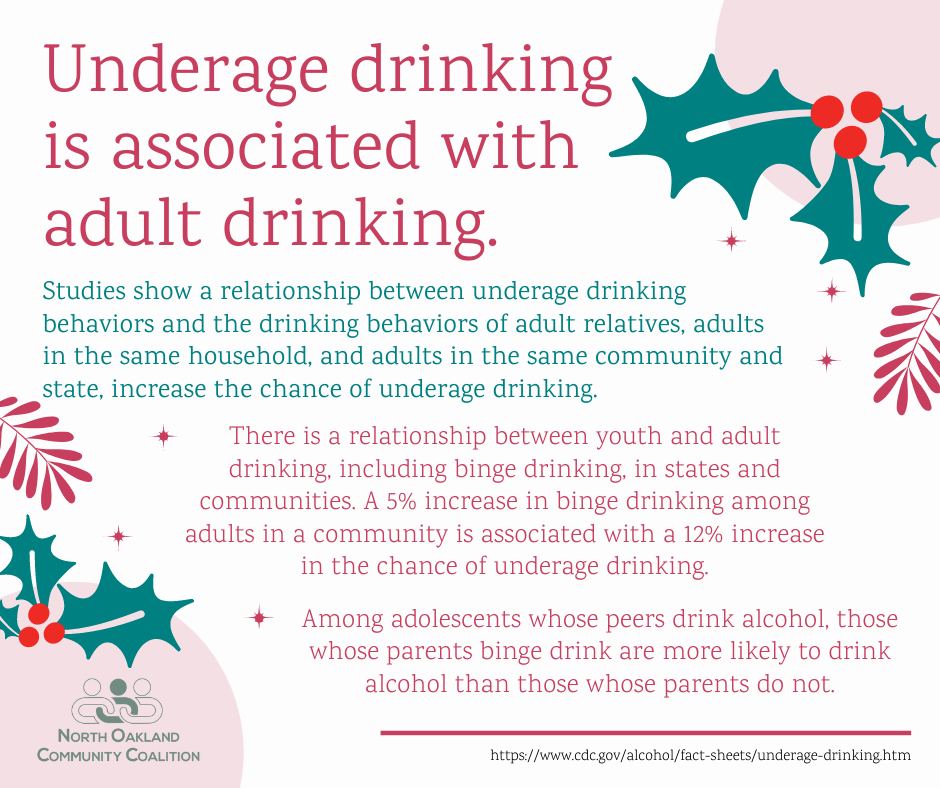
You can help prevent underage drinking by modeling responsibility during holiday celebrations. Visit our website www.noccmi.org for more tips on how you can talk with your kids about underage drinking.

Prevent excessive alcohol use by avoiding:

  • Binge drinking (defined as consuming 4 or more alcoholic beverages per occasion for women or 5 or more drinks per occasion for men).
  • Heavy drinking (defined as consuming 8 or more alcoholic beverages per week for women or 15 or more alcoholic beverages per week for men).
  • Any drinking by pregnant women or anyone younger than age 21.