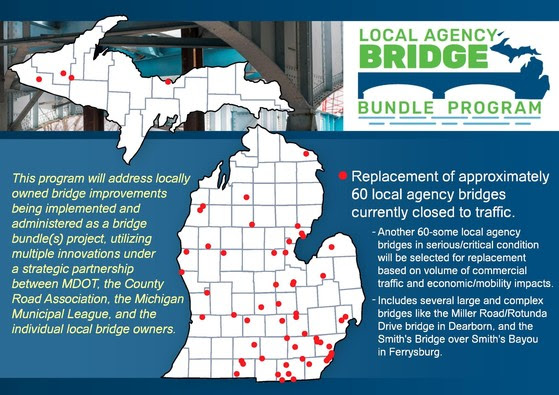
MDOT: What is bridge bundling?
|

|

Press Release FOR IMMEDIATE RELEASE: Feb. 10, 2021 CONTACT: Lynn Sutfin, 517-241-2112, SutfinL1@ MDHHS’ Dr. Joneigh Khaldun named to LANSING, Mich. – Today, President Joe Biden and Vice President Kamala Harris announced non-federal members of the Biden-Harris COVID-19 Health Equity Task Force, including Dr. Joneigh Khaldun, chief medical executive and chief deputy for health at the Michigan Department of Health and Human Services. “We are so proud that Dr. J is joining this national task force,” said Gov. Gretchen Whitmer. “She’s an extraordinary public servant who has helped our state navigate the pandemic through her confident leadership and unparalleled expertise. Michiganders are grateful for everything she has and continues to do for us, and we know that the Biden Administration is lucky to have her on board.” “I am honored to be part of the COVID-19 Health Equity Task Force and to play a part in helping address inequities as they relate to the COVID-19 pandemic, said Khaldun. “The virus has had a disproportionate impact on our most vulnerable communities, including communities of color. I look forward to making contributions as part of this task force that will ensure that future pandemic responses do not ignore or exacerbate health inequities.” Khaldun has been the lead strategist advising the state’s COVID-19 response and has held former roles leading work to address disparities as Detroit’s health director and the chief medical officer of Baltimore. Other members include:
The 12 task force members represent a diversity of backgrounds and expertise, a range of racial and ethnic groups, and a number of important populations, including: children and youth; educators and students; health care providers, immigrants; individuals with disabilities; LGBTQ+ individuals; public health experts; rural communities; state, local, territorial and Tribal governments; and unions. The Task Force is charged with issuing a range of recommendations to help inform the COVID-19 response and recovery. This includes recommendations on equitable allocation of COVID-19 resources and relief funds, effective outreach and communication to underserved and minority populations and improving cultural proficiency within the Federal Government. Additional recommendations include efforts to improve data collection and use, as well as a long-term plan to address data shortfalls regarding communities of color and other underserved populations. The Task Force’s work will conclude after issuing a final report to the COVID-19 Response Coordinator describing the drivers of observed COVID-19 inequities, the potential for ongoing disparities faced by COVID-19 survivors, and actions to ensure that future pandemic responses do not ignore or exacerbate health inequities. Information around this outbreak is changing rapidly. The latest information is available at Michigan.gov/Coronavirus
|

|

Press Release FOR IMMEDIATE RELEASE: Feb. 11, 2021 CONTACT: Bob Wheaton, 517-241-2112, wheatonb@ Additional food assistance for 350,000 Michigan families in response to COVID-19 extended through February LANSING, Mich. – Approximately 350,000 Michigan families will continue to have access to additional food assistance benefits during February as a response to the COVID-19 pandemic, the Michigan Department of Health and Human Services (MDHHS) announced today. Michigan previously approved the additional food assistance beginning in March 2020 – and now that is being extended for February 2021 with approval from the U.S. Department of Agriculture Food and Nutrition Service. “As the COVID-19 pandemic continues to impact virtually every aspect of our lives, the last thing Michigan families should have to worry about is being able to afford their groceries each week,” said Gov. Gretchen Whitmer. “Michiganders deserve to have peace of mind in knowing resources are available to help them during this time, which is why I’m grateful we can continue providing this vital support for families throughout the state.” Eligible clients will see additional food assistance benefits on their Bridge Card by Feb. 28, with payments beginning for some households on Feb. 18. Additional benefits will be loaded onto Bridge Cards as a separate payment from the assistance that is provided earlier in the month. “Extending these food assistance benefits is part of the department’s continuing efforts to help Michiganders put food on the table during the pandemic,” said MDHHS Director Elizabeth Hertel. “We will continue to work with our partners in the federal government to provide easy access to nutritious food.” More than 1.2 million people in Michigan receive federal Supplemental Nutrition Assistance Program (SNAP) benefits through the state’s Food Assistance Program. Households eligible for Food Assistance Program benefits will receive additional benefits in February to bring all current SNAP cases to the maximum monthly allowance for that group size. This change only applies to customers not currently receiving the maximum benefit amount. The 350,000 households that receive increased benefits represent greater than 50 percent of the more than 690,000 Michigan households that received food assistance in September. The remaining households already receive the maximum benefit. Below are the maximum allowable benefits for SNAP customers based on their respective household size:
The federal government is providing additional funding to states for food assistance under House Resolution 6201, the Families First Coronavirus Response Act. Eligible families do not need to re-apply to receive the additional benefits. People who receive food assistance can check their benefits balance on their Michigan Bridge Card by going online to www.michigan.gov/MIBridges or calling a consumer service representative toll-free at 888-678-8914. They can ask questions about the additional benefits by calling or emailing their caseworker. Customer service is available 24 hours a day, seven days a week. Spanish and Arabic service is available. If you are deaf, deafblind, or hard of hearing or speech-impaired, call the Michigan Relay Center at 7-1-1. Information around the COVID-19 outbreak is changing rapidly. The latest information is available at Michigan.gov/Coronavirus |

Pontiac, Michigan – Oakland County is providing free user-friendly screening software to local restaurants and public schools in the county to help enhance safety protocols and streamline the process of screening and tracking for COVID-19.
The county’s Department of Economic Development has contracted with Rochester-based software developer Clear To Go! for its software and app that helps ensure anyone who enters a building is healthy and adheres to current health protocols. The county is paying between $500,000-$750,000 for the cost of the software using federal Coronavirus Aid, Relief, and Economic Security (CARES) Act funding passed at the end of 2020. The contract runs through June.
“One of the challenges for restaurants, schools and businesses is screening clients, students or employees and then keeping track of the all the data,” County Executive David Coulter said. “This software allows our schools, businesses and restaurants to stay safe, run more efficiently and be less intrusive for everyone.”
Scott Garretson, co-founder and chief executive officer of the company, said Clear To Go! has performed over 1.5 million screenings and helped clients manage over 15,000 cases. This includes screening apps for employees, case management for human resources and a visitor management system. Its software is in use in several local communities and Lake Orion Schools.
“Clear To Go! provides a simple solution to help organizations of all sizes streamline daily health screening, tracking who was onsite for tracing, and manage cases/quarantines to know when it is safe for them to return onsite,” Garretson said. “The biggest time saving our clients experience is with our case management solution. Managing quarantines and failed screenings to know when a person can return onsite can be very time consuming. We help our clients prioritize cases and allow end users to share additional information with their open case directly to save time.”
According to a published description of the process, employees, guests or students who enter a location are screened with the Clear To Go! iOS, Android or SMS app using a configurable set of key COVID-19 health-related questions and optional temperature check.
Once the individual is cleared, the information then is linked to a Clear To Go! badge allowing that person to work onsite until the next required screening period.
If an employee or guest fails the screening, Clear To Go!’s case management tool provides early warning detection and a central point to ensure an employer’s established processes and protocols are followed, and then tracks all documents and communications from a human resources perspective.