
Bridge inspections with drone boats an infrastructure “Gamechanger”

Bridge inspections with drone boats an infrastructure “Gamechanger”

MDOT E-mail

MDOT on facebook MDOT on Twitter MDOT on YouTube Mi Drive - Know before you go. MDOT on Instagram Sign up for E-mails form MDOT
Having trouble viewing this email? View it as a Web page.

Bookmark and Share

FOR IMMEDIATE RELEASE                                               MONDAY, MARCH 15, 2020

CONTACT: Dan Weingarten, MDOT Office of Communications, 906-250-4809
                      WeingartenD@Michigan.gov

Bridge inspections with drone boats
an infrastructure “Gamechanger”

Fast facts:
–  The American Society of Civil Engineers (ASCE) recently named the Michigan Department of Transportation’s (MDOT) use of unmanned remote-controlled boats for bridge inspection to the group’s list of ”2021 Infrastructure Gamechangers.”
–  Sonar EMILY is a remote-piloted boat that MDOT has been using to combat bridge scour, the degradation of the streambed around bridge abutments due to water currents.
– Unmanned surface vehicles can be much safer and less labor-intensive than traditional bridge inspection methods.

March 15, 2021 — It’s a big recognition for a little boat. The American Society of Civil Engineers (ASCE) recently named the Michigan Department of Transportation’s (MDOT) use of unmanned remote-controlled boats for bridge inspection to the group’s list of ”Infrastructure Gamechangers” for 2021. ASCE combed through successful infrastructure solutions across the country to identify 13 of the most innovative examples.

Sonar EMILY (EMergency Integrated LanYard) is a remote-piloted boat that MDOT has been using to combat bridge scour, the degradation of the streambed around bridge abutments due to water currents. Scour is a leading cause of bridge failure.

After a 2016 study, MDOT has deployed EMILY units in the field to measure bridge scour and inspect bridges and culverts where access is limited. Results showed it could be safer, less labor-intensive and, in some cases, less costly than traditional techniques.

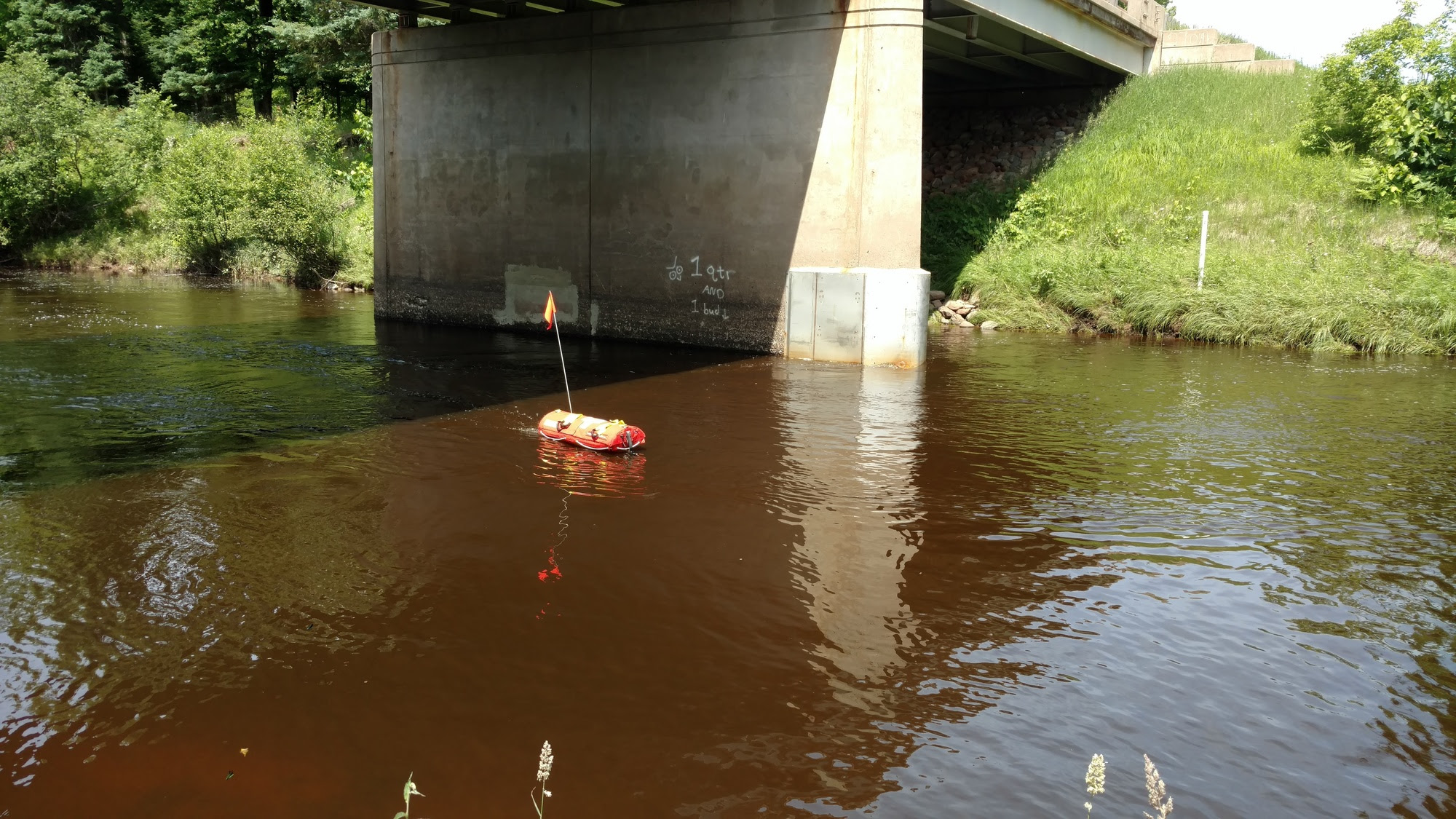
A powerful, durable, maneuverable water-jet-powered device, EMILY is about 4 1/2 feet long, 2 feet wide and a foot tall. It can be equipped with sonar to allow inspectors to take depth measurements and a topside camera to view the underside of bridges.

During the unprecedented flood event that struck Michigan in May 2020, MDOT used EMILY to help perform preliminary inspections of bridges across the area.

Midland, Gladwin, Saginaw, Arenac, and Iosco counties were declared disaster areas after several days of heavy rain and multiple dam failures. At its peak, more than 20 state trunkline and local bridges were impacted by flooding, resulting in immediate closures to protect the motoring public. More than 10,000 households were evacuated in Midland County over a 24-hour period.

MDOT focused emergency repair efforts on freeways carrying the highest traffic volumes, working to restore mobility to impacted communities as quickly and safely as possible. EMILY played a role in the rapid response.

”Even while water levels were still on the rise in the flooded areas, we were able to get EMILY in the water to determine if scour was getting worse in some locations,” said MDOT Bay Region Bridge Engineer Paul Schiefer. ”After water levels stabilized, we were able to use the system again to confirm again that there were no scour issues that needed to be addressed before opening a bridge to traffic.”

Some flooded structures were so badly damaged, repairs took nearly a year. Through the flood and the aftermath, EMILY helped cut inspection time – and risk.

”EMILY is a great asset for MDOT,” Schiefer said. ”During the flood response, it allowed us to monitor bridge conditions without putting a diver in a potentially dangerous situation.”

With four units strategically positioned around the state, MDOT is ready to deploy the EMILY system for both extreme high-water events and routine bridge inspections. In addition, the agency plans to use the technology for other applications as appropriate: getting images of bridge substructure below water, viewing the underside of bridges, inspecting hard-to-see culverts, and documenting bridge performance.

MDOT’s drone boat use and the other projects on the Gamechangers list are a sample of industry innovations that can help address the nationwide challenges outlined in the ASCE’s recent 2021 Report Card for America’s Infrastructure. The Report Card assessed 17 categories of infrastructure and assigned a grade of C-, a modest improvement from the D+ given in 2017.

For more information on ASCE’s Infrastructure Gamechangers go to https://www.infrastructurereportcard.org/solutions/gamechangers/.

ASCE, founded in 1852, is the country’s oldest national engineering organization. It represents more than 150,000 civil engineers in private practice, government, industry, and academia who are dedicated to advancing the science and profession of civil engineering.

###

Protect workers. Protect drivers. Safe work zones for all.
www.Michigan.gov/WorkZoneSafety

  www.twitter.com/MDOT_UP | www.facebook.com/MichiganDOT | www.youtube.com/MichiganDOT

Drone boat 1

A remote-controlled boat equipped with a sonar unit can maneuver around bridge piers and abutments during a high-water event for safer, more efficient inspections. (MDOT photo)


Drone boat 2

MDOT has deployed four Sonar EMILY (EMergency Integrated LanYard) units for use around Michigan in bridge scour inspections. Unmanned surface vehicles (USVs) like these promise efficient, safe, and cost-effective inspections during high-water events. (MDOT photo)


 Drone boat imagery

An example of the kind of imagery acquired by a Sonar EMILY boat. Inspectors can use the images to monitor the streambed around bridge piers. (MDOT photo)


An MDOT research spotlight video on using unmanned boats in use for bridge inspection is at https://www.youtube.com/watch?v=bJnrMVSzKqs.

Gary Peters: Americans still need additional support

Gary Peters: Americans still need additional support

U.S. Senator Gary Peters
Friend –A year into this pandemic, it’s clear that Michiganders and Americans still need additional support to put food on the table, pay their bills and make ends meet. I have heard gut-wrenching personal stories from countless Michiganders – who are trying to keep their heads above water and get through this public health and economic crisis.

That’s why I was proud to help pass — and am so glad that — the American Rescue Plan has been signed into law. This bill will deliver comprehensive, robust relief for Michigan families, workers, small businesses, schools and communities.

Image

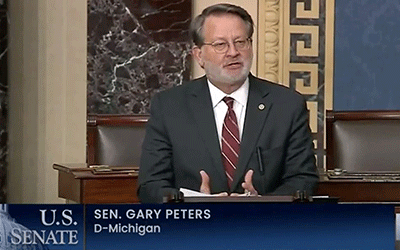
Click here to view my recent floor speech on how the American Rescue Plan
will deliver critical relief to Michiganders.

The American Rescue Plan contains significant funding for key priorities to stop the spread of this virus and provide Michiganders with much needed relief, including:

  • Direct Stimulus Checks: The package includes a new round of direct payments of $1,400 per adult and child to most Americans. This would ensure that a typical family of four would receive an additional $5,600.
  • Resources to Accelerate Vaccine Distribution: The bill includes $50 billion to help the Federal Emergency Management Agency (FEMA) support a national vaccination program. This was something I talked about with President Biden and Vice President Harris directly in the Oval Office, and something I secured as Chairman of the Senate Homeland Security and Governmental Affairs Committee.
  • Support to Safely Reopen Schools: The package includes $170 billion to help schools reopen safely under the guidance of public health officials.
  • Unemployment Assistance: The legislation provides an additional $300 per week for all workers receiving unemployment benefits, through September 6, 2021.
  • Support for Small Businesses: The bill includes $7 billion in support for the Paycheck Protection Program AND $25 billion in grants for restaurants and bars. I also led the charge in securing $10 billion to provide $10 billion for the State Small Business Credit Initiative, including $1.5 billion to support minority-owned businesses. And;
  • Support for Local Communities: The legislation provides $350 billion in emergency funding for cash-strapped communities across the country to continue essential services and retain critical frontline workers such as police officers, firefighters, EMTs and teachers.

Securing this comprehensive support has been my TOP priority. This package has not only received broad support in Michigan and across the country, but is also one of the most popular pieces of legislation to be signed into law in decades.

While we’ve made important progress, we cannot let up now. The virus doesn’t take a day off – and neither can we. Our state and our country has needed a shot in the arm to overcome this pandemic, and I am confident that this landmark package will provide the resources needed to get us through this crisis.

Thanks for reading,

Image

Gary Peters
United States Senator for Michigan

Additional food assistance extended through March

Additional food assistance extended through March

MDHHS banner with logo no names

Press Release


FOR IMMEDIATE RELEASE: March 16, 2021 

CONTACT: Bob Wheaton, 517-241-2112, wheatonb@michigan.gov  

Additional food assistance for 350,000 Michigan families in response to COVID-19 extended through March

LANSING, Mich. – Approximately 350,000 Michigan families will continue to have access to additional food assistance benefits during March as a response to the COVID-19 pandemic, the Michigan Department of Health and Human Services (MDHHS) announced today.

Michigan previously approved the additional food assistance beginning in March 2020 – and now that is being extended for March 2021 with approval from the U.S. Department of Agriculture Food and Nutrition Service.

“Michigan has been a national leader in making sure families can put food on the table during COVID, and we must continue to ensure that no Michigander goes hungry during this challenging time,” said Governor Gretchen Whitmer. “I am pleased to work with our federal partners to continue supporting 350,000 families through March.”

Eligible clients will see additional food assistance benefits on their Bridge Card March 20 to 30. Additional benefits will be loaded onto Bridge Cards as a separate payment from the assistance that is provided earlier in the month.

“MDHHS remains dedicated to helping families afford groceries. We are all in this together as we combat COVID-19,” said MDHHS Director Elizabeth Hertel. “I promise we will continue to work tirelessly on behalf of Michiganders who are in need.”

Nearly 1.3 million people in Michigan receive federal Supplemental Nutrition Assistance Program (SNAP) benefits through the state’s Food Assistance Program.

Households eligible for Food Assistance Program benefits will receive additional benefits in March to bring all current SNAP cases to the maximum monthly allowance for that group size. This change only applies to customers not currently receiving the maximum benefit amount. The 350,000 households that receive increased benefits represent close to 50 percent of the more than 707,000 Michigan households that received food assistance in January. The remaining households already receive the maximum benefit.

Below are the maximum allowable benefits for SNAP customers based on their respective household size:

  • One Person: $234
  • Two Persons: $430
  • Three Persons: $616
  • Four Persons: $782
  • Five Persons: $929
  • Six Persons: $1,114
  • Seven Persons: $1,232
  • Eight Persons: $1,408

The federal government is providing additional funding to states for food assistance under House Resolution 6201, the Families First Coronavirus Response Act.

Eligible families do not need to re-apply to receive the additional benefits. People who receive food assistance can check their benefits balance on their Michigan Bridge Card by going online to www.michigan.gov/MIBridges or calling a consumer service representative toll-free at 888-678-8914. They can ask questions about the additional benefits by calling or emailing their caseworker.

Customer service is available 24 hours a day, seven days a week. Spanish and Arabic service is available. If you are deaf, deafblind, or hard of hearing or speech-impaired, call the Michigan Relay Center at 7-1-1.

Information around the COVID-19 outbreak is changing rapidly. The latest information is available at Michigan.gov/Coronavirus and CDC.gov/Coronavirus.

low-income college students can apply for food assistance

MDHHS banner with logo no names

Press Release


FOR IMMEDIATE RELEASE: March 11, 2021 

MDHHS CONTACT: Bob Wheaton, 517-241-2112, wheatonb@michigan.gov

LEO CONTACT: Elyse Walter, 517-449-9731, waltere@michigan.gov

Michigan low-income college students enrolled in career and technical education programs can apply for food assistance
 

Benefits available to Perkins program enrollees

LANSING, Mich. – Michigan students in college career and technical education programs are reminded they are now eligible to receive food assistance if they meet other eligibility requirements.

The Michigan Departments of Labor and Economic Opportunity (LEO) and Health and Human Services (MDHHS) are encouraging students to apply for food assistance benefits online at Michigan.gov/MIBridges.

LEO and MDHHS developed this new initiative in 2020 to address rising food insecurity among students that has been made worse by COVID-19.

Close to 16,000 low-income college students in Michigan who are enrolled in career and technical education (CTE) programs are eligible to receive food assistance benefits through the federal Supplemental Nutrition Assistance Program (SNAP).

“As many CTE students are back on their campuses, what better time to encourage them to take advantage of critical resources that will support their lives as they prepare for high-demand, critical job openings,” said LEO Acting Director Susan Corbin. “These SNAP benefits will help them focus on their educational needs and prepare for a successful future.”

Previously, college students enrolled in qualifying CTE programs who attended school at least half-time could not qualify for SNAP benefits, even if they met income eligibility requirements, unless they fell into certain categories such as working at least 20 hours per week, caring for a child, or being unable to work.

“MDHHS was already working to help more people put nutritious food on the table prior to the pandemic,” said MDHHS Director Elizabeth Hertel. “COVID-19 made this priority even more critical. Due to the pandemic, many students lost their jobs. As a result, they lost their SNAP eligibility through no fault of their own.”

College students in Michigan are eligible for SNAP if they meet income and other program requirements and are enrolled at least half-time in an occupational program that leads to employment under the Strengthening Career and Technical Education for the Twenty-First Century Act of 2018 known as Perkins V.   

Additionally, CTE college students who enroll in SNAP can take advantage of an additional payment provided each month until June, which amounts to an extra 15% to help recipients affected by the COVID-19 pandemic.

The Perkins Postsecondary Career and Technical Education Program provides funding to 28 community colleges, three public universities and one tribal college to support pathways to high-wage, high-skilled, and in-demand careers that require less than a bachelor’s degree.

Those institutions offer more than 3,600 qualifying programs, offering a certificate or associate’s degree to careers in fields such as information technology, health care, hospitality and manufacturing. There are nearly 90,000 students enrolled in these programs in Michigan. Some of those students may already be receiving food assistance benefits, while others will become eligible for this new opportunity.

For anyone currently enrolled in a Perkins program with an existing food assistance case who has experienced a loss of income, their MDHHS caseworker will determine Perkins program status to ensure the benefits are correct.
Any Perkins student who wants to apply for food assistance should provide documentation from their school that outlines their major and program or course of study to assist in determining their eligibility for SNAP. Examples could include a proof of registration and a document showing their major, program, or course of study. A caseworker will use that information to determine eligibility.

Students interested in applying for food assistance can go to Michigan.gov/MIBridges. Verification of enrollment in a Perkins program must be provided by the student or may be requested from the postsecondary institution.
Learn more about the Perkins Postsecondary CTE Program at Michigan.gov/LEO-Perkins.

small Businesses Receive $10,000 Boost From ITC Michigan

small Businesses Receive $10,000 Boost From ITC Michigan

Main Street Oakland County Crowdfunding Campaign To Help Small Businesses Hurt By COVID-19 Receives $10,000 Boost From ITC Michigan

​Pontiac, Michigan – The Main Street Oakland County crowdfunding campaign to support downtown small businesses struggling because of the coronavirus pandemic has raised more than $300,000 thanks to a recent $10,000 boost from ITC Michigan, based in Novi, Michigan.

The countywide campaign, launched in the early days of the pandemic last year, is the first of its kind in the nation to be sponsored by a Main Street program. The funds were generated from 21 of Main Street Oakland County’s 25 designated communities. The campaign surpassed its original $100,000 goal due to generous contributions from the general public, local governments and corporations, like ITC.

Funds raised were utilized by local downtown management organizations to provide grants for more than 200 small businesses independently owned and operated with 30 employees or less, including retailers and restaurants in the various downtown districts.

“Small businesses are the life blood of our economy and the hope for our future when we emerge from the COVID-19 pandemic,” Oakland County Executive David Coulter said. “That’s why it’s been vital to support them throughout this public health crisis in a number of ways, including with the Main Street Oakland County crowdfunding campaign. Thank you to ITC Michigan for their generosity.”

Main Street Oakland County matched dollars raised by each community at $1 for each $1 contributed, up to $4,000. The campaign used the Patronicity platform, and each community set their own fundraising goals and made their case to the public to build their fund.

“ITC Michigan has always taken an active role in the communities we serve,” said Simon Whitelocke, president of ITC Michigan. “During this extraordinary time, there are tremendous humanitarian and economic needs across our home state. We’re proud to support the Main Street Oakland County crowdfunding campaign, which is making a positive impact on the small business community that is so vital to our economy.”

The crowdfunding campaign was one of the many ways Oakland County assisted businesses throughout the pandemic. The Oakland County Executive and the Board of Commissioners allocated over $80 million of the county’s share of CARES Act funding to small businesses. These included:

  • $32 Million Grant Fund to assist 3,153 retail, restaurants, and other businesses
  • $14 Million Stabilization Fund for 3,500 small business
  • $11 Million Michigan Small Business Restart Grant helped nearly 3,000 Oakland County businesses including minority-, women-, and veteran-owned businesses.
  • $10 Million Oakland Together Restaurant Relief Program for about 785 restaurants.
  • $10 Million Industry 4.0 PPE Resilience Grants Program approved grants for 235 businesses.
  • $1 Million to 23 companies who shifted production to personal protective equipment such as masks, gowns, and face shields.
  • 15,000 Small Business Reopening Kits which contained PPE.

Plus, the county coordinated the Michigan Small Business Survival Grant which awarded over $6 Million to 1,348 businesses.

The following crowdfunding participating communities, ranging from 600 to 60,000 in population, met or exceeded their funding marks over the course of the two-month campaign: Berkley, Birmingham, Clarkston, Clawson, Farmington, Ferndale, Franklin, Hazel Park, Highland, Holly, Lake Orion, Lathrup Village, Leonard, Madison Heights, Oak Park, Ortonville, Oxford, Pontiac, Rochester, South Lyon and Wixom.

The crowdfund contributions were used by each community to help their small businesses pay for rent, utilities, wages, inventory, PPE acquisition, and marketing. For example, the Ferndale Downtown Development Authority utilized funding to develop a marketplace for their small businesses where they could obtain difficult to find PPE at no cost. The Wixom Downtown Development Authority provided grants to small businesses that allowed them to keep operating and prevent their permanent closure.

All donations were coordinated through the Community Foundation of Greater Rochester. Questions about the program can be sent to Main Street Oakland County coordinator John Bry at bryj@oakgov.com.

In 2020, public and private investment in Main Street Oakland County totaled almost $36 million and resulted in 24 net new jobs; 36 net new businesses; and contributions of more than 16,308 volunteer hours.

To date, more than $962 million in public and private investments have been made to Main Street Oakland County downtowns, establishing 1,254 net new businesses and generating more than 8,000 jobs. Oakland County is the first and still only county in the United States to operate a full-service, county-wide Main Street program.