Whitmer Announces 21 Rebuilding Michigan Road Projects

|

|
|


Press Release FOR IMMEDIATE RELEASE: March 23, 2021 CONTACT: Bob Wheaton, 517-241-2112, wheatonb@ Focus on improving safety of youth in Michigan’s child-caring institutions and juvenile justice facilities will continue Committee wraps up work after setting stage for improvements LANSING, Mich. – Michigan youth who are under state care and supervision in child-caring institutions and juvenile justice facilities will be safer because of the work of a diverse group of child welfare stakeholders that is holding its last meeting today. The group’s accomplishments include revising Michigan licensing rules to eliminate the use of physical restraints and seclusion in child-caring institutions, and creating a statewide Youth Advisory Board made up of children who have experienced the child welfare system. The Child-Caring Institution Steering Committee formed by the Michigan Department of Health and Human Services (MDHHS) began meeting in September 2020 in response to a report from national experts recommending improved oversight of safety and quality of care to children receiving residential services – including a move towards restraint-free programs. Former MDHHS Children’s Services Agency executive director JooYeun Chang requested the review following the tragic death of a youth in May 2020 due to improper and unnecessary restraint in a licensed facility. “MDHHS remains dedicated to improving safety and quality of care in Michigan’s child-caring institutions and reducing reliance on congregate care,” said Stacie Bladen, interim Children’s Services Agency executive director and co-chair of the steering committee. Members and workgroup participants moved the state closer to eliminating coercive interventions in residential programs and improving positive long-term outcomes for children and their families. The proposed licensing rules – if approved following a public hearing – will permanently ban restraint and seclusion in child-caring institutions. They will take the place of temporary emergency rules that are in place until July. The statewide Youth Advisory Board will be critical in reviewing and recommending changes in policy and practice to better support youth and families in the child welfare system. The board began meeting this month, led by Brandi McKenzie, MDHHS Youth in Transition analyst, and Christine Hansen, Michigan Youth Opportunities Initiative coordinator. Steering Committee co-chair Sean de Four, chief executive officer of Southwest Solutions in Detroit, said providers remain committed to working with the state and stakeholders to safely and effectively support youth who have experienced trauma. “This effort was a true partnership between the provider community, MDHHS and a wide variety of stakeholders on behalf of the children and families who require the intensive treatment provided by Michigan’s residential care settings,” he said. “We came together as a community committed to transforming our system, to ensure that tragedies like the one that brought us together never happen again. After six months of diligent effort, we are confident that the reforms developed by the workgroups will move us toward a radically improved system of residential care.” Other reform measures from the steering committee include:
“The Six Core Strategies© training through Building Bridges Initiative was pivotal for our agency in considering our areas of strength and our areas to develop more fully in supporting youth in residential programming, said Mary Muliett, chief executive officer of D.A. Blodgett – St. Johns, a child-caring institution. “The sessions spurred energy and thought from our whole team and was an amazing launching point towards creating an even stronger model for youth and their families. We are grateful for the department’s support in these efforts.” The steering committee consisted of seven workgroups focused on intervention policy and practice, contract monitoring, licensing oversight, data reporting, caseworker policy and practice, youth and family engagement, and financial and organization structures. |

Press Release FOR IMMEDIATE RELEASE: March 22, 2021 CONTACT: Chelsea Wuth, 517-241-2112, WuthC@michigan.gov Benefits of having a family physician recognized during Family Medicine Week LANSING, Mich. – The week of March 21-27, 2021, is being recognized by Governor Gretchen Whitmer, Michigan Department of Health and Human Services, Michigan Academy of Family Physicians, and Michigan Association of Osteopathic Family Physicians as Family Medicine Week in Michigan. The weeklong observance highlights family physicians’ dedication to providing comprehensive primary care to Michiganders across the state to help them maintain health and wellness, and to reduce costs to the healthcare system. Research shows that adults and children with a family physician as their regular source of care have lower annual costs of care, visit the doctor less, are prescribed fewer medications, and report less difficulty accessing care. “Primary care is the foundation of our healthcare system and so critical to promoting the health of individuals, families, and communities. Family medicine providers understand the importance of prevention and how to best approach health from a holistic viewpoint,” said Dr. Joneigh Khaldun, chief medical executive and chief deputy for health at the Michigan Department of Health and Human Services (MDHHS). “Visiting your family physician for regular check-ups can help you stay healthy and prevent illness. I am proud of how our family medicine physicians have stepped up during this pandemic to take care of their patients.” According to a Kaiser Family Foundation survey, eight out of 10 people are likely to rely on the advice of their personal primary care physician when deciding to get immunized. This makes family physicians key partners in helping the State of Michigan reach its goal of vaccinating 70% or more of its residents aged 16 and older against COVID-19. Michigan Academy of Family Physicians and Michigan Association of Osteopathic Family Physicians collectively represent more than 5,000 family physicians, family medicine residents, and medical students statewide. Together they are hosting Michigan Family Medicine Advocacy Day on March 23 to provide an opportunity for family medicine advocates to discuss legislative and policy issues impacting healthcare access and delivery in the state. Contact your local healthcare system if you need a family physician. To learn more about Michigan Academy of Family Physicians, visit mafp.com. To learn more about Michigan Association of Osteopathic Family Physicians, visit maofp.org. You can view Governor Whitmer’s Family Medicine Week proclamation at https://www.mafp.com/michigan- |

|
|||||||||
|
|||||||||
News Digest – Week of March 22, 2021
Beautify your backgrounds with stunning virtual backdrops like this. |
|||||||||
|


FOR IMMEDIATE RELEASE March 22, 2021 Contact: Press@Michigan.gov
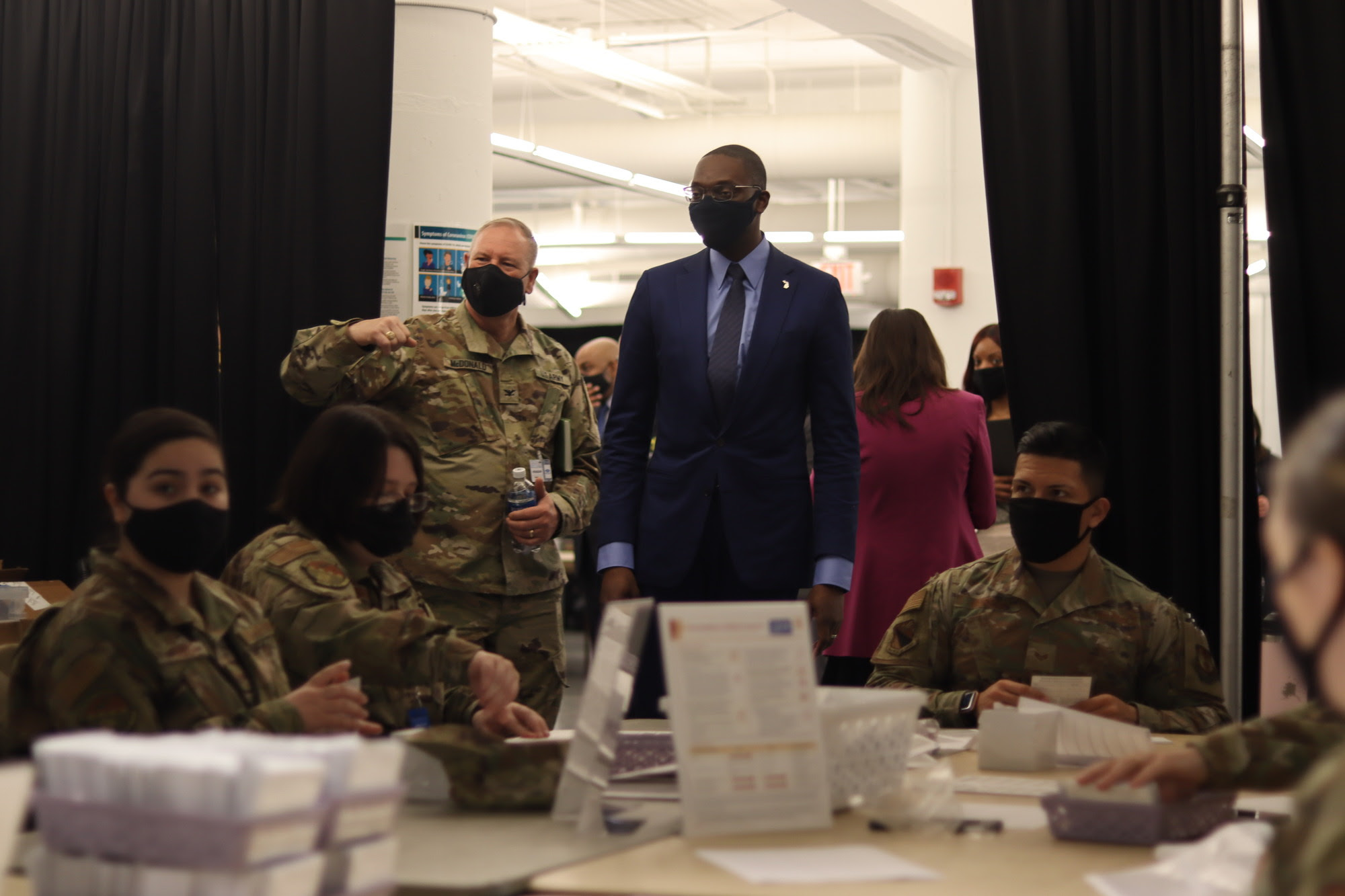
PHOTOS: Lt. Governor Gilchrist Joins Members of Congress for Visit to Community Vaccination Site at Ford Field Before March 24 Opening
LANSING, Mich. — Today, Lt. Governor Garlin Gilchrist visited Ford Field alongside members of Congress to observe the partnerships and logistics supporting Michigan’s first federal community vaccination site, which is expected to administer an additional 6,000 vaccines per day for eight weeks beginning on March 24.
“We continue to keep our foot on the gas to ensure that every Michigander who wants a vaccine can get one as quickly as possible,” said Lt. Governor Gilchrist. “The Ford Field community vaccine site is an opportunity to be a national leader in vaccine distribution by building upon the work that we’ve done to ensure equitable access to this safe and effective vaccine — and we thank our local, federal, hospital, and private sector partners for making it happen. We know the vaccine is the most effective way to get back to normal, so that we can all hug our families, get together again, and create economic opportunity going forward. It’s on all of us to stand tall by getting the vaccine when it is our turn.”
To date, Michigan has administered 3,412,372 vaccines, moving the state closer to its goal of equitably vaccinating at least 70% of Michiganders ages 16 and older as soon as possible. As part of these efforts, Michigan is working to administer 50,000 shots per day, partnering with organizations like Ford Field to create more opportunities for Michigan residents to receive a vaccine.
Ford Field will operate starting March 24 from 8 a.m. to 8:30 p.m. seven days a week for eight weeks under the federal government’s vaccination pilot program. The site was selected according to the U.S. Centers for Disease Control and Prevention priority tool to help those hardest hit and most vulnerable. The Ford Field clinic has the capacity to administer 6,000 doses daily.
The vaccine will be offered at no cost and insurance is not required, nor will it be requested at the vaccination clinic. All Michigan residents currently eligible to receive the vaccine can register for an appointment if they qualify under the Michigan Department of Health and Human Services (MDHHS). The most recent vaccine prioritization guidance can be found on Michigan’s COVID-19 website.
The site will be managed by the state of Michigan with support from FEMA, Wayne County, the city of Detroit, Ford Field, Meijer, Henry Ford Health System, the Detroit Lions, and the Protect Michigan Commission.
|


 Want to see more stunning pictures like this, taken by Michigan state parks photo ambassador
  Have questions about fishing in Michigan and 2021 fishing regulations? Check out these upcoming virtual “Conversations & Coffee” events, focusing on fisheries management areas around the state, to get answers and talk with DNR Fisheries Division staff.
 Want to learn more about what Michigan is doing to prevent and control invasive plants, pests and animals? The Michigan Invasive Species Program’s NotMISpecies webinar series explores how agencies, universities and locally led organizations are working together to protect Michigan’s natural resources. The series examines species-specific actions, innovations in research and technology, and programs designed to help communities prevent and manage harmful invasive species.
 The sun is out, and so are new virtual backgrounds from the DNR!