Gov. Whitmer Signs Balanced, Bipartisan FY26 Budget

Gov. Whitmer Signs Balanced, Bipartisan FY26 Budget

Governor Whitmer Header

FOR IMMEDIATE RELEASE 

October 7, 2025

Contact: press@michigan.gov


Gov. Whitmer Signs Balanced, Bipartisan FY26 Budget to Fix the Damn Roads, Cut Taxes, Lower Costs, Protect Public Health & Safety

Balanced budget delivers on the kitchen-table issues including roads, taxes, health care, public safety, government efficiency, and protections for Michigan’s air, land, and water


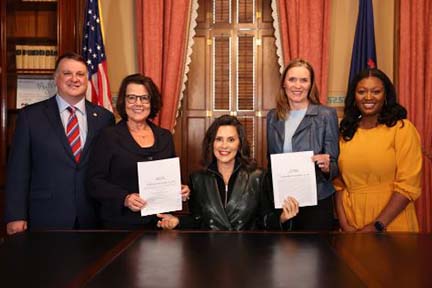
LANSING, Mich. — Today, Governor Gretchen Whitmer signed her seventh balanced, bipartisan budget into law. The fiscal year 2026 (FY26) budget secures sustainable, long-term funding to fix Michigan’s state and local roads, tax cuts for seniors and working families, protections for core health care services, funding for public safety, investments in Michigan’s air, land, and water, and commonsense changes to improve government efficiency. The FY26 budget totals $81 billion, including a general fund total of $14.1 billion.


Additionally, as a part of the budget deal, Speaker Hall and Majority Leader Brinks agreed to pass bipartisan legislation before the end of the calendar year that will make it easier to create and retain good-paying, high-skill jobs in Michigan. Governor Whitmer called for commonsense, job creating legislation in the Mackinac Policy Conference keynote and several of her series of Road Ahead speeches this year. The legislation will help Michigan continue to lead the future of advanced manufacturing, regardless of the economic uncertainty at the federal level.


“This balanced budget delivers on the kitchen table issues that make a real difference in people’s lives,” said Governor Whitmer. “Our budget fixes the damn roads, cuts taxes for seniors and working families, funds first responders, secures core health care services that millions of Michiganders rely on, protects our air, lakes, and land, and increases government efficiency to saves taxpayers time and money. I’m so grateful to legislators on both sides of the aisle for coming together to get this done. Amidst so much uncertainty caused by a chaotic tariff strategy and a national government shutdown, Michigan is showing everyone how to get things done. In the weeks and months ahead, we will build on this momentum and come together on commonsense tools to create and retain good-paying jobs.”


Budget signing


Click here to view the governor’s budget video.


“Our number one priority is helping more people afford to stay and succeed in Michigan, by providing access to health, jobs, and safety for their families,” said Lt. Governor Garlin Gilchrist II. “This budget does just that. It positions mothers and babies to be healthier and escape poverty. It helps seniors keep what they’ve earned by completing the rollback of the retirement tax. It tackles higher prices for working families by expanding the working families tax cut. It protects access to Medicaid for the millions of Michiganders who use it. With this budget, we are Standing Tall for a Michigan where everyone can afford to live a good life and raise their family. Let’s keep getting it done.”


“While this budget cycle featured unprecedented challenges, it also provided us the opportunity to show the rest of the country what leadership can look like in divisive political times,” said Senate Majority Leader Winnie Brinks. “The result: a bipartisan budget that fixes our roads, strengthens public schools, protects health care access, and insulates us from some of the toughest federal cuts. Michiganders and their communities stand to benefit both immediately and into the future because of groundwork we are laying today.”


“People are frustrated when they struggle to pay their bills while the government burns through billions of dollars of their money like it’s nothing,” said Speaker of the House Matt Hall. “Our state government spending has grown way beyond its means, and it’s time to rein it in. This budget makes a significant difference in eliminating waste, fraud and abuse to lower state spending and give the taxpayers better value for their dollars. That’s how we were finally able to get our local roads fixed and pass the public safety trust fund, all while eliminating taxes on tips, overtime and social security. You can do a lot when you take the time to evaluate state spending and set better priorities.”


“In Michigan, we’re proving that both sides can come together to do hard things, and I’m proud of the budget. It fixes the damn roads, protects Medicaid coverage for more than 2 million Michiganders, and invests in our kids from pre-k through college,” said State Budget Director Jen Flood. “At a time when families are dealing with higher costs, this budget builds on our record of fiscal responsibility by paying down debt and cutting taxes for seniors and working families.”


Legislator Quotes

“House Democrats came to the negotiating table months ago ready to work and get a budget done–but we were also clear that Michigan schools, healthcare, and public safety were not going to be on the chopping block,” said House Democratic Leader Ranjeev Puri (D-Canton). “Michigan Democrats worked together to protect those key areas of the budget, and as a result we protected universal free meals and Medicaid, raised state trooper pay and increased Public Safety Revenue Sharing, and did so while developing a long-term road funding plan. This bipartisan, balanced budget was the result of months of work, but the fight continues now to ensure every person in this state has access to the resources and opportunities they need to thrive.”


“This budget represents our joint priorities with record investments in education; support for our law enforcement; putting Michigan families first; and fixing the damn roads,” said state Representative Ann Bollin (R- Brighton Township), Chair of the House Appropriations Committee. “I am grateful for the collaboration and bipartisan effort to deliver a budget that is fiscally responsible and responsive to the needs of people and businesses across Michigan.”


“The people of Michigan deserve a budget that prioritizes their well-being and economic prosperity, especially in the midst of political chaos we too often see coming from Washington DC.” said state Senator Sarah Anthony (D- Lansing), Chair of the Senate Appropriations Committee. “This budget shows we can come together across party lines to fix today’s real problems – from fixing local roads and bridges, to protecting the social safety net, this budget keeps our state moving forward while keeping our people front and center.


Stakeholder Quotes

“Together with our partners in the legislature and Governor Whitmer, we are investing in the infrastructure and assets that will move the State of Michigan forward,” said Mark Hackel, Macomb County Executive. “With a new, sustained pool of funding, we will enhance our efforts to fix local roads.  At Selfridge, the state continues to invest in the critical resources that will bolster operations to ensure that our hometown airbase will support a new fighter and tanker mission.”


“This historic, long-term road funding agreement is a game-changer for Michigan,” said Rob Coppersmith, executive vice president of the Michigan Infrastructure & Transportation Association. “After decades of short-term fixes and inaction, this budget delivers real, sustainable investment that will repair and rebuild our roads, save good-paying jobs, and strengthen Michigan’s economy. We’re grateful for the leadership of Governor Whitmer, Senate Majority Leader Winnie Brinks, and House Speaker Matt Hall in getting this done. This is a major step forward, but our work isn’t over. We must continue building on this momentum to ensure Michigan’s roads remain safe, reliable, and well-maintained for decades to come.”


“The bipartisan, forward looking, state budget that the legislature passed and the Governor has signed delivers real results for Michiganders,” said Brent Pilarski, Business Manager, Michigan Laborers District Council (LiUNA MI). “Investing an additional nearly $2 billion annually in sustainable long-term road funding creates economic security for business expansion and careers in the construction industry. This budget demonstrates commitment to funding Michigan’s infrastructure and keeping skilled building tradesman employed in Michigan for decades to come.”


“We are grateful for Gov. Whitmer, Senate Majority Leader Brinks and Speaker of the House Hall for their leadership in creating a budget that will continue to advance the health of individuals and communities throughout Michigan,” said Brian Peters, CEO of the Michigan Health & Hospital Association. “This budget provides important state funding that patients, healthcare workers and hospitals rely on to maintain access to care and protect important healthcare services.”


“We’re relieved that state lawmakers were finally able to come to the table and reach a budget agreement, and that they and the governor were committed to doing what they could to protect Medicaid and SNAP for Michiganders,” said Monique Stanton, President and CEO of the Michigan League for Public Policy. “Over 2.6 million Michiganders rely on Medicaid for health care, and 1.4 million count on SNAP to put food on the table, and in these uncertain times, it was crucial for our leaders to prioritize their well-being,”


“Thanks to strong bipartisan leadership, thousands of Michigan babies will now have access to the resources they need to grow up healthy, secure, and supported from the very beginning.” said Dr. Mona Hanna, director of Rx Kids and associate dean of public health at Michigan State University College of Human Medicine. “This is a cutting-edge program that will propel the next generation and is a pillar of Governor Whitmer’s legacy.”


“On behalf of moms, babies and families in Michigan we are relieved to have a FY 26 budget in place,” said Amy Zaagman, Executive Director of the Michigan Council for Maternal & Child Health. “We continue to be grateful to Governor Whitmer for her leadership and to the Legislature for their dedication to key investments that are making a difference. The lowest infant mortality rate on record is a testament to what sustaining meaningful funding can do to save lives.”


Lowering Costs, Fixing Roads, Creating Jobs, Growing Michigan’s Economy

Lowering Costs & Cutting Taxes

  • Continuing to roll back the retirement tax on seniors, saving 500,000 households an average of $1,000 a year.
  • Continuing to deliver the Working Families Tax Credit, Michigan’s match of the federal Earned Income Tax Credit (EITC), putting an average combined refund of $3,500 in the pockets of 650,000 families.
  • Eliminating state taxes on tips, overtime pay, and Social Security income, saving hundreds of thousands of seniors and working families money on their taxes every year.

Fixing the Damn Roads (and more)

  • Nearly $2 billion in ongoing resources for improving state and local roads when fully implemented over the next four years, with significant new ongoing investments in bridges and public transit.
  • $417 million for water infrastructure initiatives to strengthen local systems and replace lead service lines.
  • $322.4 million for airport safety and improvement projects, ensuring safe and modern aviation infrastructure across Michigan.
  • $53.2 million for transportation economic development, promoting road and infrastructure projects that support job growth and business investment.
  • $50 million for the Michigan Housing and Community Development Fund to support affordable housing needs and to revitalize downtown areas and adjacent neighborhoods in Michigan.
  • $40 million for rail grade separation projects to improve safety and reduce traffic congestion.

Growing Our Economy 

  • $59.4 million to support Michigan’s business attraction and community revitalization programs to incentivize job creation, investment, and the revitalization of blighted properties.
  • $56.5 million to support job creation services, entrepreneurship, and defense and aerospace innovation to support new and emerging business growth in key industries.
  • $13.4 million in support of arts and cultural institutions that bring inspiration, creativity and vibrancy to communities across the state, making them unique and desirable places to work, live and raise a family.
  • $17 million to continue the iconic Pure Michigan campaign to fuel tourism, support local businesses, and strengthen Michigan’s economy.
  • $2.3 million for the Office of Rural Prosperity to support economic growth and infrastructure projects in rural communities across Michigan.
  • $1.4 million for the rural development fund grant program, sustaining land-based industries and rural infrastructure.

Workers and Small Businesses

  • $439.1 million for workforce development programs and grants, including training opportunities for youth, dislocated workers, and underserved populations, to build pathways into good-paying jobs.
  • $188.8 million for Michigan Rehabilitation Services, helping individuals with disabilities prepare for, obtain, and maintain employment.
  • $31.8 million for Going Pro to help Michigan employers train and retain workers, offering on-the-job experience, apprenticeships, and classroom instruction that lead to industry-recognized credentials.
  • $25.2 million for the Community and Worker Economic Transition program, assisting workers and businesses affected by industry shifts to connect with retraining, job placement, and economic transition resources.
  • $5 million to address workforce needs across the state by filling talent gaps in key industries, expanding pre-apprenticeships and registered apprenticeships, and supporting employer-led collaboratives and other innovative job creation strategies.

Leveling the Playing Field

  • $236 million for Michigan Indigent Defense Commission grants, which supports local trial courts and expands access to counsel for low-income defendants and improves fairness in Michigan’s justice system.
  • $30.3 million for specialized services grants, which provide transit support for seniors and people with disabilities.
  • $3 million for financial literacy program supported with philanthropic funds to empower residents with the financial knowledge they need to manage and secure their future.


Safe, Healthy Communities

The FY26 budget strengthens the foundations of Michigan’s communities by investing in public safety, making health care more affordable and accessible, and protecting natural resources. These investments keep neighborhoods safe, ensure families can get the care they need, and preserve Michigan’s land and water for future generations:

Protecting Public Safety

  • $1.6 billion in revenue sharing to continue support for all cities, villages, townships, and counties across the state, helping them provide services, including first responders, transportation, and water infrastructure, as well as placemaking and recreation.
  • $95 million for new local public safety focused programs to provide cities, villages, townships, and counties with additional resources for law enforcement, prosecution, and other public safety related recruitment, retention, training, and firefighting equipment needs, as well as to support community violence intervention efforts.
  • Funding to sustain 2,000 uniformed personnel in the Michigan State Police, ensuring strong law enforcement and patrol services that provide highway safety, traffic enforcement, and emergency response services across Michigan.
  • $51.7 million for forensic science operations, supporting crime lab services like DNA testing, toxicology, firearms, and trace evidence analysis that help solve cases across the state.
  • $45 million for regulation of insurance companies and financial institutions to ensure fair practices, protect consumers, and maintain stability in Michigan’s insurance and banking system.
  • $44 million for statewide judicial information systems, including a $2 million increase to support the continued migration of trial courts to the statewide case management system, supporting improved data collection and reliability, streamlined trial court operations, and reduced local government costs.
  • $32.1 million for additional negotiated wage increase, above standard cost-of-living increases, for corrections officers and supervisory ranks, increasing their quality of life and financial stability and recognizing them for the difficult jobs they do.
  • $31.1 million to raise wages for non-supervisory enlisted positions (troopers and sergeants) in the Michigan State Police.
  • $29.9 million for the Criminal Justice Information Center, which manages criminal history records and background checks used by courts, employers, and law enforcement agencies.
  • $26 million for capital improvements and infrastructure projects at Selfridge Air National Guard Base, bringing the total investments for base improvements since FY23 to over $60 million, which has been crucial in the state’s efforts to secure new aircraft at the base.
  • $20.1 million for drug treatment, mental health, and veterans’ courts, providing alternatives to incarceration that connect people with treatment and reduce recidivism.
  • $19.6 million for complaint investigation and enforcement, supporting staff to investigate and resolve civil rights violations.
  • $17.9 million for consumer protection and services staff who investigate complaints, assist residents in disputes with insurers or lenders, and improve financial literacy.
  • $13.3 million for in-service training, administered through the Michigan Commission on Law Enforcement Standards, to support training for law enforcement officers statewide.
  • $10.5 million, including a $400,000 increase, to support access for low-income litigants in civil court matters, including assistance via local Self-Help Centers, legal aid organizations, and the online Michigan Legal Help website.
  • $9.9 million for liquor law enforcement grants to help local police and the Liquor Control Commission ensure safety and compliance with state liquor laws.
Gov. Whitmer Signs Education Budget

Gov. Whitmer Signs Education Budget

Governor Whitmer Header

FOR IMMEDIATE RELEASE  

October 7, 2025

Contact: press@michigan.gov


Gov. Whitmer Signs Education Budget with $10,000 Per-Pupil, Free Meals, Literacy Support, Educator Bonuses, Free Pre-K & Community College for All

Budget includes historic per-pupil funding, protects free school meals, pre-K, community college for all, addresses literacy crisis head-on, shores up educator pipeline


LANSING, Mich. — Today, Governor Gretchen Whitmer signed her seventh record education budget into law. The balanced, bipartisan fiscal year 2026 (FY26) school aid budget delivers record per-pupil funding of $10,050, continues free school meals for all to lower costs for families, boosts literacy supports, funds free pre-K and community college for all to save Michiganders money, builds up campuses, and delivers recruitment and retention bonuses to educators to put more money in their pockets. The FY26 Education Omnibus budget totals $24.1 billion, with $19.5 billion from the School Aid Fund.


“This education budget will help our kids learn, grow, and thrive from pre-K through college or trade school and beyond,” said Governor Whitmer. “With record per-pupil funding of more than $10,000 for every child in every school, free breakfast and lunch for all to save parents almost $1,000 a year, per kid, free pre-K and free community college for all, and even more literacy support, we’re making sure every student has the tools and opportunities they need to succeed right here in Michigan without breaking the bank. We are supporting our hardworking educators with attraction and retention bonuses and free training programs to prepare even more skilled, qualified teachers for the classroom. Finally, we’re investing in our school, community college, and university campuses so they are even safer and better places for all our students.”


education budget


Click here to view the governor’s budget video.


“This education budget will make a difference for kids in communities across Michigan and set future generations up for success,” said Lt. Governor Garlin Gilchrist II. “It builds on our historic investments in students, educators, and schools with unprecedented per-pupil funding and free breakfast and lunch for all 1.4 million public school students. We will keep students safe thanks to record funding for school safety and mental health, while exposing them to career opportunities through before- and after-school programs, expanded career and technical education, and apprenticeships. Let’s keep Standing Tall so that every student knows they can afford to stay and succeed in Michigan.”


“I’m proud that we held the line and worked across the aisle to successfully deliver another historic education budget that puts the real needs of students front and center,” said Senate Majority Leader Winnie Brinks (D-Grand Rapids). “By securing the highest ever per-pupil funding, continuing the widely successful universal school meals program, and boosting literacy programs and at-risk funding, this bipartisan budget illustrates our unwavering commitment to Michigan students, educators, and schools.”


“Michigan’s new education budget puts parents and kids first, and it’s about time we had a state budget that did that,” said Speaker of the House Matt Hall. “Past budgets were stuffed full of earmarks and regulations, some of which even paid out to for-profit companies by taking money out of the classroom. That’s not right, and I’m glad we were able to come together to turn that around. This plan gives new flexibility to local districts, empowers parents to guide their children’s future, funds free breakfast and lunch, and increases funding for smaller classroom sizes. Together, we gave schools a major boost as the new year gets underway.”


“This education budget puts Michigan students first—whether they’re starting preschool, learning to read, preparing for college, or training for good-paying jobs,” said State Budget Director Jen Flood. “Governor Whitmer is protecting critical classroom funding, supporting our educators, and keeping college within reach for more Michigan families. Even in a year where tough decisions have been made elsewhere, education remains a priority—it is the foundation of long-term growth for Michigan.”


Legislator Quotes

“I am incredibly proud of the bipartisan school budget that’s being signed into law today,” said State Senate Darrin Camilleri (D-Trenton), Chair of the Senate Appropriations Subcommittee on K-12. “Senate Democrats worked hand in hand with Governor Whitmer to negotiate a budget that builds on our most successful programs – maintaining free breakfast and lunch for all students, increasing funding for at-risk schools investing in mental health and school safety grants, and raising our per pupil payment to a record high. We still have a lot of work to do, but this budget deserves credit for its sanity and clarity during this period in our country and the ongoing political chaos in Washington DC. I look forward to building on this progress in the coming years and making Michigan an event better place to raise a family and to go to school.”


“While Michigan continues to be generous in supporting public education, we are still awaiting much needed progress in student performance,” said state Representative Tim Kelly (R-Clinton), Chair of the House Appropriations Subcommittee on School Aid & the Department of Education. “That said, I am pleased to support a school aid budget with an historic increase in the foundation allowance, one that fully funds all public school students regardless of the school they choose to attend. Restoring health and safety, plus food support for every child, including non-public students, an increase for at-risk kids and installing important guardrails in how funds are used and spent.”


“This budget proves that when House Democrats stay at the table, we deliver results that make a real difference in people’s everyday lives,” said state Rep. Alabas Farhat (D-Dearborn). “We stepped up to increase per-pupil funding and ensured that kids can count on healthy meals at school. We protected at-risk funding for our most vulnerable students, maintained resources for English language learners, and prevented cuts to school mental health programs. This budget includes improvements to the classrooms where our kids learn and funding to keep our schools safe. Families can rest assured that here in Lansing we are making investments in their children so they can have successful futures.”


Stakeholder Quotes

“The Michigan Association of State Universities (MASU) commends Governor Whitmer and state lawmakers for coming together across party lines to champion higher education in Michigan,” said Daniel Hurley, CEO of MASU. “The budget invests directly in student success and strengthens the essential role our 15 public universities play in fueling innovation, driving economic growth, and preparing the workforce of tomorrow. It represents meaningful progress toward more stable, sustained funding for higher education and a stronger, more prosperous future for Michigan.”


“Michigan’s community and tribal colleges applaud this budget for sustaining critical student scholarships like the Community College Guarantee, part of the Michigan Achievement Scholarship, and Michigan Reconnect,” said Brandy Johnson, President, Michigan Community College Association. “These investments keep higher education within reach for recent high school graduates and adult learners alike, ensuring more residents can earn the skills and credentials needed to succeed in today’s workforce and strengthen Michigan’s economy.”


“This budget makes meaningful investments in Michigan’s students — from continued free meals to mental-health supports — and that’s worth celebrating,” said Tonya Whitehead, PhD, President, Michigan PTA. “As we move forward, we hope future budgets will arrive on time, with even greater transparency and family input. Public funds should continue to strengthen our public schools, where every child is welcome and every dollar makes a difference.”


“We are deeply grateful for the Governor’s continued commitment to Michigan’s young people, and for the bipartisan support we achieved through the FY26 budget process,” said Erin Skene-Pratt, Executive Director, Michigan After School Partnership (MASP). This investment in before- and afterschool programs, as well as summer learning opportunities, reflects a clear understanding that learning doesn’t end when the school day does. By supporting school-time and out-of-school-time programs together, our state is giving every child—no matter their ZIP code—the chance to learn, grow, and thrive.”


“As Michigan parents, we want to thank Gov. Whitmer and legislators from both parties for coming together and putting our children first,” said Jennifer Tuksal, a Rochester Hills parent and member of Michigan Parent Alliance for Safe Schools. “By putting aside their political differences, our elected leaders ensured that no child in Michigan starts the school day hungry and every child gets the nutrition and energy they need to learn, thrive and succeed in the classroom and beyond.”


Prioritizing Students and Educators

From preschool to postsecondary, the budget prioritizes students and educators with another historic per-pupil increase and dedicated funding for school meals.

K-12 Education

  • $657 million to expand free pre-K to every 4-year-old in Michigan, regardless of family income.
  • $593.5 million to support school operations through a 4.6% increase in base per-pupil funding—equating to an additional $442 per student, for a total of $10,050 per pupil.
  • $321 million in total funding to support student mental health and school safety needs.
  • $274 million to provide a 25% increase in funding to support academically at-risk students, English language learners, career and technical education students, and students in rural school districts.
  • $248.1 million to continue providing free breakfast and lunch to Michigan’s 1.4 million public school students, helping students focus on learning and saving families nearly $1,000 per year.
  • $203 million for an educator stipend program to recruit and retain teachers, putting money back in the pockets of educators.
  • Up to $200 million in school infrastructure funding, to fix buildings and keep dollars in the classroom.
  • $190.9 million to continue expanded support for special education services, a 9.4% increase in the state allocation from adjusted current law levels.
  • $142 million for career and technical education operations, including $70 million to support the expansion and creation of programs in underserved areas.
  • $125 million to continue support to districts for school transportation.
  • $122 million for initiatives to directly support student literacy.
  • $75 million to support students and parents through before and after school programming.
  • $25 million to continue the Strong Beginnings preschool program for 3-year-olds.
  • $10 million to fund Great Start Readiness Program startup grants.
  • $6.1 million for partnership district support, providing oversight and assistance to schools and districts.

Higher Education & Workforce Development

  • $1.8 billion in total for university operations, providing base support for Michigan’s 15 public universities to keep tuition affordable, maintain high-quality academic programs, and help students graduate and find good-paying, in-demand jobs.
  • $380 million for the Michigan Achievement Scholarship, which provides a tuition free pathway for full-time community college students through the community college guarantee, and up to $27,500 for full-time students at public or private 4-year universities.
  • More than 62,000 scholarships were awarded in the 2024-25 school year, and 120,000 students are expected to benefit once the program is fully implemented.
  • A total of $375 million for community college operations, supporting Michigan’s 28 community colleges to deliver affordable associate degrees, transfer pathways, and skilled trades training across the state, helping more young people land good-paying jobs.
  • $122.3 million for the Tuition Incentive Program (TIP), helping low-income students cover tuition costs at community colleges, public universities, and private colleges.
  • $42 million for the Michigan Reconnect program, giving adult learners aged 25 and older a tuition-free pathway to earn an associate degree or skilled trades certificate.


Many Believe AI Bubble Will Burst, Affecting Electric Utilities

Many Believe AI Bubble Will Burst, Affecting Electric Utilities


A Google data center in Council Bluffs, Iowa. Credit: Creative CommonsMany Believe the AI Bubble Will Burst, Affecting Electric Utilities

By Llewellyn King
Forbes.com  Sept. 29. 2025

The data center-utility romance may be in for a period of adjustment, if history repeats itself.

The writing about artificial intelligence talks increasingly about the AI bubble and speculates on how and when it will burst.

If this happens, there will be consequences for the whole economy and specific consequences for electric utilities, which have responded to growth in data centers with big investments in new generation and upgraded infrastructure.

Those discussing a bubble burst, including The New York Times, The Wall Street Journal and The Economist, point to the enormous sums of money now chasing the dream of AI.

About $1.5 trillion will be invested worldwide on AI this year, and this will rise to $4 trillion over the next several years, according to widely published calculations.

The Wall Street Journal points out that while the big tech companies have invested mightily in AI infrastructure, they have been joined by many lesser companies, which are mostly debt-financed, and this increases the chances of a shakeout.

It is also akin to the dot-com bubble of the 1990s, when debt-financed dreams overwhelmed financial reality.

The underlying problem for AI companies is that revenues are almost nonexistent while expenditures are gargantuan. Aside from those companies with hardware in the game, like Nvidia, the others are still struggling with business plans.

Few in the AI field have a clear picture of how they will make money. Their business plans are sketchy, but the market has indulged them anyway.

Whereas players like Alphabet and Meta have been built on advertising, that doesn’t appear to be an option with AI. In fact, Alphabet is seeing its Google search business impacted by advertising-free AI searches. More and more people are using the AI option provided on the Google search bar.

The dot-com bubble of the 1990s burst spectacularly in 2000, cutting three quarters of the value of the Nasdaq and wiping out many small investors. It was another case of bad business plans and high expectations.

All of big tech’s leading players are pushing market capitalizations that are history-making: Early in July, Nvidia’s market cap was $3.85 trillion; Microsoft’s, $3.70 trillion; Apple’s, $3.06 trillion; Amazon’s, $2.33 trillion; Alphabet’s, $2.15 trillion, Meta’s, $1.86 trillion; and Tesla’s, $1.02 trillion.

The electric utilities have been the beneficiaries and the victims of this investment explosion. A beneficiary because a whole new and exciting market has opened up, and a victim because the surge in demand for power from the data centers has pushed up electricity prices —  by 20 percent since 2020, according to the Energy Information Administration.

Electric utilities face the prospect of stranded assets if there is an AI bubble burst while they build to meet the projected AI demand.

Another threat comes from the evolution in the chips that run AI. The vast demand for power applies to all phases of the process, with cooling taking 40 to 60 percent of this, an engineer who designs data centers told me. That percentage is coming down with evolved chips and sophisticated cooling (using more water and less air conditioning) and introducing cooling in the chips themselves.

The incorporation of photons (light) is already underway as the industry struggles to perfect photon chips. These would be much more efficient, use far less power and generate almost no heat.

With photon chips, data centers would be much more efficient and fewer might be needed, and those would use much less electricity.

A  big reduction — temporarily if the AI bubble bursts, and permanently if new chip architecture takes over — in electricity demand is possible. But it won’t affect the overall growing demand for electricity. That will continue as the economy electrifies.

Electric utilities are also challenged by the move to self-generation by tech companies and their insistence on green power.

The rate of growth of data centers is beginning to be affected by supply chain issues. Many of the components still come from overseas and the data centers are running into the same supply chain constraints that have been plaguing the electric utilities.

Additionally, according to a data center designer, skilled labor is in very short supply, from people who pull wire to those who pour concrete.

The collaboration between electric utilities and data centers is stable, though it may still encounter some nasty shocks. Datapoint: PG&E has just announced that it will spend $73 billion on upgrading its power supply to meet surging demand, mostly from data centers.

Week Six Rankings and Rankings Explanation

Week Six Rankings and Rankings Explanation

Week Six Rankings and Rankings Explanation.

Written Saturday October 4th at 8:05 AM

Here are the rankings and ranking explanation this week.

Rankings

1. Harper Woods: Pioneers are rolling right now.

2. Clarkston: Wolves senior experience is showing right now.

3. Farmington: Falcons have turned things around since their week two loss to Holly.

4. Adams: Brady Lindstrom has been a huge addition for the Highlanders.

5. Stoney Creek: Cougars will be fine despite tough loss to Adams.

6. West Bloomfield: Lakers defense has a lot to explain after what happened against Oxford.7. Ferndale: We’ll see what the Eagles are when they have the Wayne County gauntlet.

8. Oxford: No one will ever question the Wildcats resiliency.

9. North Farmington: Elijah Cobb is the answer at quarterback for the Raiders.

10. Berkley: Bears are a completely different team since their 0-2 start.


Rankings Explanation

Not much change at the top two spots with Clarkston and Harper Woods. Farmington has been red hot lately which is why they are at three. Adams with their win over Stoney Creek goes to four. I decided to keep Stoney Creek at five despite their tough overtime loss to Adams. West Bloomfield went down three spots to six, I have concerns about their defense going forward. I thought of moving Oxford to seven but Ferndale has managed to play well and win the Gold which is why they are at seven while the Wildcats are at eight. North Farmington goes down to nine despite winning over Seaholm. Berkley enters the top ten after their big 37-30 win over Jackson Northwest, I’ve liked the way the Bears are playing right now. Groves I kept on the outside looking in despite being 3-3 at the moment but that could all change soon enough.