by orionontv | Aug 7, 2025 | Recreation
|
|
 |
News Release
|
|
August 7, 2025
Contact: Cheryl Nelson, 231-284-1714, or Joanne Foreman, 517-284-5814
August is Tree Check Month
Michigan’s Invasive Species Program is joining with the U.S. Department of Agriculture’s Animal and Plant Health Inspection Service in asking the public to look for and report signs of the invasive Asian longhorned beetle.
 Each year, APHIS declares August as Tree Check Month because this is the most likely time to see the beetle and the damage it causes to trees. Everyone can help look for signs of this destructive beetle by checking trees on their property and in their community for damage. Each year, APHIS declares August as Tree Check Month because this is the most likely time to see the beetle and the damage it causes to trees. Everyone can help look for signs of this destructive beetle by checking trees on their property and in their community for damage.
The Asian longhorned beetle, or ALB for short, is a non-native, wood-boring beetle considered invasive in North America because it attacks at least 12 types of hardwood trees, including maples, elms, horse chestnuts, birches and willows. There are no predators or diseases in North America to keep ALB populations in check.
In its larval stage, the insect feeds inside tree trunks and branches during the colder months. The beetle creates tunnels as it feeds, and then it chews its way out as an adult in the warmer months, creating large, round exit holes approximately 3/8 to 1/2-inch in size. |
Why be concerned?
Infested trees do not recover and eventually die. They also can become safety hazards since branches can drop and trees can fall, especially during storms.
Isolated infestations in several states have caused the removal of thousands of trees in neighborhoods, parks and natural areas.
Although ALB has not yet been discovered in Michigan, it is crucial to look for any potential signs of its presence. Discovering early signs of infestation can prevent widespread damage to the state’s forest resources, urban landscapes and maple syrup production.
Look for signs
 The adult beetle has markings that are easy to recognize: The adult beetle has markings that are easy to recognize:
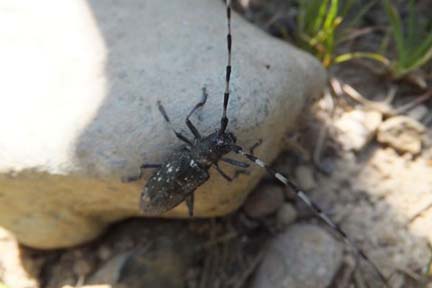
- A shiny, black body with white spots. Its body is about 1 to 1.5 inches long.
- Black and white antennae that are longer than its body.
- Six legs with feet that can appear bluish.
Signs that a tree might be infested include:
- Round exit holes about the diameter of a pencil found in tree trunks and branches.
- Shallow, oval or round scars in the bark, where the adult beetle chewed an egg-laying site.
- Material that looks like wood shavings lying on the ground around the tree or in the branches.
- Dead branches or limbs falling from an otherwise healthy-looking tree.
|
Be aware of look-alikes
Several beetles and bugs native to Michigan often are mistaken for the Asian longhorned beetle, but there are differences to be aware of:
- The white-spotted pine sawyer has a distinctive white spot below the base of its head – between its wings – and is dull black to bronze in color.
- The brown prionid is a common native longhorned beetle distinguished by its overall brown color and lack of patterns on its wings or antennae.
- The cottonwood borer is about the same size as the Asian longhorned beetle and is also black and white, but has a pattern of single, broad black stripes down each wing, and its antennae are all dark.
- The northeastern pine sawyer reaches up to 2 inches in length, has very long antennae and is gray in color.
- The eastern eyed click beetle has distinctive eye circles on the back of its head. It rolls over when threatened, then clicks and makes a flipping movement to get back on its feet.
Report signs of ALB
If you think you found a beetle or tree damage, report it by calling the ALB hotline at 1-866-702-9938. Or submit an online report through the ALB web page. Try to photograph the beetle or tree damage. If you can, capture the beetle in a durable container and freeze it. This helps preserve the insect for identification.
Don’t move firewood
 ALB doesn’t move far on its own, but it can and has hitchhiked to new areas in untreated firewood. When traveling, leave firewood at home and purchase what you need locally or choose certified, heat-treated firewood to help prevent this destructive pest from showing up at your favorite places. ALB doesn’t move far on its own, but it can and has hitchhiked to new areas in untreated firewood. When traveling, leave firewood at home and purchase what you need locally or choose certified, heat-treated firewood to help prevent this destructive pest from showing up at your favorite places.
For more information about ALB, call the USDA at 1-866-702-9938 or visit APHIS.USDA.gov/Plant-Pests-Diseases/ALB. |
Note to editors: Accompanying photos are available below for download. Caption information follows.
ALB on twig: In August, the Asian longhorned beetle emerges from trees to feed on leaves and bark before mating, laying eggs and starting another generation of tree-killing beetles. Photo courtesy of the ALB Eradication Program.
Identification: The Asian longhorned beetle is a large, shiny black beetle with irregular white spots and black and white, banded antennae. Photo courtesy of USDA APHIS PPQ.
Adult and frass: Material resembling wood shavings at the base of a tree or tree branches is a sign of Asian longhorned beetle infestation. Photo courtesy of the ALB Eradication Program.
WSPS: The white-spotted pine sawyer is native to Michigan and often mistaken for the Asian longhorned beetle. Look for a white spot between the upper wings to identify this pine sawyer. Photo courtesy of William M. Ciesla, Forest Health Management International, Bugwood.org.
Prionid: The brown prionid is a native longhorned beetle that’s all brown with no distinctive marks on its wings or antennae. Photo courtesy of the Kansas Department of Agriculture, Bugwood.org.
Cottonwood: The cottonwood borer’s antennae are all black. Photo courtesy of Gerald J. Lenhard, Louisiana State University, Bugwood.org.
NEPS: The northeastern pine sawyer is a large beetle reaching 2 inches in length. Its body is primarily gray with white and black spots. Photo courtesy of Jim Brighton.
Eyed beetle: The eastern eyed click beetle is distinguished by large circles on the back of its head. Photo courtesy of iNaturalist. |
   |
|
by orionontv | Aug 5, 2025 | Recreation
|
|
 |
DNR News
|
|
Aug. 5, 2025
Contacts: Kerry Gray (DNR), 734-691-1806; Kayla Collins (DTE Energy Foundation) 313-235-5555; or Melinda Jones (ReLeaf Michigan)
Help your community go green: Apply for Michigan’s $100,000 tree planting grant program
 The Michigan Department of Natural Resources, in partnership with the DTE Foundation and ReLeaf Michigan, is offering $100,000 in grant funding through the DTE Foundation Tree Planting Grant Program. This initiative supports community tree planting efforts across Michigan. The Michigan Department of Natural Resources, in partnership with the DTE Foundation and ReLeaf Michigan, is offering $100,000 in grant funding through the DTE Foundation Tree Planting Grant Program. This initiative supports community tree planting efforts across Michigan.
The DNR is now accepting applications for the 2025-26 grant cycle. The program provides financial assistance to communities served by DTE Energy’s electric and natural gas services. Grants are available to support projects that plant trees away from utility lines along streets, in parks and near schools – all of which can help to mitigate climate change, enhance local beauty and engage residents in environmental stewardship.
Since 1996, this grant program has been a joint effort between the DTE Foundation and the DNR’s Urban and Community Forestry program to improve communities and the environment through tree planting. ReLeaf Michigan, the only statewide nonprofit dedicated to tree planting and homeowner education, was added to the program to provide technical support to grantees and help ensure successful and sustainable tree planting efforts.
“At the DTE Foundation, we believe that real change takes root when communities come together,” said Rodney Cole, the foundation’s president. “Tree planting is more than an environmental initiative; it’s a way to bring neighbors together, strengthen local pride and create healthier, more vibrant places to live.
“We’re proud to support this work alongside dedicated partners like the Michigan Department of Natural Resources and ReLeaf Michigan, whose efforts continue to strengthen our communities and protect the environment for future generations.”
Application info
Applicants can request up to $4,000 with a 1-to-1 matching requirement. Additionally:
- Applications must be submitted through DNR MiGrants by Sept. 15.
- Grant awards will be announced in October 2025.
- Projects must be completed by Sept. 1, 2026.
Learn more and apply for a tree planting grant at Michigan.gov/UCF.
About the DTE Energy Foundation
The DTE Energy Foundation is the philanthropic arm of DTE Energy with a strong legacy of community support and involvement. In 2024, the Foundation provided $14.5 million in grant support to 375 nonprofit organizations in communities where the company has a business presence, with a focus on driving positive, meaningful change in priority giving areas: arts and culture, community transformation, economic progress, education and employment, environment and human needs. As one of Michigan’s leading corporate citizens, DTE aspires to be the best in the world and the best for the world. Visit DTEFoundation.com to learn more. |
|
|

by orionontv | Aug 5, 2025 | Environmental
|
|
|
News Release
|
|
Aug. 5, 2025
Contact: Joanne Foreman, 517-284-5814
New study shows impacts to native mushroom species
What started as a fun and tasty culinary trend – growing exotic mushrooms at home from a simple storebought or online kit – has become another threat to Michigan’s natural resources.
A recent article published in The Conversation describes U.S. Forest Service researchers’ findings regarding the impact of golden oyster mushrooms (Pleurotus citrinopileatus) on Wisconsin forests.
 Native to Asian and Russian hardwood forests, these imported mushrooms are now growing in the wild in areas of the Midwest, including Michigan’s southern Lower Peninsula. Native to Asian and Russian hardwood forests, these imported mushrooms are now growing in the wild in areas of the Midwest, including Michigan’s southern Lower Peninsula.
Golden oyster mushrooms, known for their bright yellow caps and nutty flavor, are featured on restaurant menus and in cooking videos. The mushrooms became popular among DIY enthusiasts with the introduction of grow kits in the early 2000s. By 2010, they began appearing in U.S. forests.
According to Aishwarya Veerabahu, a graduate student in the Department of Botany at the University of Wisconsin-Madison, “No one knows exactly how golden oyster mushrooms escaped into the wild, whether from a grow kit, a commercial mushroom farm or outdoor logs inoculated with golden oysters – a home-cultivation technique.”
To assist with research efforts, Michiganders are encouraged to report any sightings of golden oyster mushrooms in the wild. Observations can be recorded at iNaturalist.org. |
Why be concerned?
Veerabahu and colleagues sampled fungal communities in forests around Madison, Wisconsin, and determined that in logs colonized by golden oyster mushrooms, only half the expected diversity of native fungal species was present.
“Fungi are sources of revolutionary medicines, including antibiotics like penicillin, cholesterol medication and organ transplant stabilizers,” said Veerabahu. “The value of undiscovered, potentially useful chemicals can be lost when invasive species push others out.”
What can be done?
Veerabahu recommends that people consider refraining from using golden oyster mushroom grow kits to prevent any new introductions.
“For people who make a living selling these mushrooms, consider adding a note that this species is invasive and should be cultivated indoors and not composted,” she said. “If you enjoy growing mushrooms at home, try cultivating safe, native species that you have [lawfully] collected in your region.”
New species are often introduced by people long before the species’ invasive qualities are known. To avoid introducing or spreading species that may be invasive, never release pets, aquarium plants or other species into the wild, choose native species for gardening, and keep exotic plants – and fungi – indoors.
For more information on golden oyster mushrooms, read Veerabahu’s full article.
Note to editors: Accompanying photos are available below for download. Caption information follows.
Golden oyster: Fungal ecologist Aishwarya Veerabahu stands beside a patch of golden oyster mushrooms growing on a stump in a Wisconsin forest. Photo courtesy of Aishwarya Veerabahu. |
|
|
|

by orionontv | Aug 4, 2025 | Health and Wellness
|
Press Release
FOR IMMEDIATE RELEASE: Aug. 4, 2025
CONTACT: Lynn Sutfin, 517-241-2112, SutfinL1@michigan.gov
My Life, My Quit program launches mobile app
to help Michigan youth quit tobacco, vapes
LANSING, Mich – Youth in Michigan now have a new way to access free help to quit using tobacco and nicotine products, including e-cigarettes/vapes. The My Life, My Quit™ program has launched a mobile app, making it easy for teens to get confidential support from their smartphones.
“This new app will meet teens where they are with tools that support quitting tobacco products,” said Dr. Natasha Bagdasarian, chief medical executive. “We are grateful My Life. My Quit. worked with young adults to update their programming and are excited to promote this new option to youth in Michigan.”
As part of an effort to help young Michiganders quit tobacco, MDHHS contracts with the My Life, My Quit program. This free, evidence-based, service is designed specifically for youth who want to quit using tobacco and e-cigarette products. It offers live text and phone coaching, interactive content and personalized quit plans. The new app was developed in response to feedback from teen users and has been created to improve accessibility and expand engagement.
The app includes features like:
- Real time chat with a quit coach.
- Reminders and motivational messages.
- Progress training and interactive quit planning tools.
- Seamless connection to the full My Life, My Quit program across devices.
The app is available for download from Google Play and Apple App stores.
Youth and young adults can continue to enroll in the program by visiting MyLifeMyQuit.org or by texting “Start My Quit” to 36072.
According to the 2023 Michigan Youth Tobacco Survey, 13.2% of respondents reported current use of any tobacco product. The most common type of tobacco product used were e-cigarettes with 11.1% of youth reporting that they had used an e-cigarette in the last 30 days.
MDHHS reminds Michigan residents there are numerous benefits to quitting tobacco including financial savings, better health and more time spent with loved ones. As it can take several attempts to quit for good, tobacco users are encouraged not to give up after a failed attempt.
For additional information and resources, visit Michigan.gov/tobacco. |

by Becky Andrus | Aug 4, 2025 | Uncategorized
Press Release
FOR IMMEDIATE RELEASE: Aug. 5, 2025
CONTACT: Lynn Sutfin, 517-241-2112, SutfinL1@michigan.gov
Governor Whitmer declares August as Breastfeeding Month
Aug. 1-7 – World Breastfeeding Week
Aug. 8-14 – Indigenous Milk Medicine Week
Aug. 15-21 – Asian American, Native Hawaiian, Pacific Islander Breastfeeding Week
Aug. 25-31 – Black Breastfeeding Week
Sept. 1-7 – Workplace Lactation Week
Sept. 2-8 – Latina/x Breastfeeding Week (Semana de La Lactancia Latina)
LANSING, Mich. – Michigan is committed to encouraging a strong foundation for life by supporting breastfeeding as not only a lifestyle choice, but an essential public health priority. As part of this effort, Gov. Gretchen Whitmer declared August 2025 as Breastfeeding Month.
“Breastfeeding can be beneficial to both babies and parents and protect babies against allergies, sickness and many diseases,” said Dr. Natasha Bagdasarian, chief medical executive. “We recognize that not all parents are able to breastfeed, and in those cases we offer resources to ensure that the nutritional needs of infants are met, and that parents feel supported. Michigan is committed to helping breastfeeding parents reach their goals through community-based support including doulas, lactation consultants and peer counselors.”
The American Academy of Pediatrics recommends breastfeeding up to age 2 years and beyond. Breastmilk provides countless benefits to the infant, including a decrease in the risk of respiratory and ear infections, gastrointestinal tract infections, necrotizing enterocolitis, sudden infant death syndrome, asthma, atopic dermatitis, eczema, celiac disease, inflammatory bowel disease, obesity, Type 2 Diabetes and leukemia. It also reduces the incidence of breast and ovarian cancers, postpartum depression and cardiovascular disease for the breastfeeding parent; conditions that disproportionately impact Black, Brown and Indigenous people.
According to the World Health Organization, optimal breastfeeding is so critical that it could save the lives of more than 820,000 children under the age of five each year. Although 90% of Michigan families start breastfeeding, the difference between white non-Hispanic initiation (91.3%) and Black, non-Hispanic initiation (81.6%) highlights the barriers that impact families of color. Lack of support both in and out of the health care system, lack of access to high quality, affordable childcare and insufficient paid work leave negatively impact the number of people that start and continue feeding breast milk to their infants.
Michigan is taking action to remove barriers and increase support through several initiatives:
- Educating health care providers on the benefits of breastfeeding and the history of lactation for Black parents.
- Increasing access to breastfeeding support including online resources for families and doula-led breastfeeding training at the bedside.
- Partnering with and funding local/regional breastfeeding providers.
- Increasing childcare access by increasing compensation of childcare providers and the number of providers.
- Requiring implicit bias training for clinicians.
- Offering breastfeeding training opportunities to clinicians and community-based organizations.
Michigan’s Women, Infants and Children (WIC) program is celebrating National Breastfeeding Month with the theme, “WIC Supports Superheroes.” WIC assists breastfeeding families in the following ways:
- Free, unlimited access to lactation consultants and breastfeeding peer counselors including telehealth, phone call or in-person appointment.
- All WIC staff receive lactation training so families can be assured that everyone they interact with can support their infant feeding goals.
- Breastfeeding clients get more WIC foods, including canned fish, and can stay on the program longer.
- At 6 months, breastfed babies receive infant meats and more fruits and vegetables.
- WIC offers a breastfeeding warmline available seven days a week from 8 a.m. to 8 p.m. at 833-MIWICBF (833-649-4223).
For more information on events and happenings in Michigan for National Breastfeeding Month, visit the Michigan Breastfeeding Network.