
DNR biologists remove lid stuck on bear’s neck for 2 years

DNR biologists remove lid stuck on bear’s neck for 2 years

 
DNR banner with link to website

DNR News

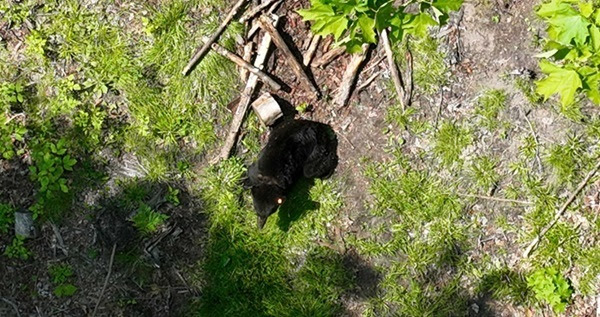
drone view of a black bear roaming in an open, green, forested area shortly after a DNR wildlife team removed a lid from around its neckJune 18, 2025
Contact: Cody Norton, 906-228-6561

DNR biologists remove lid stuck on bear’s neck for 2 years

In a case that highlights the importance of Michigan’s bear-baiting regulations, state wildlife biologists in Montmorency County recently removed a plastic lid from the neck of a young black bear that had carried the encumbrance around for two years.

It isn’t known exactly where or how the male bear got its head stuck in a 5-inch hole in the lid. The blue plastic lid is similar to those that fit 55-gallon drums used by hunters to bait bear and by landowners to store materials that can attract bears, such as chicken feed.

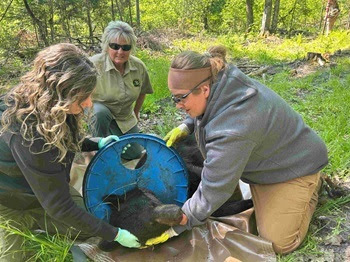
Three women from the DNR's wildlife staff work to remove a round, blue, plastic lid from the neck of an anesthetized black bearWhile baiting is a legal method for hunting bears in Michigan, bait containers can only be used on private land and may only have holes that are either 1 inch or less in diameter or 22 inches or greater in diameter.
Landowners can do their part by recycling or crushing containers such as empty cheeseball tubs and being “BearWise” about securing garbage, said Cody Norton of the Michigan Department of Natural Resources. He pointed to cases in FloridaWisconsin and Tennessee in which bears got their heads stuck in food containers.

“Container openings of a certain size can result in bears and other wildlife getting their heads or other body parts stuck in them, leading to injury or death,” said Norton, the DNR’s bear, furbearer and small game specialist. “It’s important to remember that the opening diameter is more important than the size of the container.”

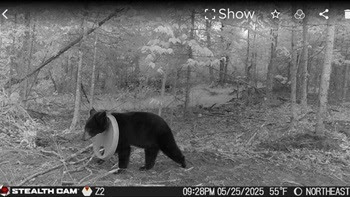
a black-and-white trail camera image shows a black bear with his head stuck in the hole of a round barrel lid, walking in a Hillman forestBiologists at the DNR’s Atlanta field office became aware of the bear in 2023 after seeing trail camera photos of the then-cub with its head stuck in the lid. The bear would prove elusive over the next two years, occasionally appearing on other trail camera photos but then disappearing after a day or so.
Then, in late May, a Hillman resident spotted the bear in trail camera photos taken on his wooded acreage and alerted the DNR. With the landowner’s permission, state biologists set up a baited enclosure trap and caught the animal safely on June 2. After anesthetizing the bear, they cut the lid off its neck and collected body measurements and other data.

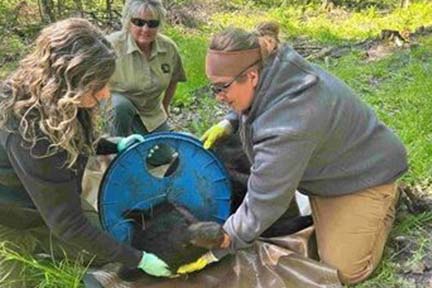
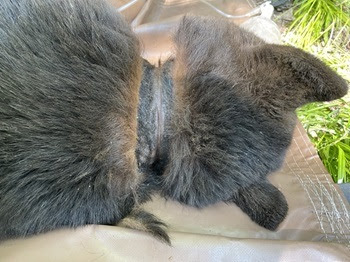
back of the black bear's neck, showing matted down fur and scarring due to the plastic lid compressing the area for two yearsThe bear weighed 110 pounds, which is fairly standard for a 2-year-old bear that’s still growing. It had significant scarring and an abscess on its neck but otherwise seemed healthy. Once the anesthesia wore off, the bear was released back onto the property.

Norton said the trapping, chemical immobilizing and data-collecting effort provided DNR staff with valuable training and information that can inform future research and bear-management strategies. Michigan is home to about 13,000 black bears – 1,700 of them in the northern Lower Peninsula.

To learn more about living with black bears and minimizing bear encounters, visit BearWise.


Note to editors: Accompanying photos may be downloaded from this folder. All photos courtesy Michigan Department of Natural Resources, except for the trail camera photo. Corresponding caption information follows.

  • Immobilized bear: DNR staffers, from left, Angela Kujawa, Sherry Raifsnider and Miranda VanCleave work to remove a lid from an immobilized black bear. The bear had gotten its head stuck in one of two holes in the plastic lid.
  • Collecting data: DNR wildlife biologist Angela Kujawa collects data from an immobilized black bear.
  • Trail camera: A trail camera on private property in Hillman captured this photo of a black bear with a lid stuck on its neck. (Image provided by private resident.)
  • Scarring: The black bear had significant scarring and an abscess on its neck but was otherwise healthy.
  • Free at last: A DNR drone photo of the black bear after the lid was removed from its neck.


Following the severe March 28-30 ice storm in northern Michigan, the Department of Natural Resources continues assessments and cleanup at many DNR-managed locations. Find a dashboard with the latest status (open, partially open, temporarily closed) of state parks, state-managed trails, boating access sites and state forest campgrounds; an interactive map; safety updates; and more on the DNR’s ice storm response page.
EGLE joins EPA and local leaders at revitalized Superfund

EGLE joins EPA and local leaders at revitalized Superfund

 
EGLE Main GovD banner
FOR IMMEDIATE RELEASE
June 17, 2025
EGLE Media Office, EGLE-Media-Office@Michigan.gov, 517-284-9278

EGLE joins EPA and local leaders at revitalized Superfund site bringing jobs, tourism and economic growth to the region

Once-polluted Torch Lake site now a model for environmental and economic renewal 

HOUGHTON, Mich.— Today, Michigan Department of Environment, Great Lakes, and Energy Director Phil Roos and U.S. EPA Region 5 Director Anne Vogel joined state and local leaders and project partners for a ribbon cutting to celebrate the official opening of the Keweenaw Waters Resort—a 25-acre waterfront campground featuring sustainably built-cabins and RV and tent sites. The resort sits on the former site of the Michigan Smelter Tailings, one of several locations in Houghton County designated for cleanup under the U.S. Environmental Protection Agency’s (EPA) Superfund Program.

“This project shows what’s possible when we commit to restoring communities that were once written off,” said EGLE Director Roos. “This portion of the Torch Lake site was once among the most contaminated in Michigan. Today, it’s supporting local jobs, drawing in visitors and protecting the environment for future generations. It’s a powerful example of how long-term investment in environmental restoration creates real opportunities when government, residents and businesses come together.”

The event highlighted the long-term collaboration and investment that made the redevelopment possible. Following remarks, attendees participated in a walking tour of the resort grounds—once the site of industrial contamination along the Keweenaw Waterway, now is home to cabins, campsites and recreational amenities that are drawing visitors and economic activity to the region.

“Transforming pollution hotspots into tourist destinations like the Keweenaw Waters Resort is the kind of outcome that EPA strives for,” said EPA Region 5 Administrator Anne Vogel. “EPA is honored to bring clean water, land, and air—and economic opportunity—to this scenic Michigan community.”

Developer Derek Bradway of Bradway Enterprises brought a new vision to life on the shores of the Keweenaw Waterway, something that was unthinkable decades ago. The Keweenaw Waters Resort spans 25 acres and includes 24 sustainably constructed cabins and 89 RV and tent sites.  A swimming beach, fishing dock and nature boardwalk are currently in development.

“This beautiful development has received a lot of local support as well as positive reviews from our guests,” said Derek Bradway, Keweenaw Water Resorts site developer. “It is a testimony of what can be done when all parties, national, state and local can align with the private sector.  Because of the work done by the EGLE and EPA, sites like this are ready to be put back into use, for everyone’s benefit.”

The former Michigan Smelter Tailings site was added to the EPA’s National Priorities List (NPL) in 1986 due to severe soil and water contamination. The overall greater Torch Lake Superfund Site cleanup began circa September 1998 and was managed by EGLE’s Superfund Section and EPA Region 5 and included excavating hazardous materials, covering more than 800 acres of contaminated ground with engineered soil and vegetation and establishing long-term monitoring and site controls. EGLE and EPA continue to inspect and maintain the broader Torch Lake site, which includes 13 designated cleanup zones across Houghton County.

Since 1985, EGLE has partnered with the EPA under the Superfund law—formally the Comprehensive Environmental Response, Compensation and Liability Act (CERCLA)—to assess and clean up the nation’s most hazardous sites. Across Michigan, 22 Superfund sites have been cleaned up, while 65 sites are in the process of being cleaned up.

For more information on EGLE’s efforts to support communities through environmental cleanup and redevelopment, visit www.michigan.gov/egle.

EGLE does not discriminate on the basis of race, sex, religion, age, national origin, color, marital status, disability, political beliefs, height, weight, genetic information, or sexual orientation in the administration of any of its programs or activities and prohibits intimidation and retaliation, as required by applicable laws and regulations

DNR Wildlife Habitat Grant application period now open

DNR Wildlife Habitat Grant application period now open

DNR banner with link to website

DNR News

Blazing star in wet mesic sand prairie Allegan SGA
June 17, 2025
Contact: Clay Buchanan, 517-614-0918 or Chip Kosloski, 517-281-1705

DNR Wildlife Habitat Grant application period now open

Now through July 29, 2025, the Michigan Department of Natural Resources Wildlife Habitat Grant Program is accepting applications with a focus on projects that restore large complexes of grassland and savanna habitat.

“Grasslands and savannas were once abundant, but are now rare in Michigan,” said DNR Wildlife Division Chief Sara Thompson. “By partnering with conservationists across the state to restore grasslands, we can provide important habitat for wildlife, as well as numerous benefits for Michiganders. Grasslands help prevent erosion and flooding, filter runoff, and pull carbon dioxide out of the air – protecting our water and air.”

Funding for this critical habitat work is available for local, state, federal and tribal governments, and profit and nonprofit groups through an open, competitive process. Minimum grant amounts will be set at $50,000, with the maximum being the amount of funds available for this grant cycle. The 2025 overall available grant amount is approximately $500,000.

Applications are open now and must be submitted through the MiGrants system no later than July 29 to be considered for funding. Successful grant applications will be announced in late summer 2025. The detailed program handbook and more information are available at the Wildlife Habitat Grants webpage.

Grassland habitats are home to some of Michigan’s most popular wildlife species, including ring-necked pheasants and wild turkeys, as well as some of the rarest, such as Karner blue butterflies and Henslow’s aparrows.

Grassland habitat 350Many grassland species depend on large grassland areas, but those remaining in Michigan are typically small, isolated, and lack sufficient plant diversity to provide habitat for many important grassland species. The 2025 Wildlife Habitat Grant Program seeks to develop and maintain large grassland and savanna complexes of 100 or more acres and improve connectivity between habitat patches.

To learn more about efforts to conserve Michigan’s grasslands and savannas, read the Large Grasslands Wildlife Action Plan and the Prairies & Savannas Wildlife Action Plan.

The Wildlife Habitat Grant Program began in October 2013 and is funded from the sale of hunting and fishing licenses. The DNR administers the program with the main objective to enhance and improve the quality and quantity of wildlife species habitat in support of the Wildlife Division’s strategic plan.


Note to editors: Accompanying photos are available below for download. Caption information follows.

  • Blazing star: The purple spikes of blazing star flowers rise above the grass in wet mesic sand prairie near a forest edge at Allegan State Game Area. From the Michigan Natural Features Inventory.
  • Grassland habitat: A walking path is mowed through tall brown grassland habitat at Chippewa Nature Center, framed by trees changed to fall yellow and orange in the background.
Following the severe March 28-30 ice storm in northern Michigan, the Department of Natural Resources continues assessments and cleanup at many DNR-managed locations. Find a dashboard with the latest status (open, partially open, temporarily closed) of state parks, state-managed trails, boating access sites and state forest campgrounds; an interactive map; safety updates; and more on the DNR’s ice storm response page.
Southfield Arts and Tech has new boys basketball coach

Southfield Arts and Tech has new boys basketball coach

Southfield Arts and Tech has a new Boys Basketball Coach

Written Monday June 16th at 7:23 PM

Southfield Arts and Tech has their new boys basketball coach.

The Warriors named Josh Lyle as their new boys basketball coach. He replaces Terrance Porter who stepped down in March.

The D-Zone’s Stu Carrolton confirmed the hire.

Lyle played at Eastern Michigan from 2011-2013 after transferring from Kentucky State. He averaged 24.6 points per game, 12 rebounds, and eight assists. He graduated high school from Lahser in 2010 according to his player profile page.

Lyle has been well known in the AAU circuit according to Mitten Recruit on X, he ran the D1 Elite AAU program and done several of the Mitten Recruiting events.

The Warriors really struggled last season falling 62-55 to Oak Park in the first round. They have Cameron Dickerson coming back but program strength is a serious concern for Lyle. Southfield Arts and Tech has a really tough district that has Groves, Seaholm, Berkley, Bloomfield Hills, and Birmingham Brother Rice. The Warriors will be in the Gold with Berkley, Oak Park, Harper Woods, Ferndale University, and Waterford Kettering this winter.

Lyle has a big challenge ahead of him rebuilding a Warriors program that has had success in the past but have been in a rut as of late.

Stay tuned to OAA Now for the latest on this developing story.

Lyle-Eastern Michigan Player Profile

https://emueagles.com/sports/mens-basketball/roster/josh-lyle/4268

D-Zone Tweet

https://x.com/TheDZoneBBall/status/1934744808339460363

Mitten Recruit X

https://x.com/MittenRecruit/status/1934790551934517532

AG Signs On to $7.4 Billion Purdue Pharma Settlement 

AG Signs On to $7.4 Billion Purdue Pharma Settlement 

Michigan Department of Attorney General Press Release banner

FOR IMMEDIATE RELEASE:
June 16, 2925

Media Contact:
Danny Wimmer

AG Nessel Signs On to $7.4 Billion Purdue Pharma Settlement

Michigan will receive up to $154 million

LANSING – Michigan Attorney General Dana Nessel today announced that all 55 attorneys general, representing all eligible states and U.S. territories, have agreed to sign on to a $7.4 billion settlement with Purdue Pharma and its owners, the Sackler family. The Sackler family has also informed the attorneys general of its plan to proceed with the settlement, which would resolve litigation against Purdue and the Sacklers for their role in creating and worsening the opioid crisis across the country. Now that the state sign-on period has concluded, local governments across the country will be asked to join the settlement, contingent on bankruptcy court proceedings.

“After years of settlement negotiations, this agreement finally ensures Purdue is held responsible for its role in fueling the opioid epidemic,” Nessel said. “No amount of money can undo the harm caused, but we are already seeing funds from other settlements make a real difference in prevention, treatment, and recovery efforts. I was proud to work alongside my colleagues to secure this resolution and am confident that these dollars will help communities across Michigan combat this crisis.”

Under the Sacklers’ ownership, Purdue made and aggressively marketed opioid products for decades, fueling the largest drug crisis in the nation’s history. The settlement ends the Sacklers’ control of Purdue and their ability to sell opioids in the United States. Communities across the country will directly receive funds over the next 15 years to support addiction treatment, prevention, and recovery. This settlement in principle is the nation’s largest settlement to date with the individuals responsible for the opioid crisis. Michigan’s state and local governments will receive as much as $154 million from this settlement over the next 15 years.

Most of the settlement funds will be distributed in the first three years. The Sacklers will pay $1.5 billion, and Purdue will pay roughly $900 million in the first payment, followed by $500 million after one year, an additional $500 million after two years, and $400 million after three years.

Like prior opioid settlements, the settlement with Purdue and the Sacklers will involve resolution of legal claims by state and local governments. The local government sign-on and voting solicitation process for this settlement moving forward will be contingent on bankruptcy court approval. A hearing is scheduled on that matter in the coming days.

Since taking office in 2019, Attorney General Nessel has focused intently on combatting the opioid epidemic and holding accountable those responsible for creating and fueling the crisis, resulting in over $1.6 billion dollars to Michigan governments through settlements with McKinsey & CoDistributors (Cardinal Health, McKesson, Inc., and AmerisourceBergen), Janssen Pharmaceuticals, Teva Pharmaceutical, Allergan Pharmaceutical, CVS, Walmart, and Walgreens. The money is distributed to the state and local units of government for Opioid-use disorder treatment and remediation.

Analysis of provisional data from the Michigan Department of Health and Human Services (MDHHS) indicates a 34% reduction in overdose deaths between 2023 and 2024 – about 1,000 fewer deaths. This continued progress reflects the impact of sustained, strategic investment in prevention, treatment, recovery, and harm-reduction efforts – many of which are made possible through additional funding received as a result of Michigan’s participation in the national opioid settlements.

Attorney General Dana Nessel is joined in securing this settlement in principle by the attorneys general of Alabama, Alaska, American Samoa, Arizona, Arkansas, California, Colorado, Connecticut, Delaware, the District of Columbia, Florida, Georgia, Guam, Hawai’i, Idaho, Illinois, Indiana, Iowa, Kansas, Kentucky, Louisiana, Maine, Maryland, Massachusetts, Minnesota, Mississippi, Missouri, Montana, Nebraska, Nevada, New Hampshire, New Jersey, New Mexico, New York, North Carolina, North Dakota, Northern Mariana Islands, Ohio, Oregon, Pennsylvania, Puerto Rico, Rhode Island, South Carolina, South Dakota, Tennessee, Texas, U.S. Virgin Islands, Utah, Vermont, Virginia, Washington, West Virginia, Wyoming, and Wisconsin.