
Step Towards County’s Carbon Neutrality Goal
Oakland County Takes Step Toward County Executive Coulter’s Carbon Neutrality Goal
- Oakland County is among 15 cities and counties participating in the U.S. Green Building Council’s 2022 LEED for Cities Local Government Leadership Program.
- Oakland County has a goal of reaching carbon neutrality by 2050.
- County government is already reducing energy consumption on its campus including a LEED Gold certified building.
Pontiac, Michigan – The U.S. Green Building Council (USGBC), developers of the LEED green building rating system, has selected Oakland County as one of 15 cities and counties nationwide to participate in the 2022 LEED for Cities Local Government Leadership Program.
This program brings together diverse local governments from around the country to support communities seeking LEED certification. The program provides networking opportunities, technical assistance, and access to educational resources.
“Ensuring our county government campus is operating in the most energy efficient and environmentally sound manner is the right thing to do and a top priority,” said Oakland County Executive David Coulter. “Getting this LEED certification is one more important step toward our goal of reaching carbon neutrality by 2050 and contributing to a cleaner, healthier county for future generations.”
Oakland County has already taken several steps toward the Coulter administration’s environmental sustainability goals. The county executive appointed Erin Quetell to be the county’s first environmental sustainability officer. She is managing efforts to develop and implement sustainability practices at the county.
Oakland County has also reduced its energy consumption by about 45 percent at the LEED Gold certified terminal building at Oakland County International Airport in Waterford. Plus, the county is saving both energy and money after converting outdoor lighting on its government campus from incandescent to LED lights.
“Local governments have the ability to make a big impact and serve as an example of sustainability achievement,” said Peter Templeton, president and CEO at USGBC.
Royal Oak was the first city in Michigan and the third in the United States to achieve LEED v4.1 certification in 2020. The city implemented practical and measurable sustainability strategies to improve the quality of life for residents.
In partnership with Bank of America, the program has provided more than $2 million to promote action on climate change, resilience and social equity through LEED for Cities certification.
“USGBC is a leader in supporting environmentally sustainable buildings, cities and communities and we’re proud to build on our partnership of more than 25 years,” said Rich Brown, environmental program director at Bank of America. “Creating thriving, resilient communities where residents have sustainable places to work and live meets this moment for climate action and building healthy living environments.”
The 15 local governments participating in the 2022 program represent a population of more than three million Americans. Joining Oakland County are Amesbury, Mass.; Cape Canaveral, Fla.; Columbia, S.C.; Cutler Bay, Fla.; Davidson, N.C.; Dayton, Ohio; Fort Lauderdale, Fla.; Henderson, Nev.; Issaquah, Wash.; Ithaca, N.Y.; La Crescent, Minn.; Reno, Nev.; State College, Penn., and Tucson, Ariz.
Today, more than 130 cities and communities have achieved LEED certification. LEED provides a framework for local governments to address energy, water, waste, pollution and carbon. In addition to environmental factors, the rating system considers social and economic indicators, such as health, equity, education and prosperity.
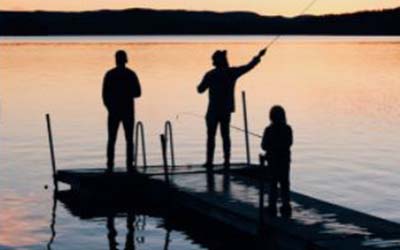

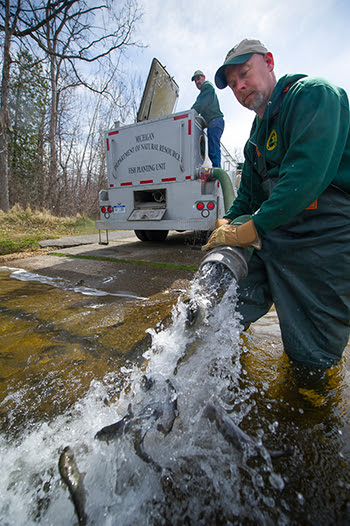 Have you seen fish stocking trucks out on the road this spring? We’re in the midst of our spring fish stocking season. This time of year, you’ll find Michigan Department of Natural Resources fish stocking trucks releasing their prized recreational cargo at hundreds of lakes and streams throughout the state.
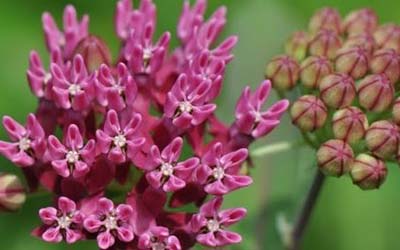

 Want to see more pictures like this, taken last spring by Michigan state parks photo ambassador
 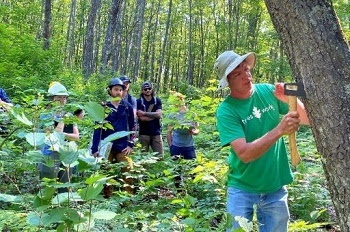 Tiny tree killers, squirrel mayhem, ugly-nest caterpillars – and what in the world is a tortrix? The 2021
 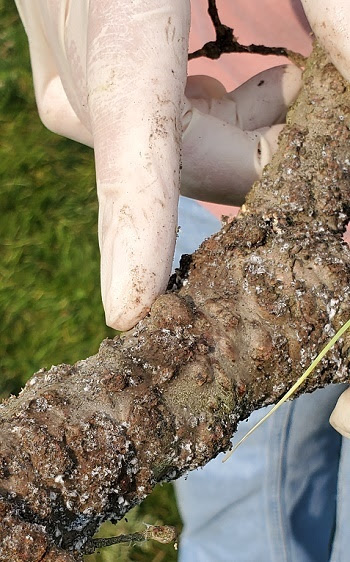 An invasive species new to Michigan, the balsam woolly adelgid, was discovered by an arborist in Kent County in July. The pocket of infested trees was destroyed, and monitoring continues to make sure that other areas are not infected.
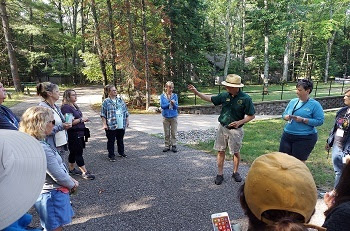 After nearly two years of pandemic uncertainty, the DNR’s popular teacher education events return to a full schedule in 2022. The Academy of Natural Resources looks forward to hosting up to 80 Michigan educators at its two program locations this summer.
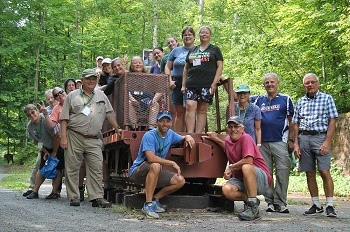 The demand for these programs has been so consistently high that in 2016 the DNR partnered with Michigan Technological University to launch an Upper Peninsula-based option. Frailey said ANR North has been a great success, and this year’s course – exploring the historical and cultural impacts on natural resources of the U.P. – is one of the most popular ever.
 Did you know that DNR Law Enforcement Division emergency dispatchers are equipped with technology comparable to that of 911 call centers? It allows them to receive and manage information from the public about poaching and other violations, dispatch conservation officers accordingly and investigate tips.
 The next meeting of the Michigan Natural Resources Committee leads off with a Wildlife Committee agenda that includes deer hunting regulations, and research and surveillance updates on chronic wasting disease and bovine tuberculosis. The meeting also will include recognition of former commissioner Vicki Pontz, a legislative update and several land transactions.