by orionontv | Jul 3, 2025 | Regional News
|
FOR IMMEDIATE RELEASE:
July 3, 2025
|
|
Twice-Sunken Lake Michigan Barge Successfully Relocated
LANSING – A twice-sunken Lake Michigan barge that raised environmental concerns has now been relocated to a legal location, announced Michigan Attorney General Dana Nessel. The barge’s owner, Donald Lewis Balcom, 90, of Traverse City, pled guilty last April in the 13th Circuit Court in Leelanau County to one count of Water Resources Protection Violation for Discharge of Injurious Substances to Waters of the State, a two-year felony. The charge stemmed from a November of 2020 incident, when the barge sank and released oil into Lake Michigan.
Under a deferred sentencing agreement, Balcom was given until June 27, 2025, to relocate the barge to a legal location, which would convert his felony conviction to one count of Watercraft Pollution – Littering from Vessel, a 92-day misdemeanor. On Monday, June 23, 2025, the barge was moved to a legal location in West Grand Traverse Bay. Over the past week, the barge has been partially dismantled and is no longer on state-owned Lake Michigan bottomlands.
“After years of environmental concerns and legal proceedings, I am pleased the barge has finally been moved and to announce the resolution of this case,” Nessel said. “We have made it abundantly clear that the bay cannot be treated as a personal junkyard. My department remains committed to working with the Department of Environment, Great Lakes, and Energy to protect the Great Lakes whenever they come under threat.”
In 2023, the Attorney General issued seven criminal charges against Balcom following years of efforts by the Michigan Department of Environment, Great Lakes, and Energy to work with Balcom toward a resolution of the issue of the sunken industrial barge and contamination of Grand Traverse Bay on the northwestern coast of Michigan’s Lower Peninsula. The barge was moved to a legal location, entitling Balcom to the reduced sentence. The Court has yet to issue an amended judgment of sentence.
|
|

by orionontv | Jul 3, 2025 | Regional News
|
FOR IMMEDIATE RELEASE:
July 3, 2025
|
|
Attorney General Nessel Reissues Consumer Alert on Michigan Towing Laws
LANSING – Michigan Attorney General Dana Nessel is reissuing her consumer alert highlighting what consumers need to know if their vehicle is towed. The alert follows a presentation delivered last week by Jason Evans, chief of the Corporate Oversight Division at the Michigan Department of Attorney General, to the City of Detroit Board of Police Commissioners Towing Committee. The alert and presentation focus on Michigan’s towing laws and consumer protections offered to vehicle owners.
“It’s important Michigan drivers understand their rights when it comes to towing,” Nessel said. “This alert gives people the information they need to know how to get their vehicles back and challenge unauthorized and unreasonable fees.”
When Vehicles Can Be Towed
Vehicles may be towed from public or private property. In cases of private property, the property owner must have a clearly visible notice posted before towing a vehicle without the owner’s consent.
After a vehicle is towed, towing companies are required to share the vehicle’s new location with local police. Within 24 hours, the police will determine if the vehicle was reported stolen. The vehicle will then be entered into the law enforcement information network as an abandoned vehicle, and the police will notify the Secretary of State.
Owners of vehicles involved in accidents must claim their vehicles within 20 days. After that, it is labeled as an abandoned vehicle.
Notification to Vehicle Owners
The Secretary of State must notify owners by mail within seven days of a vehicle being classified as abandoned. The notice will include:
- Where the vehicle was towed from;
- Towing company name;
- Address of where the vehicle is now;
- How to claim the vehicle;
- How to challenge the towing;
- How to challenge the towing and storage fees; and
- How to file with the court.
The location of the vehicle and custodian can be found online on the Secretary of State’s Michigan Abandoned Vehicle Search using the vehicle identification number (VIN) or license plate number. Vehicle owners can also contact the Abandoned Vehicle Help Desk at 517-636-5234.
Rights Regarding Towed Vehicles
The company storing the vehicle must allow the owner to inspect the vehicle and to get their items out for free, for the first visit. After that, they can’t charge the owner more than $25 per time. Attorney General Nessel encourages vehicle owners to bring their title or registration, as proof of ownership may be required.
Understanding Towing and Storage Fees
Vehicle owners are responsible for any storage fees. If a vehicle is towed after an accident or from public or private property, daily storage fees will apply while the vehicle remains at the facility. Towing and storage fees are normally set by the agreement between the police agency and the towing company. Residents can contact the police agency involved in the towing to verify fees.
Challenging a Tow or Fees
Owners have the right to challenge whether a vehicle was properly towed and the reasonableness of towing and storage fees. This must be done in a timely manner and in an appropriate district court.
|
|

by orionontv | Jun 26, 2025 | Regional News
|
FOR IMMEDIATE RELEASE:
June 26, 2025
|
|
Sixth Circuit Upholds Constitutionality of Michigan’s Lifesaving Newborn Screening Program
LANSING – Yesterday, the U.S. Court of Appeals for the Sixth Circuit issued a decision (PDF) affirming the constitutionality of Michigan’s lifesaving Newborn Screening Program and the BioTrust for Health, announced Michigan Attorney General Dana Nessel. The decision reversed a lower court’s ruling that had found the programs violated the Constitutional rights of the children and their parents to direct their children’s medical care.
The Newborn Screening Program, operated by the Michigan Department of Health and Human Services (MDHHS), collects blood samples from newborn babies and screens them for diseases, which helps save infant lives through early detection. Newborn screening looks for more than 50 disorders that can affect blood cells, brain development, how the body breaks down nutrients from food, lungs and breathing, hormones and how the body fights infection. This includes congenital hyperthyroidism, sickle cell disease and cystic fibrosis. The BioTrust for Health facilitates third-party health research using de-identified data or blood spots collected by the Newborn Screening Program.
“The Newborn Screening Program saves lives,” Nessel said. “I want to thank the Court for its decision and the dedicated attorneys in my office who litigated this case for years to ensure Michigan can continue early detection of serious diseases while also advancing medical research through privacy-protected de-identified data.”
“With this ruling, MDHHS can continue to fulfill its commitment to protect the health and well-being of Michigan families, particularly its youngest and most vulnerable residents,” said Elizabeth Hertel, MDHHS director. “Michigan’s newborn screening program is designed to quickly diagnose babies who may look healthy but have rare and often serious disorders that require early treatment. Since 1965, this program has ensured thousands of families were quickly provided information about their baby’s condition, allowing for early interventions and healthier outcomes.”
The Sixth Circuit reaffirmed that the programs’ post-screening practices, including analyzing de-identified blood spots for quality improvement and making them available to vetted health researchers, does not violate constitutional protections. The decision also vacated a lower court’s injunction that had ordered the destruction of stored blood spots and associated data.
|
|

by orionontv | Jun 24, 2025 | Regional News

FOR IMMEDIATE RELEASE
Gov. Whitmer Announces Operation Safe Neighborhoods Reaches New Milestone with Nearly 850 Illegal Guns Off the Street
LANSING, Mich. — Today, Governor Gretchen Whitmer announced nearly 850 illegal guns have been taken off the streets as part of Operation Safe Neighborhoods. Since the operation began, law enforcement officials have conducted 8,663 check-ins with felony offenders, leading to nearly 850 illegal guns taken off the street. During sweeps, officers have also recovered illegal drugs and ammunition.
“Every Michigander deserves to feel safe in their neighborhood,” said Governor Whitmer. “Through Operation Safe Neighborhoods, we’ve taken nearly 850 illegal guns off the street, making real progress to protect our communities and prevent violence before it happens. I’m proud of the continued partnership between state and local law enforcement and our shared commitment to building a safer Michigan for everyone.”
“Removing hundreds of illegal firearms from our streets is more than a statistic it’s about saving lives and giving families peace of mind,” said Lt. Governor Garlin Gilchrist II. “Operation Safe Neighborhoods is one of the many ways we’re working to build safer, more resilient communities, especially in neighborhoods that have been historically overlooked. We will keep showing up, investing in prevention, and doing everything we can to ensure every Michiganders feel safe and supported.”
Operation Safe Neighborhoods is a statewide crackdown on crime aimed at reducing gun violence by getting illegal guns off the street and out of the hands of people who cannot legally possess a gun due to prior criminal history.
“Removing guns from individuals who cannot legally possess them is one tangible action we can take to help reduce harm and violence inflicted on our neighbors and loved ones,” said Col. James F. Grady II, director of the MSP. “Efforts like Operation Safe Neighborhoods make a real difference in our communities which are too often the target. Our troopers see the deadly results and devastating impact of illegal guns every day.”
Nearly one in three reported violent crimes in Michigan involve a firearm. This initiative builds on Governor Whitmer’s MI Safe Communities program that she launched in 2021 to invest in local police, get illegal guns off the street, and fund expanded opportunities in jobs, education, and the justice system.
About Operation Safe Neighborhoods
Michigan Department of Corrections (MDOC) parole and probation agents team up with local law enforcement across the state and conduct enhanced compliance checks on probationers and parolees who are legally prohibited from possessing a firearm.
There are roughly 32,000 probationers and 8,600 parolees in the state, many of whom have been convicted previously of a gun crime. These individuals are supervised by more than 1,000 MDOC parole and probation agents. The plan the department devised and implemented is aimed at focusing on high-risk individuals who have weapons possession in their criminal history that could be used to commit further crime.
Governor Whitmer’s Record Breaking Public Safety Investments
Since taking office, Governor Whitmer has worked closely with local leaders, law enforcement officers, and community organizations to ensure people feel safe in their neighborhoods. The governor has signed five balanced, bipartisan budgets, each making record investments to help communities fund local law enforcement departments and hire more first responders.
Since taking office, Governor Whitmer has invested over $1.6 billion into public safety. This year’s budget includes $75 million to establish a Public Safety Trust Fund to provide cities, villages, and townships with additional resources for police services and to support community violence intervention efforts and $11 million for firearm injury and violence prevention grants, and community violence intervention services to reduce gun violence and save lives.
In April 2023, Governor Whitmer signed commonsense gun violence prevention bills that will establish universal background checks for all firearm purchases and safe storage requirements. In May 2023, Governor Whitmer signed bills establishing extreme risk protection orders in Michigan, ensuring police officers, health care professionals, and family members concerned about someone who may harm themselves or others can seek a court order to temporarily confiscate their firearms. In November 2023, Governor Whitmer signed bills disallowing convicted domestic abusers from owning firearms. In June 2024, Governor Whitmer signed ED 2024-4 to establish the Michigan Gun Violence Prevention Task Force to further work in gun violence reduction.
Governor Whitmer proposed the commonsense gun violence prevention legislation during her 2023 State of the State address and has worked with the Michigan Legislature, community groups, law enforcement, students and parents following the shooting at Michigan State University in February 2023 and the shooting at Oxford High School in November 2021 to get these commonsense measures that will reduce gun violence signed into law.
|

by orionontv | Jun 20, 2025 | Regional News
|
FOR IMMEDIATE RELEASE:
June 18, 2025
|
|
AG Nessel Challenges DOE Order Mandating Continued Operation of Consumers Energy Coal-Powered Electric Plant
Attorney General argues the Order will burden Michigan utility customers with unnecessary costs and needless additional pollution from the 60-year-old Ottawa County coal plant that was scheduled to close May 31st
LANSING – Today, Michigan Attorney General Dana Nessel filed a Request for Rehearing (PDF) with the U.S. Department of Energy (DOE), challenging the DOE’s arbitrary and illegal order seeking to stop the planned retirement of Consumers Energy’s J.H. Campbell coal-fired power plant in West Olive, Michigan, under the pretense of a fabricated energy emergency.
“Michigan must be in the fight to maintain self-determination in where our power comes from,” said Nessel. “The closure of this coal-powered electric plant has been planned for years, the utility made all due preparations to maintain our energy load without it, and the closure has been agreed to and cited in settlements affecting customer costs.
“In particular, if this arbitrary and unlawful order is allowed to stand, the only effect Michiganders will feel will be the pinch in their pockets. The costs of maintaining production at the plant, long since prepared for closure, could be an enormous burden on the rate-paying customers of Consumers Energy. And that’s before taking into account the environmental and public health costs of continuing to fuel a coal-powered plant.”
The retirement of the Campbell Plant, originally built in the 1960s, has been the matter of extensive planning and analysis by state regulators and the broader inter-state power grid. This has included the procurement of replacement power resources, and the planning for future resources, to more than account for the removal of the Campbell Plant. In fact, the retirement was initially sought by Consumers Energy in its June 30, 2021 integrated resource plan application. Parties in that case, including the Attorney General, signed a settlement that included the retirement of the Campbell Plant and the settlement was approved by the Michigan Public Service Commission in June of 2022. The retirement of the Campbell Plant and its replacement with more cost-effective resources were elements of a carefully considered plan that was expected to save Michigan ratepayers nearly $600 million.
“This unprecedented Order of the Department of Energy declares an emergency without evidence, completely ignores state and federal regulators that approved the plants retirement, and will potentially put enormous costs onto utility customers who receive no real benefit,” Nessel continued. “As I have done throughout my years in office, today we’re fighting for affordable utility bills and the rights of Michiganders to clean up their energy production.”
The Department of Energy’s May 23, 2025, Order to cancel the Campbell retirement disregards all prior planning and regulatory approvals, in yet another example of the Trump administration arbitrarily declaring a false emergency as a pretext for advancing its policy agenda by means outside its normal authority. The Order states that the plant will continue to run through August, though it is possible the DOE could issue another order at that point extending again the plant’s producing lifetime. Never before has the DOE delayed the retirement of a power plant absent a request from the operating utility or local governmental body, and only ever in response to concrete, particularized emergencies, and subject to limitations to ensure that the order extends no further than necessary to address the emergency at hand.
The Attorney General’s request for rehearing challenges the DOE’s Order on its inability to show an actual emergency, as well as for several other violations of the DOE’s authority under the Federal Power Act, which grants the DOE’s emergency powers. The Attorney General’s challenges include that the Order as issued exceeds the authority granted to the DOE, and that the DOE failed to take required steps to limit the amount of operation to only when necessary and to minimize environmental impacts.
Under the Federal Power Act, the Department of Energy has 30 days to respond to the Attorney General’s request.
|
|
by orionontv | Jun 20, 2025 | Regional News
FOR IMMEDIATE RELEASE
June 18, 2025
Contact: Ron Leix, Treasury, 517-335-2167
More Than 300 Individuals Attend Annual Fundraiser on Michigan State Capitol Lawn
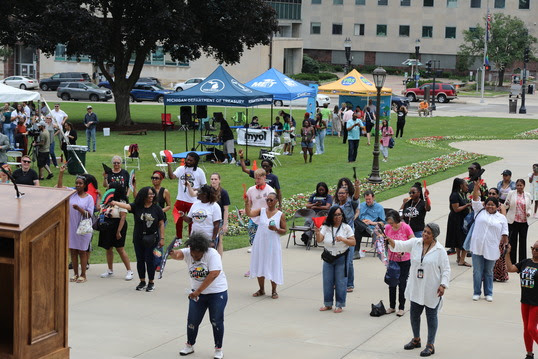
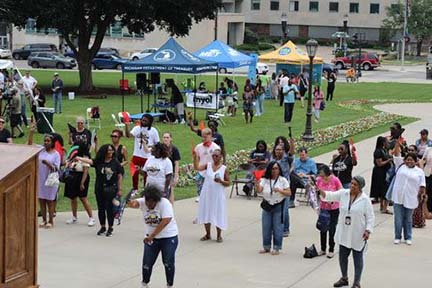
Attendees participate in activities at the Michigan Education Trust’s 13th annual Pizza Party on the Michigan State Capitol Lawn on Wednesday, June 18. The pizza party raised $13,000 to help make the dream of a college education possible for students enrolled in Michigan colleges and universities who have experienced foster care. (Photo: Christopher Bryant/Michigan Department of Treasury)
LANSING, Mich. – The more than 300 people who attended the Michigan Education Trust’s 13th annual Pizza Party on the Michigan State Capitol Lawn got their fill of pizza and helped fill the Fostering Futures Scholarship Trust Fund, which awards scholarships to students enrolled in Michigan colleges and universities who have experienced foster care.
The $13,000 raised at the Wednesday, June 18, pizza party fundraiser will help make the dream of a college education a reality for students who otherwise might lack resources to pursue higher education when they age out of the foster care system.
For a minimum donation of $10, attendees received a slice of pizza, dessert and a drink.
This year, the Michigan Department of Treasury’s Black History Committee partnered with the Fostering Futures Scholarship to hold a celebration in honor of Juneteenth.
Students who receive this scholarship can use the money for tuition, housing, books and other college expenses. Funds raised through the Fostering Futures Scholarship Trust Fund provide scholarships to young adults who have experienced foster care and are enrolled at a Michigan degree-granting college or university. Awards are paid to the students’ college or university for expenses.
Approximately10,000 youth are currently in Michigan’s foster care system. Nationally, fewer than 10% of former foster youth enroll in college after high school, and only 3% earn a degree. The Fostering Futures Scholarship Trust Fund, established in 2012, has raised more than $1.4 million through events and contributions.
In addition, over 140 pillows and more than 200 pillowcases were collected during the pizza party for The Pillow Effect, a Michigan Youth Opportunities Initiative (MYOI) project. Because children entering foster care often don’t have their essential personal items with them, donations will benefit counties across Michigan, including Ingham, Eaton, Clinton, Ionia and Shiawassee.
The Pizza Party on the Capitol Lawn is sponsored by Hungry Howie’s, Park West Foundation, Michigan Student Financial Aid Association, Michigan College Access Network, LAFCU, Güd Marketing, Michigan First Credit Union, WKAR PBS, the Michigan Association of Broadcasters, WLNS-TV 6, and MSU Federal Credit Union, with support from the Michigan Department of Health and Human Services and MYOI.
Couldn’t attend and want to make a difference?
Donate or register online using a credit card, or to make a donation by check, complete and submit the Fostering Futures Scholarship Contribution Form along with a check made payable to the State of Michigan — Fostering Futures Scholarship.
Contributions made by Dec. 31 are eligible for a tax deduction on federal and state income tax forms in the year they are made. MET’s Fostering Futures Scholarship Trust Fund is an IRC Section 170(c) organization, making all donations tax deductible.
To learn more about the Fostering Futures Scholarship Trust Fund or to donate, go to www.michigan.gov/fosteringfutures.
About MET
Administered by the Michigan Department of Treasury, MET is the state’s Section 529 prepaid tuition program, which allows for the purchase of future college tuition credits based on today’s rates. MET, Michigan Education Savings Program (MESP) and MI 529 Advisor Plan (MAP), Michigan’s three Section 529 college savings programs, offer Michigan taxpayers a state income tax deduction on contributions and potential tax-free growth on earnings if account proceeds are used to pay for qualified higher education expenses.
More information about MET is available at www.michigan.gov/setwithmet or 800-MET-4-KID (800-638-4543).