by orionontv | Jul 8, 2025 | Transportation
FOR IMMEDIATE RELEASE MEDIA CONTACT
July 8, 2025 Diane Cross
CrossD2@Michigan.gov
MDOT public open house July 30 on pedestrian bridge study
in Wayne, Oakland, and Macomb counties
SOUTHFIELD, Mich. – The Michigan Department of Transportation (MDOT) invites the public to provide their input on the usage of pedestrian bridges in their community. This open house is part of a series that will be held in different locations around the Metro Region.
Attendees will be able to view posters, take a survey, and view a presentation outlining MDOT’s efforts through this study to better understand the usage of state-owned pedestrian bridges in the region.
Who:
Interested residents
Community stakeholders
Local businesses
MDOT staff and consultants
When:
Wednesday, July 30, 2025
6 – 8 p.m.
Presentation begins at 6:15 p.m.
Where:
The Hawk Community Center – Black Box Room
29995 W 12 Mile Rd.,
Farmington Hills, MI 48334
Accessibility:
Attendees who require mobility, visual, hearing, written, or other assistance for effective participation should contact Orlando Curry at 517-241-7462 or CurryO@Michigan.gov, preferably at least five business days prior to the scheduled meeting. Forms are located on the Title VI webpage. Requests made after this timeframe will be evaluated and honored to the extent possible.
Public input:
If you use one or more pedestrian bridges in the Metro Region, please fill out and share this interactive map/survey If you have comments or questions regarding the study, please email MDOT-Metro-Communications@Michigan.gov.
Sign up to receive project updates on the pedestrian bridge study.
Background:
MDOT is conducting a study of state-owned pedestrian bridges in the Metro Region. The study team will collect data on current conditions and travel patterns, perform on-site observations, and engage with people across the region to identify priorities and better understand community needs. The study’s data will be used to develop a future strategic plan for preserving non-motorized connectivity with a right-sized network of pedestrian bridges and other active transportation facilities.

by orionontv | Jul 3, 2025 | Regional News
|
FOR IMMEDIATE RELEASE:
July 3, 2025
|
|
Twice-Sunken Lake Michigan Barge Successfully Relocated
LANSING – A twice-sunken Lake Michigan barge that raised environmental concerns has now been relocated to a legal location, announced Michigan Attorney General Dana Nessel. The barge’s owner, Donald Lewis Balcom, 90, of Traverse City, pled guilty last April in the 13th Circuit Court in Leelanau County to one count of Water Resources Protection Violation for Discharge of Injurious Substances to Waters of the State, a two-year felony. The charge stemmed from a November of 2020 incident, when the barge sank and released oil into Lake Michigan.
Under a deferred sentencing agreement, Balcom was given until June 27, 2025, to relocate the barge to a legal location, which would convert his felony conviction to one count of Watercraft Pollution – Littering from Vessel, a 92-day misdemeanor. On Monday, June 23, 2025, the barge was moved to a legal location in West Grand Traverse Bay. Over the past week, the barge has been partially dismantled and is no longer on state-owned Lake Michigan bottomlands.
“After years of environmental concerns and legal proceedings, I am pleased the barge has finally been moved and to announce the resolution of this case,” Nessel said. “We have made it abundantly clear that the bay cannot be treated as a personal junkyard. My department remains committed to working with the Department of Environment, Great Lakes, and Energy to protect the Great Lakes whenever they come under threat.”
In 2023, the Attorney General issued seven criminal charges against Balcom following years of efforts by the Michigan Department of Environment, Great Lakes, and Energy to work with Balcom toward a resolution of the issue of the sunken industrial barge and contamination of Grand Traverse Bay on the northwestern coast of Michigan’s Lower Peninsula. The barge was moved to a legal location, entitling Balcom to the reduced sentence. The Court has yet to issue an amended judgment of sentence.
|
|

by orionontv | Jul 3, 2025 | Recreation
|
|
 |
DNR News
|
|
July 3, 2025
Contact: Jeff Corser (Lower Peninsula), 989-385-5617 or Celeste Chingwa (Upper Peninsula), 906-250-2466
Celebrate safely: Prevent wildfires this Independence Day
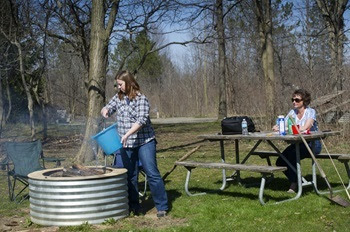 As you plan for a fun-filled Fourth of July holiday, whether it includes fireworks, camping, off-roading or simply tackling projects around the yard, don’t forget to take precautions to prevent wildfires. As you plan for a fun-filled Fourth of July holiday, whether it includes fireworks, camping, off-roading or simply tackling projects around the yard, don’t forget to take precautions to prevent wildfires.
“Nine out of 10 wildfires are caused by people,” said Paul Rogers, fire prevention specialist with the Michigan Department of Natural Resources. “With fireworks, campfires and outdoor equipment in use during the holiday, it’s important to stay alert and take simple steps to protect people, property and the outdoor places we love.”
Fire danger has been on the lower side this year due to regular rain, but that doesn’t mean the risk is zero, especially with fireworks. There is currently an area of drought extending from Muskegon to Saginaw Bay (as shown on this U.S. Drought Monitor map) that is experiencing above-normal drought conditions – everyone is advised to use great caution in that area.
“Fireworks can ignite dry grass or brush in an instant,” Rogers said. “Avoid aiming them into wooded areas or tall vegetation. And always check your local ordinances – many communities only allow fireworks on the holiday itself and the days immediately before and after.”
Rogers encouraged Michigan residents and visitors to put safety first with any celebrations or yardwork.
Fireworks safety
- If lighting fireworks on grass, wet the area first and keep a hose and water bucket nearby.
- Soak used sparklers and spent fireworks in water before throwing away.
- Sky lanterns and aerial fireworks are not allowed in Michigan state parks or recreation areas.
Campfire safety
- Use a designated fire ring on bare soil, away from trees and low-hanging branches.
- When extinguishing your fire, drench it with water, stir the ashes and repeat until the embers are cool to the touch.
- Be cautious of floating embers, which can ignite dry grass, leaves or brush.
Debris burning
- Check current burn permits; burning isn’t allowed on hot, dry or windy days.
- Keep burn piles manageable and no larger than 3 feet high and wide.
- Always have a water source nearby.
- Instead of burning, consider composting or recycling yard debris.
- Fires should be at least 10 feet from logs, stumps and other flammable materials.
For more information on fire prevention and safe burning practices, visit Michigan.gov/FireManagement. |
Note to editors: Accompanying photos are available below for download. Caption information follows.
|
|

by orionontv | Jul 3, 2025 | Regional News
|
FOR IMMEDIATE RELEASE:
July 3, 2025
|
|
Attorney General Nessel Reissues Consumer Alert on Michigan Towing Laws
LANSING – Michigan Attorney General Dana Nessel is reissuing her consumer alert highlighting what consumers need to know if their vehicle is towed. The alert follows a presentation delivered last week by Jason Evans, chief of the Corporate Oversight Division at the Michigan Department of Attorney General, to the City of Detroit Board of Police Commissioners Towing Committee. The alert and presentation focus on Michigan’s towing laws and consumer protections offered to vehicle owners.
“It’s important Michigan drivers understand their rights when it comes to towing,” Nessel said. “This alert gives people the information they need to know how to get their vehicles back and challenge unauthorized and unreasonable fees.”
When Vehicles Can Be Towed
Vehicles may be towed from public or private property. In cases of private property, the property owner must have a clearly visible notice posted before towing a vehicle without the owner’s consent.
After a vehicle is towed, towing companies are required to share the vehicle’s new location with local police. Within 24 hours, the police will determine if the vehicle was reported stolen. The vehicle will then be entered into the law enforcement information network as an abandoned vehicle, and the police will notify the Secretary of State.
Owners of vehicles involved in accidents must claim their vehicles within 20 days. After that, it is labeled as an abandoned vehicle.
Notification to Vehicle Owners
The Secretary of State must notify owners by mail within seven days of a vehicle being classified as abandoned. The notice will include:
- Where the vehicle was towed from;
- Towing company name;
- Address of where the vehicle is now;
- How to claim the vehicle;
- How to challenge the towing;
- How to challenge the towing and storage fees; and
- How to file with the court.
The location of the vehicle and custodian can be found online on the Secretary of State’s Michigan Abandoned Vehicle Search using the vehicle identification number (VIN) or license plate number. Vehicle owners can also contact the Abandoned Vehicle Help Desk at 517-636-5234.
Rights Regarding Towed Vehicles
The company storing the vehicle must allow the owner to inspect the vehicle and to get their items out for free, for the first visit. After that, they can’t charge the owner more than $25 per time. Attorney General Nessel encourages vehicle owners to bring their title or registration, as proof of ownership may be required.
Understanding Towing and Storage Fees
Vehicle owners are responsible for any storage fees. If a vehicle is towed after an accident or from public or private property, daily storage fees will apply while the vehicle remains at the facility. Towing and storage fees are normally set by the agreement between the police agency and the towing company. Residents can contact the police agency involved in the towing to verify fees.
Challenging a Tow or Fees
Owners have the right to challenge whether a vehicle was properly towed and the reasonableness of towing and storage fees. This must be done in a timely manner and in an appropriate district court.
|
|
by orionontv | Jul 2, 2025 | Transportation
Reprise: A veteran Michigan pollster talks about perceptions of road conditions and repairs
This week’s edition of the Talking Michigan Podcast features a reprise of a 2022 conversation with a veteran Michigan pollster about the public’s view of road conditions, repairs and funding.
At the time, the pollster, Richard Czuba, talked about perceptions of improvements because of Gov. Whitmer’s Rebuilding Michigan program, which allowed MDOT officials to capitalize on a favorable bond market to rebuild many of the state’s busiest roads. The department leveraged debt to make vital improvements, but the need for a sustainable funding solution persists. |
|