by orionontv | Jul 25, 2025 | Regional News
Gov. Whitmer Announces Michigan Receives Disaster Declaration from President Trump for Northern Michigan Ice Storm Recovery Efforts
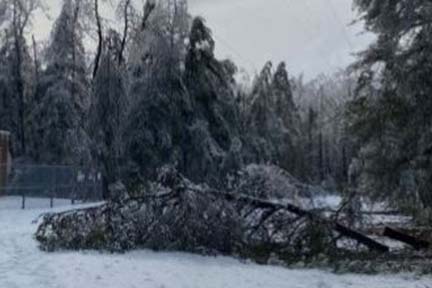
LANSING, Mich. – Today, Governor Gretchen Whitmer announced that President Donald Trump has approved Michigan’s request for a disaster declaration to help communities impacted by the historic ice storm in Northern Michigan earlier this year. The devastating storm knocked out power and communications and left hundreds of miles of roads blocked by fallen trees and debris.
“Yesterday, I spoke to President Trump who confirmed that communities in Northern Michigan impacted by the historic ice storm damage earlier this year will start to receive federal disaster funding,” said Governor Whitmer. “With this initial support, we can help communities recover costs associated with cleanup efforts. I want to thank the president and our congressional delegation for supporting our request, and I look forward to collaborating further on much-needed additional resources. Michiganders across the state stepped up to help our neighbors, and while other parts of our request remain under review, we will continue advocating together to help Northern Michigan recover and rebuild.”
“Many Northern Michigan individuals, families, and small businesses are still recovering from the historic ice storms that hit our state earlier this year,” said Lt. Governor Garlin Gilchrist II. “This federal emergency declaration will help local leaders, communities, and Northern Michigan families get back on their feet and move forward with their lives. While this storm was devastating, Michiganders are strong, and we will Stand Tall together.”
“I’m pleased that funding is coming to Northern Michigan to bolster the ongoing recovery efforts following the ice storm this March,” said U.S. Senator Gary Peters. “The State of Michigan and local emergency managers continue to work hard because this job is not finished, and I’ll keep fighting to help our communities get the resources they need to bounce back stronger.”
“President Trump’s approval of a Major Disaster Declaration for the counties impacted by March’s devastating ice storm is welcome news,” said U.S. Representative Jack Bergman. “I’m grateful to his Administration for working to get this done. This long-awaited decision unlocks critical resources to help our communities recover and rebuild as quickly as possible. It’s been a true team effort – from local agencies to state and federal partners. Northern Michigan is no stranger to tough times – but it’s in moments like these, when our communities rally and move forward together, that the true spirit of Northern Michigan shines brightest.”
“The Michigan State Police has supported response efforts from the moment this storm began, coordinating statewide resources through the State Emergency Operations Center to assist local communities impacted by the storm,” said Col. James F. Grady II, director of the MSP. “This federal declaration is a crucial next step. It allows us to continue supporting our partners through long-term recovery.”
Federal Disaster Declaration
The declaration opens the path to Federal Emergency Management Agency (FEMA) Public Assistance in Alcona, Alpena, Antrim, Charlevoix, Cheboygan, Crawford, Emmet, Kalkaska, Mackinac, Montmorency, Oscoda, Otsego, and Presque Isle Counties and the Little Traverse Bay Bands of Odawa Indians. The administration continues to review the request for Individual Assistance and Public Assistance under Schedule F.
Advocating for Northern Michigan
On May 16, Governor Whitmer submitted a formal request for a major disaster declaration to help Northern Michigan recover and rebuild from the historic ice storms that hit the region hard in late March. The governor also traveled to the White House to meet with President Trump, advocating for federal assistance for Northern Michigan. The governor previously asked for an Emergency Declaration, which would authorize up to $5 million in immediate public assistance to support emergency efforts, including debris management needs.
She will continue working with the administration to pursue further relief from FEMA, and her request for individual assistance (IA) remains under review by the federal administration. IA can include grants for temporary housing and home repairs, low-cost loans to cover uninsured property losses, and other programs to help individuals and business owners recover from the effects of the disaster. She will also seek resources for hazard mitigation measures statewide.
On March 31, Governor Whitmer declared a state of emergency to respond to the storm’s impact. The declaration initially covered 10 counties and was expanded to include 12 counties: Alcona, Alpena, Antrim, Charlevoix, Cheboygan, Crawford, Emmet, Mackinac, Montmorency, Oscoda, Otsego, and Presque Isle counties. Governor Whitmer also deployed the Michigan National Guard to provide more personnel and specialized equipment to help with ice storm recovery efforts in northern Michigan. Lastly, the Governor Whitmer declared an energy emergency in the Upper Peninsula to help expedite delivery of fuel and other critical supplies to impacted areas.
Residents and business owners who sustained losses in the designated areas can begin applying for assistance at www.DisasterAssistance.gov, by calling 800-621-FEMA (3362), or by using the FEMA App. Anyone using a relay service, such as video relay service (VRS), captioned telephone service or others, can give FEMA the number for that service.
On June 11, the U.S. Small Business Administration (SBA) separately granted an administrative disaster declaration for Cheboygan County and the contiguous counties of Charlevoix, Emmet, Mackinac, Montmorency, Otsego, and Presque Isle. SBA established two Disaster Loan Outreach Centers for one-on-one assistance, open now through July 26 at 2:00pm:
- Bodman Building in Cheboygan County
- Little Traverse Township in Emmet County
Loan applications are also available online or by mail. For additional information on low-interest SBA loans or the application process, visit the MySBA Loan Portal or call 1-800-659-2955. The physical loan application deadline is Aug. 8. Small businesses and non-profits have until March 9, 2026, to apply for EIDLs (working capital loans). So far SBA has disbursed $572,322 in loans for this disaster.

by orionontv | Jul 25, 2025 | Transportation
07/25-07/28/25 WEEKEND WORK for MDOT (I, M, US roads)
This weekend construction, in addition to on-going projects other than these locations. Always check Michigan.gov/drive for this info and for ALL projects and follow @MDOT_MetroDet.
Multiple work crews may be involved in these closures. WEATHER AFFECTS ALL WORK AND MAY CAUSE DELAYS OR CANCELLATIONS.
Grand River:
Oakland – EB/WB Grand River CLOSED at Halsted intermittently, Sat 7am-8am, utility work.
I-75:
Wayne – NB/SB I-75, Schaefer to Dearborn St, 3 lanes open, Fri 7AM-1pm, barrier wall.
Wayne – NB/SB I-75 RAMPS CLOSED to SB M-10/Lodge, Fri 9pm-Mon 5am, road repair.
I-94:
Macomb – EB/WB I-94 ramps to 23 Mile, 1 ramp lane open, Fri 9am-Sat 10am, paving.
Macomb – WB I-94 at Henry B Joy Blvd, 1 LANE OPEN, Mon 9AM-12pm, bridge work.
I-696:
Macomb – EB/WB I-696 RAMPS CLOSED to NB Mound, Tues 9am-11am, bridge work.
Oakland – EB I-696, Middlebelt Rd to Inkster, 1 LANE OPEN, Sat 5am-2pm, bridge work.
Oakland – WB I-696, Greenfield Rd to Lahser Rd, 1 LANE OPEN, Sat 7am-2pm, pavement markings.
M-3: (Gratiot)
Macomb – NB/SB M-3 CLOSED at 23 Mile, Sat 9pm-Sun 10am, paving.
Macomb – WB 23 Mile CLOSED I-94 to Gratiot Ave, Fri 9pm-Sat 10am, paving.
M-8: (Davison)
Wayne – EB/WB M-8 RAMPS CLOSED to SB M-10, Sat 12am-10am, road work.
M-10: (Lodge)
Wayne – SB M-10 CLOSED I-75 to Griswold, Fri 9pm-Mon 5am, road work.
Wayne – SB M-10 RAMP CLOSED to Bagley, Fri 9pm-Mon 5am, road repair.
Wayne – NB/SB Trumbull RAMPS CLOSED to SB M-10, Fri 9pm-Mon 5am, road repair.
Wayne – NB M-10 RAMP CLOSED to WB M-8, Sat 12am-9am, road work.
Wayne – SB M-10 RAMP CLOSED to EB M-8, Sat 2am-5am, road work.
M-14:
Wayne – NB/SB Sheldon at M-14, 2 LANES OPEN, Mon 6am-Thu 10pm, bridge work.
M-85: (Fort St)
Wayne – EB/WB M-85 CLOSED Miller Rd to Denmark St, Fri 9AM-Mon 5am, bridge work.

by orionontv | Jul 24, 2025 | Transportation
How safety cameras slow down drivers in school zones
On this week’s Talking Michigan Transportation podcast, Garrett Dawe, engineer of traffic and safety for the Michigan Department of Transportation (MDOT), talks about a pilot project to study the use of safety cameras for automated enforcement in school zones.
 An appropriation in the Fiscal Year 2025 state budget called for MDOT to conduct a pilot project on automated speed enforcement in school zones. Dawe explains that his team has been studying proposals and will make an announcement soon of a vendor to conduct the pilot. An appropriation in the Fiscal Year 2025 state budget called for MDOT to conduct a pilot project on automated speed enforcement in school zones. Dawe explains that his team has been studying proposals and will make an announcement soon of a vendor to conduct the pilot.
According to the Insurance Institute of Highway Safety (IIHS) and the National Conference of State Legislatures (NCSL), at least 12 states (Arkansas, Colorado, Georgia, Illinois, Maryland, Missouri, New York, Rhode Island, Tennessee, Utah, Virginia and Washington) conduct school-zone automated speed enforcement. In Georgia and Rhode Island, school zones are the only locations where automated speed enforcement is allowed in the state.
According to National Highway Traffic Safety Administration (NHTSA) statistics, between 2011 and 2020, 218 school-age children (ages 18 and younger) died in school transportation-related crashes; 44 were occupants of school transportation vehicles, 83 were occupants of other vehicles, 85 were pedestrians, five were bicyclists and one was an “other” nonoccupant. |
|

by orionontv | Jul 24, 2025 | Recreation
|
|
 |
News Release
|
|
July 24, 2025
Contact: Aaron Switzer, 231-383-2565, for hatchery information or Lucas Nathan, 517-599-9323, for invasive species information
The Michigan Department of Natural Resources recently confirmed the presence of invasive red swamp crayfish in an outdoor muskellunge rearing pond at Wolf Lake State Fish Hatchery in Mattawan, Van Buren County, Michigan.
After stocking muskellunge in Thornapple Lake in Barry County and Lake Hudson in Lenawee County, hatchery staff found the carcasses of two unusual crayfish in the collection basket of Wolf Lake Hatchery Pond 20 (where the fish were reared) after the pond was drained. Crayfish traps were quickly deployed in Pond 20 and two adjacent ponds, resulting in the capture of one live, positively identified red swamp crayfish in Pond 20.
 Though native to the southern U.S., red swamp crayfish have been prohibited in Michigan since 2014 and considered invasive in the state because of their ability to aggressively outcompete native crayfish for food and habitat, their high reproductive rate and their destructive burrowing along shorelines that can destabilize banks and infrastructure. Though native to the southern U.S., red swamp crayfish have been prohibited in Michigan since 2014 and considered invasive in the state because of their ability to aggressively outcompete native crayfish for food and habitat, their high reproductive rate and their destructive burrowing along shorelines that can destabilize banks and infrastructure.
Populations of red swamp crayfish were first detected in Michigan in 2017, with simultaneous discoveries in Sunset Lake in Kalamazoo and a drainage pond in Pontiac. To date, isolated infestations have been confirmed in Kalamazoo, Livingston, Macomb, Oakland, Van Buren and Wayne counties. Infestations are believed to result from the release or escape of aquarium pets, live bait or live crayfish brought to Michigan for crawfish boils. |
Potentially affected lakes
Most fish stocked from Michigan’s state hatcheries are raised in tanks within hatchery buildings, inaccessible to outside species. Some fish, like muskellunge and walleye, are moved to outdoor rearing ponds to grow and improve survivability before being released.
The muskie sent to Thornapple Lake and Lake Hudson from Wolf Lake Hatchery in July were 12 to 13 inches in length, and each was individually handled and tagged before release, significantly reducing the likelihood that red swamp crayfish were transferred with them to the receiving waters.
Out of an abundance of caution, the DNR is developing a monitoring plan for both lakes and will alert lake users to report any sightings of the invasive crayfish.
Hatchery operations
The outdoor ponds at Wolf Lake State Fish Hatchery are sourced from well water, along with natural spring water that circulates through the ponds and is then released into a drain that eventually connects to the Paw Paw River.
According to Joe Mickevich, DNR southern area hatcheries manager, such an open system cannot easily prevent undesired species – including crayfish, tadpoles and even some small fish – from finding their way into the ponds, either over land or from bird and waterfowl movement.
When collecting fish from ponds for stocking at Wolf Lake Hatchery, the ponds are drained into the kettle, or collection box. Fish are netted from the collection box and loaded onto stocking units while staff attempt to remove as much bycatch, or undesired species, as possible. When needed, ponds are treated with rotenone, an aquatic pesticide, before the next use.
Response actions
 While the source of the adult red swamp crayfish in Pond 20 is still unknown, Michigan’s Invasive Species Program staff is exploring several possibilities, including a known population 15 miles away, bait or aquarium release into the pond or nearby Wolf Lake, or accidental transport through forage fish used to feed the fish reared in Pond 20 but sourced from other states. While the source of the adult red swamp crayfish in Pond 20 is still unknown, Michigan’s Invasive Species Program staff is exploring several possibilities, including a known population 15 miles away, bait or aquarium release into the pond or nearby Wolf Lake, or accidental transport through forage fish used to feed the fish reared in Pond 20 but sourced from other states.
The DNR and MISP are working together to determine the extent of the infestation and minimize the possibility of spreading the invasive crayfish to new locations. |
- In the last week, 165 traps were set, spanning all 11 earthen bottom ponds at Wolf Lake Hatchery to determine the range of infestation at the site.
- The DNR is exploring the use of environmental DNA, or eDNA, to help determine the potential source, spread and presence of red swamp crayfish in the hatchery and surrounding waters.
- Suppliers and officials from states where minnows were sourced are fully cooperating with Michigan’s efforts to trace shipments and verify quality control measures to prevent contamination.
- Pending the results of trapping and assessment of risk, the DNR plans to explore potential control options at Wolf Lake Hatchery ponds, such as draining and drying ponds over the winter or adding pesticide, which has been used successfully on an experimental basis in some infested ponds in southeast Michigan.
- MISP and DNR staff are working to evaluate additional biosecurity measures, including improved screening of intake and outlet waters, additional screening methods to prevent bycatch from being transported with stocked fish and the use of only clean well water for fish transport.
- Wolf Lake Hatchery’s lined muskellunge ponds will be offline in 2026 for previously planned construction. Young muskie from this year’s harvest will be reared at Thompson State Fish Hatchery in Manistique, Michigan.
Because red swamp crayfish is a prohibited species in Michigan, it is illegal to knowingly possess, introduce, import, sell or offer the species for sale as a live organism, except under certain circumstances.
People can help prevent the spread of invasive species by knowing the laws, never releasing aquarium pets or plants into the wild, using bait only in the waters where it was captured and disposing of unused bait in the trash.
For more information on invasive red swamp crayfish, including identifying characteristics, visit Michigan.gov/Invasives. To report sightings of red swamp crayfish, collect and freeze a sample or take photos, note the location, and email information to Kathleen Quebedeaux, DNR Fisheries Division, QuebedeauxK@Michigan.gov.
Michigan’s Invasive Species Program is cooperatively implemented by the Michigan departments of Agriculture and Rural Development; Environment, Great Lakes, and Energy; and Natural Resources.
Note to editors: Accompanying photos are available below for download. Caption information follows.
- RSC Wolf Lake: The live red swamp crayfish trapped in Pond 20 at Wolf Lake Hatchery. Despite its dark color, the raised red bumps on its claws and hourglass shape on its back help to identify it as an invasive red swamp crayfish.
- RSC Trap: DNR Fisheries Division staff check red swamp crayfish traps at an infested pond in Novi, Michigan.
- Photos of red swamp crayfish management efforts in southeast Michigan can be found on the Michigan DNR Canto site.
|
   |
|

by orionontv | Jul 23, 2025 | Environmental
FOR IMMEDIATE RELEASE
July 23, 2025
Josef Greenberg, EGLE Spokesperson, GreenbergJ@Michigan.gov, 517-897-4965
EGLE Media Office, EGLE-Media-Office@Michigan.gov, 517-284-9278
EGLE awards $4.2 million in brownfield grants that will create 287 new homes in Michigan
The Michigan Department of Environment, Great Lakes, and Energy (EGLE) is awarding a combined $4.2 million in Brownfield Redevelopment Grants to six projects that will create a total of 287 new housing units in Michigan.
“Today we’re transforming more abandoned or underutilized property sites into hundreds of units of quality, affordable homes across Michigan,” said Governor Gretchen Whitmer. “These brownfield grants not only provide more Michiganders with safe places to live, but they also make our communities stronger, better places for small businesses and future investment. Together, we will grow our economy, drive down the cost of housing, and create good-paying construction jobs along the way.”
The new housing redevelopments include:
Auburn Place 454 Auburn Avenue, Pontiac
A $1 million grant will help cover environmental costs for the redevelopment of a vacant and contaminated site into 54 new units of affordable housing. Most apartments in the five-story building will be reserved for households making 30%-60% of the Area Median Income. A few will be set aside for tenants who are currently homeless. The Michigan State Housing Development Authority (MSHDA) and Oakland County Housing Trust Fund are helping fund the $30.3 million project, which is expected to be finished in the summer of 2026.
Read more about the Auburn Place project, or contact EGLE Brownfield Coordinator Michelle Bakun at Bakunm@Michigan.gov or 568-234-3502.
Cadillac Lofts II 223 Mitchell Street, Cadillac
The site of a former dry cleaner is being turned into a four-story mixed-use building with 50 apartments plus commercial space. An $817,925 EGLE grant will pay to haul away contaminated soil and install a vapor mitigation system. MSHDA, the Michigan Economic Development Corporation, and the U.S. Department of Housing and Urban Development are also contributing funding. The $16.7 million redevelopment is the second phase of the Cadillac Lofts project. Phase I, which also used an EGLE grant, was finished in 2024. Phase II is scheduled to be finished in the fall of 2026.
Read more about the Cadillac Lofts II project, or contact EGLE Brownfield Coordinator Aaron Assmann at AssmanA@Michigan.gov or 616-430-5275.
Flats on Bridge 401 South Bridge Street, Elk Rapids
The village of Elk Rapids in Antrim County will be getting 24 new units of workforce housing thanks in part to a $700,000 EGLE grant. The former bulk petroleum site has contaminated soil that will need to be removed. An Affordable Housing Deed Restriction requires apartments to be set aside for households making up to 80% of the Area Median Income. MSHDA awarded the project Low-Income Housing Tax Credits while the village of Elk Rapids approved Payment in Lieu of Taxes to help reduce costs. Construction is expected to be done in the spring of 2027.
Read more about the Flats on Bridge project, or contact EGLE Brownfield Coordinator Julie Lowe at LoweJ2@Michigan.gov or 989-619-0617.
Lofts of Muskegon 122 West Muskegon Avenue, Muskegon
The home of a former gas station, auto shop, rubber company, and dry cleaner is being redeveloped into 46 units of new affordable housing. An $850,000 EGLE grant will be used to dispose of contaminated soil, install a vapor mitigation system and perform other environmental work. The $16 million redevelopment will have units set aside for households making 30%-80% of the Area Median Income. MSHDA Low Income Housing Tax Credits and city of Muskegon Payment in Lieu of Taxes will help reduce costs. Construction is scheduled to be done in the spring of 2026.
Read more about the Lofts of Muskegon project, or contact EGLE Brownfield Coordinator Aaron Assmann at AssmanA@Michigan.gov or 616-430-5275.
Royal Oak Cottages Woodside Road, Glen Lodge Road, Garden Lane, Parkside Street, Westview Avenue, Royal Oak Township
EGLE awarded a $410,000 grant to help with the creation of 24 new affordable single-family homes. They will be priced at 30%-60% of the Area Median Income. The grant will be used to dispose of contaminated soil. The $15.7 million redevelopment is getting financial assistance from Oakland County, Low Income Housing Tax Credits from MSHDA, and Payment in Lieu of Taxes from Royal Oak Township. The homes are expected to be finished in the spring of 2026.
Read more about the Royal Oak Cottages project, or contact EGLE Brownfield Coordinator Abbie Hanson at HansonA2@Michigan.gov or 906-202-1285.
Water Street Lofts 114 First Street, 1201 Washington Avenue, 1210 North Water Street, Bay City
Downtown Bay City will be getting 89 new apartment units at a site that’s currently vacant and contaminated. EGLE Brownfield Site Assessment funds were used to investigate the properties. A $400,000 EGLE grant will pay for management of contaminated soil and groundwater. MSHDA and the Bay City Brownfield Redevelopment Authority are providing financial incentives. The $23.4 million redevelopment will be walking distance from the Saginaw River riverwalk when it’s finished in 2027. Read more about the Water Street Lofts project, or contact EGLE Brownfield Coordinator Heath Bobick at BobickH@Michigan.gov or 517-281-6457.
More than half of EGLE’s annual budget supports local projects, protects public health and the environment, and helps create economic growth and jobs for Michigan workers. Redevelopment increases the value of brownfield sites and other nearby properties. In 2024 EGLE awarded $25.1 million in brownfield incentives to 87 projects around Michigan. |
|